>
Galaxiiformes (Southern smelts) >
Galaxiidae (Galaxiids) > Galaxiinae
Etymology: Galaxiella: Greek, galaxias, ou = a kind of fish, diminutive (Ref. 45335); toourtkoourt: The specific name is derived from the Australian indigenous language groups Tjapwurrung, Korn Kopan noot, and Peekwurrung, meaning 'little fish in freshwater'.
Environment: milieu / climate zone / نطاق العمق / distribution range
البيئة
; المياه العذبة; مياه مخلوطة القاع; pH range: 5.3 - 9.3; غير مهاجرة. Tropical; 5°C - 27°C (Ref. 104902)
Oceania: southeastern mainland Australia from the upper Barwon River system near Barwon Downs, Victoria, west to the Cortina Lakes, near the Coorong, South Australia.
الحجم / وزن / العمر
النضج: Lm ? range ? - ? cm
Max length : 3.4 cm TL ذكر/ مختلط الجنس; (Ref. 104902); 4.2 cm TL (female)
وصف مختصر
مفاتيح التعريف | الوصف الخارجي | قياسات المظهر الخارجي
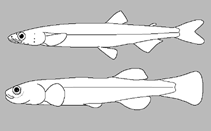
الأشعة الظهرية الناعمة (المجموع) : 5 - 8; أشعه شرجية لينه: 7 - 10; فقرات: 34 - 38. Galaxiella toourtkoourt can be diagnosed from other congeners by following characters: caudal fin rays usually 13 (12-15); anal fin rays usually 8 (7-10); pectoral fin rays usually 12 (8-13); usually 36 (34-38) vertebrae; and 7 laterosensory pores in the preopercular-supramaxillary series. Adults very small (usually 2.06-3.06 cm SL in females; 1.67-2.40 cm SL in males); short caudal peduncle usually 19.6-21.9 % SL (17.2-23.8 % SL in females; 17.9-24.4 % SL in males); origin of dorsal fin more or less in line with anal fin (particularly females) with horizontal distance between dorsal fin and anal fin origins usually 0.0-2.7 % SL (2.5-2.8 in females; 2.6-3.9 in males). Adults possess three longitudinal black stripes (easier to discern in adult males) and reduced markings on ventral surface (typically two to three black blotches at isthmus) (Ref. 104902).
Body shape (shape guide): elongated.
Facultative air-breathing in the genus (Ref. 126274); Occurs in swamps, wetlands, shallow lakes, billabongs, small creeks and artificial earthen
drains at low elevation (mean 100 m above sea level, typically 22-176 m above sea level). Inhabits mostly shallow areas (mean maximum depth 1.1 m, typically 0.5-2.0 m), with still to low water velocities (or often backwaters in faster flowing conditions) and partial shading (mean 27 %, typically 5-50 % surface cover). Occasionally found in inland with slightly saline waters. Water quality measurements at the time of collection indicate this species can thrive in a broad range of conditions: water temperatures 5.2-26.9 °C; dissolved oxygen levels of 20-263 % saturation; pH of 5.3-9.3; water electrical conductivity of 94-13,620 μS/cm and turbidity of 1-96 NTU . Usually collected together with other native fish species, particularly Nannoperca australis (65 % frequency), Galaxias maculatus (12 % frequency), and burrowing crayfish (e.g. Engaeus spp., Geocharax spp.) (18 % frequency). Often found with introduced fish species Gambusia holbrooki (Ref. 104902).
Life cycle and mating behavior
النضج | التكاثر | وضع البيض | بيض | الخصوبة | Larvae
Coleman, R.A., A.A. Hoffmann and T.A. Raadik, 2015. A review of Galaxiella pusilla (Mack) (Teleostei: Galaxiidae) in south-eastern Australia with a description of a new species. Zootaxa 4021(2):243-281. (Ref. 104902)
IUCN Red List Status (Ref. 130435: Version 2025-1)
استخدامات بشرية
أدوات
تقارير خاصة
Download XML
مصادر علي الأنترنت
Estimates based on models
Phylogenetic diversity index (مرجع
82804): PD
50 = 0.5625 [Uniqueness, from 0.5 = low to 2.0 = high].
Bayesian length-weight: a=0.00490 (0.00206 - 0.01165), b=3.12 (2.91 - 3.33), in cm total length, based on LWR estimates for this (Sub)family-body shape (Ref.
93245).
مستوى غذائي (مرجع
69278): 3.1 ±0.3 se; based on size and trophs of closest relatives
المرونه (مرجع
120179): عالي, الحد الزمني الأدني لتضاعف عدد أفراد المجتمع أقل من 15 شهر (Preliminary K or Fecundity.).
Fishing Vulnerability (Ref.
59153): Low vulnerability (10 of 100).
🛈