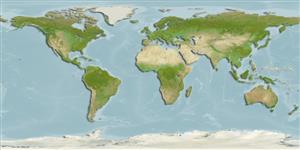
>
Gobiiformes (Gobies) >
Gobiidae (Gobies) > Gobiinae
Etymology: Trimma: Greek, trimma, -atos = something crushed (Ref. 45335); burridgeae: Named for Mary Elizabeth Burridge (for her extensive work in the revisions of Priolepis, her ongoing work on barcoding Trimmaspp., her field collection in the Philippines and Vietnam, and her extensive contributions to the maintenance of the fish and frozen tissue collections at the Royal Ontario Museum).
Eponymy: Dr Mary Elizabeth Burridge is an ichthyologist who is an Assistant Curator at the Department of Natural History, Royal Ontario Museum, Toronto, Canada. [...] (Ref. 128868), visit book page.
Environment: milieu / climate zone / rango de profundidad / distribution range
Ecología
marino pelagic-neritic; rango de profundidad 4 - 50 m (Ref. 109919), usually 20 - 30 m (Ref. 109919). Tropical
Distribución
Países | Áreas FAO | Ecosistemas | Ocurrencias, apariciones | Mapa de puntos | Introducciones | Faunafri
Western Pacific: Palau.
Tamaño / Peso / Age
Madurez: Lm ? range ? - ? cm
Max length : 2.9 cm SL macho / no sexado; (Ref. 109919)
Short description
Claves de identificación | Morfología | Morfometría
Espinas dorsales (total) : 7; Radios blandos dorsales (total) : 8 - 9. This species is distinguished by the following characters: bony interorbital 80-100% pupil diameter; 11 scales in predorsal midline with the anterior few rows often cycloid in adults; the second dorsal spine reaches to between the middle and the end of the second dorsal fin or just beyond this point; usually four free neuromasts (sensory papillae) in row f on the chin and in row r on the top of the snout; usually 14 unbranched pectoral-fin rays; an unbranched fifth pelvic-fin ray that is 47-63% the length of the fourth ray; colour of freshly collected specimens red to yellow background colour with a light stripe along the mid-lateral body that continues forward over the top of the pupil, with a light stripe below the eye bordered dorsally by a narrow red stripe (both light stripes apparently blue in life), a broad diffuse internal dark stripe over the abdominal cavity which narrows and continues posteriorly on and just below the vertebral column, ending at the pale bar in front of the dark caudal blotch (Ref. 109919).
Body shape (shape guide): elongated; Cross section: oval.
This species is apparently confined to outer reefs with vertical walls throughout the Palauan islands and is most abundant in caves and under overhangs between 20-30 m. It was collected from a huge cave (ca. 15 m wide, 4 m high) and surrounding area with sand/silt floor at 27 m, hydroids, some hard coral, sea fans, sponges and ascidians (Ref. 109919).
Life cycle and mating behavior
Madurez | Reproducción | Puesta | Huevos | Fecundidad | Larva
Winterbottom, R., 2016. Trimma tevegae and T. caudomaculatum revisited and redescribed (Acanthopterygii, Gobiidae), with descriptions of three new similar species from the western Pacific. Zootaxa 4144(1):001-053. (Ref. 109919)
IUCN Red List Status (Ref. 130435: Version 2025-1)
Threat to humans
Harmless
Human uses
Pesquerías: sin interés
Herramientas
Special reports
Download XML
Fuentes de Internet
Estimates based on models
Phylogenetic diversity index (Referencia
82804): PD
50 = 0.5000 [Uniqueness, from 0.5 = low to 2.0 = high].
Bayesian length-weight: a=0.00724 (0.00339 - 0.01546), b=3.10 (2.92 - 3.28), in cm total length, based on LWR estimates for this (Sub)family-body shape (Ref.
93245).
Resiliencia (Referencia
120179): Alto, población duplicada en un tiempo mínimo inferior a 15 meses (Preliminary K or Fecundity.).
Fishing Vulnerability (Ref.
59153): Low vulnerability (10 of 100).
🛈