



Rhynchobatus immaculatus Last, ho & Chen, 2013
Taiwanese Wedgefish
Carica il tuo foto e Video
Google image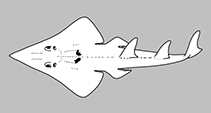 No image available for this species;
drawing shows typical species in Rhinidae.
Google image
drawing shows typical species in Rhinidae.
Classificazione / Nomi Nomi Comuni | Sinonimi | Catalog of Fishes(Genere, Specie) | ITIS | CoL | WoRMS | Cloffa
Elasmobranchi (squali e razze) (sharks and rays) > Rhinopristiformes (Shovelnose rays) > Rhinidae (Wedgefishes)
Etymology: Rhynchobatus: Greek, rhingchos = snout + Greek, batis, -idos = a sting ray (Raja sp.) (Ref. 45335); immaculatus: Name from Latin 'im' meaning not and 'macula' for spot, mark; based on the lack of a dark pectoral marking (rather than any white spots) which is otherwise present in small individuals of other nominal species of Rhynchobatus.
Etymology: Rhynchobatus: Greek, rhingchos = snout + Greek, batis, -idos = a sting ray (Raja sp.) (Ref. 45335); immaculatus: Name from Latin 'im' meaning not and 'macula' for spot, mark; based on the lack of a dark pectoral marking (rather than any white spots) which is otherwise present in small individuals of other nominal species of Rhynchobatus.
Ambiente: milieu / zona climatica / distribuzione batimetrica / gamma di distribuzione Ecologia
marino pelagic-neritic. Subtropical; 23°N - 25°N, 120°E - 122°E (Ref. 114953)
Distribuzione Territories | Aree FAO | Ecosistemi | Presenze | Mappa dei ritrovamenti | Introduzioni | Faunafri
Northwest Pacific: confirmed from Taiwan; probably more widespread.
Dimensione / Peso / Età
Breve descrizione Chiavi di identificazione | Morfologia | Morfometria
This medium-sized species is distinguished by the following set of characters: snout is broad, and wedge-shaped; preoral snout 19-21% TL; small eye, its length 4.1-4.5 in preorbital snout; interorbital space 2.6-2.9 in preorbital snout; about 48 tooth rows; no spines from snout; supraorbital spines are small, well differentiated, and extending from preorbit to beyond end of spiracle; predorsal spines are relatively well developed; 2 disjunct rows of 6-9 small scapular spines on each side of the disc; predorsal space 48-49% of total length; origin of the first dorsal fin is well behind origin of pelvic-fin bases; total pectoral-fin radials 65-68; vertebrae with 28-30 monospondylous precaudal centra, 124-131 precaudal free centra, 38-42 diplospondylous caudal (free) centra, 165-170 total free centra, 179-184 total centra (including synarcual centra). Colouration: dark greenish brown dorsally with a few white spots scattered on pectoral disc; no black pectoral marking; prominent row of white spots start just forward of a single white spot (above pelvic-fin origin) and coalescing posteriorly to form a white mid-lateral line on tail; orbital membrane is white with dark bar over eye; no alternating light and dark markings on the interorbital space (Ref. 94805).
Body shape (shape guide): other (see remarks); Cross section: flattened.
Body shape (shape guide): other (see remarks); Cross section: flattened.
A benthic species that was recently discovered and not well known, but apparently lives in shallow water on the continental shelf. Probably feeds on bottom-dwelling crustaceans and fishes (Ref. 114953). Specimens caught are all immature that most probably the maximum length of this medium-size wedgefish could be less than 150 cm TL (Ref. 94805).
Ciclo vitale e comportamento di accoppiamento Maturità | Riproduzione | Deposizione | Uova | Fecondità | Larve
Riferimento principale
Caricare le referenze | Bibliografia | Coordinatore | Collaboratori
Last, P.R., H.-H. Ho and R.-R. Chen, 2013. A new species of wedgefish, Rhynchobatus immaculatus (Chondrichthyes: Rhynchobatidae), from Taiwan. Zootaxa 3752(1):185-198. (Ref. 94805)
Stato della Lista Rossa IUCN (Ref. 130435: Version 2025-2 (Global))
Critically Endangered (CR) (A2bd); Date assessed: 03 December 2018
Minaccia per l'uomo
Harmless
Usi umani
FAO - Publication: search | FishSource |
Informazioni ulteriori
Ecologia trofica
Articoli alimentari (prede)
Alimentazione
Consumo di cibo
Razioni alimentari
Predatori
Articoli alimentari (prede)
Alimentazione
Consumo di cibo
Razioni alimentari
Predatori
Ecologia
Ecologia
Ecologia
Dinamica della popolazione
Parametri di crescita
Età massima / dimensioni massime
Rapporto lunghezza-peso.
Lunghezza-lunghezza rel.
Lunghezza-frequenze
Conversione di massa
Reclutamento
Abbondanza
Parametri di crescita
Età massima / dimensioni massime
Rapporto lunghezza-peso.
Lunghezza-lunghezza rel.
Lunghezza-frequenze
Conversione di massa
Reclutamento
Abbondanza
Ciclo di vita
Riproduzione
Maturità
Maturità/Gli occhielli sono relativi.
Fecondità
Deposizione
Aggregazioni riproduttive
Uova
Sviluppo delle uova
Larve
Dinamica popolazioni larvali
Riproduzione
Maturità
Maturità/Gli occhielli sono relativi.
Fecondità
Deposizione
Aggregazioni riproduttive
Uova
Sviluppo delle uova
Larve
Dinamica popolazioni larvali
Anatomia
Area branchiale
Cervello
Otolite
Area branchiale
Cervello
Otolite
Fisiologia
Composizione corporea
Nutrienti
Consumo di ossigeno
Tipo di nuoto
Velocità di nuoto
Pigmenti visivi
Suono del pesce
Malattie e parassiti
Tossicità (LC50)
Composizione corporea
Nutrienti
Consumo di ossigeno
Tipo di nuoto
Velocità di nuoto
Pigmenti visivi
Suono del pesce
Malattie e parassiti
Tossicità (LC50)
Genetica
Genome
Genetica
Eterozigosi
Ereditarietà
Diversità genetica
Genome
Genetica
Eterozigosi
Ereditarietà
Diversità genetica
Legato all'uomo
Sistemi di acquacoltura
Profili di acquacoltura
Varietà
Casi di Ciguatera
Francobolli, monete, materiale vario.
Sistemi di acquacoltura
Profili di acquacoltura
Varietà
Casi di Ciguatera
Francobolli, monete, materiale vario.
Strumenti
Libro elettronico | Giuda pratica | Generatore frequenze di lunghezza | Strumento Parametri Biologici | Mappa dei ritrovamenti |
Cattura-MSY |
Rapporti speciali
Controllo della manutenzione dell'acquario | Verificare la presenza di schede informative sulle specie | Verifica delle schede informative sull'acquacoltura
Scarica XML
Fonti Internet
AFORO (otoliths) | Aquatic Commons | BHL | Cloffa | Websites from users | Check FishWatcher | CISTI | Catalog of Fishes: Genere, Specie | DiscoverLife | ECOTOX | FAO - Publication: search | Faunafri | Fishipedia | Fishtrace | GloBI | Google Books | Google Scholar | Google | IGFA World Record | Database Nazionali | OneZoom | Open Tree of Life | Otolith Atlas of Taiwan Fishes | PubMed | Reef Life Survey | Socotra Atlas | TreeBase | Tree of Life | Wikipedia: Go, ricerca | World Records Freshwater Fishing | Zoobank | Record zoologico
Stime basate su modelli
Indice di diversità filogenetica (Fonte Biblio. 82804): PD50 = 0.5024 [Uniqueness, from 0.5 = low to 2.0 = high].
Bayesian length-weight: a=0.01000 (0.00244 - 0.04107), b=3.04 (2.81 - 3.27), in cm total length, based on all LWR estimates for this body shape (Ref. 93245).
Livello trofico (Fonte Biblio. 69278): 3.5 ±0.6 se; based on size and trophs of closest relatives