



Hypselobarbus pseudomussullah Arunachalam, Chinnaraja & Mayden, 2016
Carica il tuo foto e Video
Google image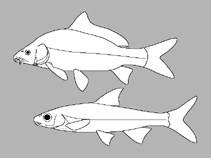 No image available for this species;
drawing shows typical species in Cyprinidae.
Google image
drawing shows typical species in Cyprinidae.
Classificazione / Nomi Nomi Comuni | Sinonimi | Catalog of Fishes(Genere, Specie) | ITIS | CoL | WoRMS | Cloffa
> Cypriniformes (Carps) > Cyprinidae (Minnows or carps) > Torinae
Etymology: Hypselobarbus: Greek, hypselos = high + Latin, barbus =barbel (Ref. 45335); pseudomussullah: The specific name pseudomussullah is a noun in apposition referring to the false or pseudo- similarity to the species that it most resembles Hypselobarbus mussullah.
Etymology: Hypselobarbus: Greek, hypselos = high + Latin, barbus =barbel (Ref. 45335); pseudomussullah: The specific name pseudomussullah is a noun in apposition referring to the false or pseudo- similarity to the species that it most resembles Hypselobarbus mussullah.
Ambiente: milieu / zona climatica / distribuzione batimetrica / gamma di distribuzione Ecologia
; acqua dolce benthopelagico. Tropical
Distribuzione Territories | Aree FAO | Ecosistemi | Presenze | Mappa dei ritrovamenti | Introduzioni | Faunafri
Asia: Nethravathi and Thunga rivers, Karnataka; Krishna River, Maharashtra in India.
Dimensione / Peso / Età
Breve descrizione Chiavi di identificazione | Morfologia | Morfometria
Spine dorsali (totale) : 4; Spine anali: 3. Hypselobarbus pseudomussullah differs from H. mussullah in having 41-42 lateral-line scale rows (vs. 44), 12-13 pre-dorsal scale rows (vs. 14), 5.5-6 transverse scale rows (vs. 7.5), 30-31circumferential scale rows (vs. 36), 11-12 transverse breast scale rows (vs. 14), and pre-pelvic fin length 51.16-53.56 %SL (vs. 47.37 %SL) and rostral barbel length 6.54-10.93 %HL (vs. 18.19 %HL). It can be distinguished from H. dubius in having weaker dorsal spine (vs. strong), 12-13 pre-dorsal scale rows (vs. 14), and 39-44 pre-anal scale rows (vs. 34-38). It is distinguished from H. micropogon in having a weaker dorsal spine (vs. strong), 39-44 pre-anal scale rows (vs. 31-34) and 30-31 circumferential scale rows (vs. 26-29). It differs from H. periyarensis in having 12-13 pre-dorsal scale rows (vs. 17-18), 30-31 circumferential scale rows (vs. 32-34), and distance between occiput to dorsal-fin origin 22.93-27.05 %SL (vs. 30.12-34.75 %SL), distance between pectoral-fin insertion to anal-fin origin 43.48-49.24 %SL (vs. 53.12-57.68 %SL), post-dorsal length 47.91-58.42 %SL (vs. 31.88-39.66 %SL) and length of maxillary barbels 12.95-23.91 % HL (vs. 26.50-29.68 %HL). It can be separated from H. kurali in having 30-31 circumferential scale rows (vs. 32-33), and 11-12 transverse breast scales (vs. 21-23). It differs from H. curmuca in having two pairs of barbels (vs. single pair), 8-8.5 upper transverse scale rows (vs. 9.5-10), 30-31 circumferential scale rows (vs. 39-40), 18 circumpeduncular scale rows ( vs. 20-21), 12-13 pre-dorsal scale rows (vs.14), and 5.5-6 lower transverse scale rows (vs. 7.5-8). It is distinguished from H. kolus in having two pairs of barbels (vs. single pair), 8-8.5 upper transverse scale rows (vs. 9.5-10), 18 circumpeduncular scale rows (vs. 20-21), 39-44 pre-anal scale rows (vs. 34-37), and 30-31 circumferential scale rows (vs. 35-37) (Ref.112605).
Body shape (shape guide): fusiform / normal.
Body shape (shape guide): fusiform / normal.
Ciclo vitale e comportamento di accoppiamento Maturità | Riproduzione | Deposizione | Uova | Fecondità | Larve
Riferimento principale
Caricare le referenze | Bibliografia | Coordinatore | Collaboratori
Arunachalam, M., S. Chinnaraja and R.L. Mayden, 2016. Remarkable rediscovery of Barbus (=Hypselobarbus) mussullah (Sykes) after 175 years of hiatus and description of a new species of Hypselobarbus Bleeker from peninsular India (Cyprinidae: Cypriniformes). FishTaxa 1(1):1-13. (Ref. 112605)
CITES
Not Evaluated
Minaccia per l'uomo
Harmless
Usi umani
FAO - Publication: search | FishSource |
Informazioni ulteriori
Ecologia trofica
Articoli alimentari (prede)
Alimentazione
Consumo di cibo
Razioni alimentari
Predatori
Articoli alimentari (prede)
Alimentazione
Consumo di cibo
Razioni alimentari
Predatori
Dinamica della popolazione
Parametri di crescita
Età massima / dimensioni massime
Rapporto lunghezza-peso.
Lunghezza-lunghezza rel.
Lunghezza-frequenze
Conversione di massa
Reclutamento
Abbondanza
Parametri di crescita
Età massima / dimensioni massime
Rapporto lunghezza-peso.
Lunghezza-lunghezza rel.
Lunghezza-frequenze
Conversione di massa
Reclutamento
Abbondanza
Ciclo di vita
Riproduzione
Maturità
Maturità/Gli occhielli sono relativi.
Fecondità
Deposizione
Aggregazioni riproduttive
Uova
Sviluppo delle uova
Larve
Dinamica popolazioni larvali
Riproduzione
Maturità
Maturità/Gli occhielli sono relativi.
Fecondità
Deposizione
Aggregazioni riproduttive
Uova
Sviluppo delle uova
Larve
Dinamica popolazioni larvali
Anatomia
Area branchiale
Cervello
Otolite
Area branchiale
Cervello
Otolite
Fisiologia
Composizione corporea
Nutrienti
Consumo di ossigeno
Tipo di nuoto
Velocità di nuoto
Pigmenti visivi
Suono del pesce
Malattie e parassiti
Tossicità (LC50)
Composizione corporea
Nutrienti
Consumo di ossigeno
Tipo di nuoto
Velocità di nuoto
Pigmenti visivi
Suono del pesce
Malattie e parassiti
Tossicità (LC50)
Genetica
Genome
Genetica
Eterozigosi
Ereditarietà
Diversità genetica
Genome
Genetica
Eterozigosi
Ereditarietà
Diversità genetica
Legato all'uomo
Sistemi di acquacoltura
Profili di acquacoltura
Varietà
Casi di Ciguatera
Francobolli, monete, materiale vario.
Sistemi di acquacoltura
Profili di acquacoltura
Varietà
Casi di Ciguatera
Francobolli, monete, materiale vario.
Strumenti
Libro elettronico | Giuda pratica | Generatore frequenze di lunghezza | Strumento Parametri Biologici | Mappa dei ritrovamenti |
Cattura-MSY |
Rapporti speciali
Controllo della manutenzione dell'acquario | Verificare la presenza di schede informative sulle specie | Verifica delle schede informative sull'acquacoltura
Scarica XML
Fonti Internet
AFORO (otoliths) | Aquatic Commons | BHL | Cloffa | Websites from users | Check FishWatcher | CISTI | Catalog of Fishes: Genere, Specie | DiscoverLife | ECOTOX | FAO - Publication: search | Faunafri | Fishipedia | Fishtrace | GloBI | Google Books | Google Scholar | Google | IGFA World Record | OneZoom | Open Tree of Life | Otolith Atlas of Taiwan Fishes | PubMed | Reef Life Survey | Socotra Atlas | TreeBase | Tree of Life | Wikipedia: Go, ricerca | World Records Freshwater Fishing | Zoobank | Record zoologico
Stime basate su modelli
Indice di diversità filogenetica (Fonte Biblio. 82804): PD50 = 0.5000 [Uniqueness, from 0.5 = low to 2.0 = high].
Bayesian length-weight: a=0.00955 (0.00430 - 0.02123), b=3.02 (2.83 - 3.21), in cm total length, based on LWR estimates for this (Sub)family-body shape (Ref. 93245).
Resilienza (Fonte Biblio. 120179): Medio, tempo minimo di raddoppiamento della popolazione 1.4 - 4.4 anni (Preliminary K or Fecundity.).