



Tanakia latimarginata Kim, Jeon & Suk, 2014
アップロード 写真 そして ビデオ
画像 | グーグルの画像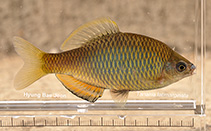 Tanakia latimarginata
画像によって Hyung-Bae Jeon
画像 | グーグルの画像
画像によって Hyung-Bae Jeon
分類 / 名前 共通名の | 類義語 | Catalog of Fishes(部類, 種) | ITIS | CoL | WoRMS | Cloffa
> Cypriniformes (Carps) > Acheilognathidae (Bitterlings)
Etymology: Tanakia: Perhaps from a Swahili word, tanaki = reservoir; due to its habitat?; latimarginata: Derived from the Latin latus (broad), and marginatus (margined), in allusion to the broad black margin of the anal-fin of mature males. An adjective.
Eponymy: Dr Shigeho Tanaka (1878–1974) was a Japanese ichthyologist who was Professor of Zoology at the Imperial University, Tokyo. [...] (Ref. 128868), visit book page.
Etymology: Tanakia: Perhaps from a Swahili word, tanaki = reservoir; due to its habitat?; latimarginata: Derived from the Latin latus (broad), and marginatus (margined), in allusion to the broad black margin of the anal-fin of mature males. An adjective.
Eponymy: Dr Shigeho Tanaka (1878–1974) was a Japanese ichthyologist who was Professor of Zoology at the Imperial University, Tokyo. [...] (Ref. 128868), visit book page.
環境:環境 / 気候帯 / 深さの範囲 / 分布範囲 生態学
; 新鮮な水 底生の漂泳性. Subtropical
分布 領土 | 国連食糧農業機関の区域 | エコシステム | 事件 | 目的のマップ | 導入 | Faunafri
Asia: Nakdong River drainage in South Korea.
サイズ / 重さ / 年齢
簡単な記述 検索表 | 形態学 | 形態計測学
背鰭 (合計) : 11; 臀鰭: 12 - 13. Tanakia latimarginata can be readily diagnosed from its phylogenetically closest congener T. lanceolata by the following characters: body generally brownish laterally in life (vs. generally silvery laterally); dorsal fin of mature males in life with an ivory to reddish-orange band distally (vs. a pale pink to pinky red band distally); and anal-fin of mature males with distal margin black, two ivory to orange bands separated by an indistinct dark band of similar width (vs. distal margin red to pink, an indistinct black band proximally). It differs from T. koreensis by the width of the black distal margin of the anal-fin of mature males (greater than the pupil diameter posteriorly to the mid-point of the fin vs. greater than or as wide as the pupil diameter posteriorly only to the second or third branched soft fin-ray), by having a light colored ovipositor in mature females (light grey to yellowish-grey vs. brownish-grey to black) and by the shape of the fifth infraorbital bone (irregularly shaped, widest dorsally vs. rectangular with uniform width along entire length or triangular, widest ventrally). It can be further distinguished from T. lanceolata and T. koreensis by having a parietal branch of the supraorbital sensory canal reaching to or extending past of the border between the frontal and parietal (vs. parietal branch of supraorbital sensory canal reaching to or extending past the border between the frontal and pterotic, without contact to the parietal) (Ref. 97360).
Body shape (shape guide): fusiform / normal.
Body shape (shape guide): fusiform / normal.
Occurs mostly in clear and shallow (40-120 cm deep) low to medium-gradient large creeks to medium rivers, over coarse sand to pebble substrates. Inhabits backwaters or shallow pools near vegetation from autumn to spring. Large individual are usually collected in rock- and gravel-bottomed riffles during summer. The type series was collected together with the congener T. lanceolata, along with the following species in the subfamily Acheilognathinae: Acheilognathus macropterus, A. majusculus, A. rhombeus, A. yamatsutae, Rhodeus ocellatus, R. notatus and R. sinensis. Spawns from April to August. Spawning males aggresively defend a territory around a mussel-spawning site. Also collected together with unionid mussels (Unio douglasiae, Anodonta woodiana, Lanceolaria grayana and Solenaia triangularis, though the major host mussels are still not known (Ref. 97360).
ライフサイクルと交尾行動 成熟 | 繁殖 | 放精 | 卵 | 生産力 | 幼生
主な参考文献
参考文献のアップロード | 参考文献 | コーディネーター | 協力者
Kim, D., H.-B. Jeon and H.Y. Suk, 2014. Tanakia latimarginata, a new species of bitterling from the Nakdong River, South Korea (Teleostei: Cyprinidae). Ichthyol. Explor. Freshwat. 25(1):59-68. (Ref. 97360)
CITES
Not Evaluated
人間に対する脅威
Harmless
人間の用途
FAO - Publication: search | FishSource |
より多くの情報
ライフサイクル
繁殖
成熟
成熟度/エラ
生産力
放精
産卵群
卵
卵の開発
幼生
幼生の動力
繁殖
成熟
成熟度/エラ
生産力
放精
産卵群
卵
卵の開発
幼生
幼生の動力
解剖学
カマ
脳
オトリス
カマ
脳
オトリス
生理学
体組成
栄養素
酸素消費
水泳タイプ
泳ぐ速さ
視覚色素
フィッシュ・サウンド
病気と寄生虫
毒性(LC50)
体組成
栄養素
酸素消費
水泳タイプ
泳ぐ速さ
視覚色素
フィッシュ・サウンド
病気と寄生虫
毒性(LC50)
遺伝子の
ゲノム
遺伝子の
ヘテロ接合性
遺伝
遺伝的多様性
ゲノム
遺伝子の
ヘテロ接合性
遺伝
遺伝的多様性
用具
特記事項
XMLをダウンロードして下さい
インターネットの情報源
AFORO (otoliths) | Aquatic Commons | BHL | Cloffa | Websites from users | Check FishWatcher | CISTI | Catalog of Fishes: 部類, 種 | DiscoverLife | ECOTOX | FAO - Publication: search | Faunafri | Fishipedia | Fishtrace | GloBI | Google Books | Google Scholar | Google | IGFA World Record | OneZoom | Open Tree of Life | Otolith Atlas of Taiwan Fishes | PubMed | Reef Life Survey | Socotra Atlas | TreeBase | 生命の木 | Wikipedia: 行く, 検索する | World Records Freshwater Fishing | Zoobank | 動物に関する記録
モデルに基づく推定値
系統多様性指数 (参照 82804): PD50 = 0.5078 [Uniqueness, from 0.5 = low to 2.0 = high].
Bayesian length-weight: a=0.01047 (0.00482 - 0.02276), b=3.10 (2.92 - 3.28), in cm total length, based on LWR estimates for this (Sub)family-body shape (Ref. 93245).
栄養段階 (参照 69278): 2.2 ±0.1 se; based on size and trophs of closest relatives
回復力 (参照 120179): 高い, 15か月以下の倍増期間の最小個体群 (Preliminary K or Fecundity.).