



Cynopoecilus notabilis Ferrer, Wingert & Malabarba, 2014
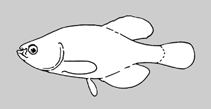
分類 / 名前 共通名の | 類義語 | Catalog of Fishes(部類, 種) | ITIS | CoL | WoRMS | Cloffa
> Cyprinodontiformes (Rivulines, killifishes and live bearers) > Rivulidae (Rivulines) > Cynolebiinae
Etymology: Cynopoecilus: Greek, kyon = dog + Greek, odous = teeth + Greek, poikilos = with a lot of colours (Ref. 45335); notabilis: From Latin adjective notabilis, meaning notable or remarkable, in reference to the morphology of the fins and coloration in males; a unique pattern among the species of Cynopoecilus.
Etymology: Cynopoecilus: Greek, kyon = dog + Greek, odous = teeth + Greek, poikilos = with a lot of colours (Ref. 45335); notabilis: From Latin adjective notabilis, meaning notable or remarkable, in reference to the morphology of the fins and coloration in males; a unique pattern among the species of Cynopoecilus.
環境:環境 / 気候帯 / 深さの範囲 / 分布範囲 生態学
; 新鮮な水 底生の漂泳性. Subtropical
分布 領土 | 国連食糧農業機関の区域 | エコシステム | 事件 | 目的のマップ | 導入 | Faunafri
South America: Rio Gravataí basin, laguna dos Patos system in Brazil.
サイズ / 重さ / 年齢
簡単な記述 検索表 | 形態学 | 形態計測学
背鰭 (合計) : 20 - 23; 臀鰭: 24 - 29. Cynopoecilus notabilis can be readily differentiated from all members of the Cynopoecilina by the following characters: 20-23 dorsal-fin rays; 29-31 scales in a longitudinal series; 10-11 transverse series of scales between the dorsal and pelvic-fin origins; and the broad and approximately straight proximal portion of the epural and parhypural. It differs from other members
of the Cynopoecilina, except for the species of Leptolebias, by having an elliptical to lanceolate caudal fin, much longer than deep. It is distinguished from all congeners by the position of the second proximal radial of the dorsal fin between the 8th and 9th vertebrae. Additional characters useful for the identification of C. notabilis from congeners include: dorsal-fin origin at the vertical through the pelvic-fin origin in males (vs. dorsal fin origin at the vertical through the genital bulb); dorsal-fin origin at the vertical through the midlength of the pelvic fin in females (vs. the dorsal-fin origin at the vertical through the anus); anal-fin origin at the vertical between the bases of the 7th and 8th dorsal-fin rays in males (vs. the anal-fin origin at the vertical between the bases of the 2nd and 3rd dorsal-fin rays); presence of a mid-lateral longitudinal black stripe on the head in males, with stripe passing close to the ventral border of eye and united to the lower black lateral body stripe at the pectoral-fin base and continuing anteriorly in a straight line reaching the articulation of the lower jaw (vs. absence of such stripe); ‘V’-shaped mark ventrally on the head, along the ventral margins of dentary in both sexes) (vs. absence of this mark); red brown stripe covering the base of all dorsal-fin rays and limited dorsally by a light yellow line in males (vs. the dorsal fins spotted at its base); nine or ten vertical bars from the region immediately posterior to the opercle to the caudal peduncle in females (vs. the lateral surface of the body with a broad black stripe or black marks); and black distal portion of the pelvic fin in males (vs. pelvic fin brownish grey or dark grey) (Ref. 98301).
Body shape (shape guide): fusiform / normal.
Body shape (shape guide): fusiform / normal.
Found only in a temporary pool characterized by clear water over a muddy bottom covered by large amount of litter within a dense fragment of wetland forest connected and adjacent to a swamp where the only known two specimens of Listrura depinnai were collected (Ref. 98301).
ライフサイクルと交尾行動 成熟 | 繁殖 | 放精 | 卵 | 生産力 | 幼生
主な参考文献
参考文献のアップロード | 参考文献 | コーディネーター : Costa, Wilson J.E.M. | 協力者
Ferrer, J., J.M. Wingert and L.R. Malabarba, 2014. Description of a new species and phylogenetic analysis of the subtribe Cynopoecilina, including continous characters without discretization (Cyprinodontiformes: Rivulidae). Zool. J. Linn. Soc. 172(4):846-866. (Ref. 98301)
IUCNのレッドリストの状況は (Ref. 130435: Version 2025-2 (Global))
脆弱 (VU) (D2); Date assessed: 30 December 2020
CITES
Not Evaluated
人間に対する脅威
Harmless
人間の用途
FAO - Publication: search | FishSource |
より多くの情報
ライフサイクル
繁殖
成熟
成熟度/エラ
生産力
放精
産卵群
卵
卵の開発
幼生
幼生の動力
繁殖
成熟
成熟度/エラ
生産力
放精
産卵群
卵
卵の開発
幼生
幼生の動力
解剖学
カマ
脳
オトリス
カマ
脳
オトリス
生理学
体組成
栄養素
酸素消費
水泳タイプ
泳ぐ速さ
視覚色素
フィッシュ・サウンド
病気と寄生虫
毒性(LC50)
体組成
栄養素
酸素消費
水泳タイプ
泳ぐ速さ
視覚色素
フィッシュ・サウンド
病気と寄生虫
毒性(LC50)
遺伝子の
ゲノム
遺伝子の
ヘテロ接合性
遺伝
遺伝的多様性
ゲノム
遺伝子の
ヘテロ接合性
遺伝
遺伝的多様性
用具
特記事項
XMLをダウンロードして下さい
インターネットの情報源
AFORO (otoliths) | Aquatic Commons | BHL | Cloffa | Websites from users | Check FishWatcher | CISTI | Catalog of Fishes: 部類, 種 | DiscoverLife | ECOTOX | FAO - Publication: search | Faunafri | Fishipedia | Fishtrace | GloBI | Google Books | Google Scholar | Google | IGFA World Record | OneZoom | Open Tree of Life | Otolith Atlas of Taiwan Fishes | PubMed | Reef Life Survey | Socotra Atlas | TreeBase | 生命の木 | Wikipedia: 行く, 検索する | World Records Freshwater Fishing | Zoobank | 動物に関する記録
モデルに基づく推定値
系統多様性指数 (参照 82804): PD50 = 0.5156 [Uniqueness, from 0.5 = low to 2.0 = high].
Bayesian length-weight: a=0.01122 (0.00514 - 0.02450), b=3.04 (2.87 - 3.21), in cm total length, based on all LWR estimates for this body shape (Ref. 93245).
栄養段階 (参照 69278): 3.2 ±0.4 se; based on size and trophs of closest relatives
回復力 (参照 120179): 高い, 15か月以下の倍増期間の最小個体群 (Preliminary K or Fecundity.).