



Ladda upp din foton och Videor
Bilder | Google image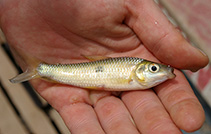 Leporinus arimaspi
Bild av Petersen, P.
Bilder | Google image
Bild av Petersen, P.
Klassificering / Namn Populärnamn | synonymer | Catalog of Fishes(Släkte, Arter) | ITIS | CoL | WoRMS | Cloffa
> Characiformes (Characins) > Anostomidae (Headstanders)
Etymology: Leporinus: Latin, lepus, leporis = rabbit (Ref. 45335); arimaspi: Named after the mythical Arimaspi people of northern Scythia in Greek mythology. The large black spot on the midlateral portion of the body in this new species is reminiscent of the single, pronounced, centrally located eye that the Arimaspi people were said to possess. A noun in apposition.
Eponymy: The Arimaspi in Greek legend were a mythical people of northern Scythia. The name was conferred due to the large black spot on the fish’s body, reminiscent of the single, centrally located eye that the Arimaspians were said to have. (Ref. 128868), visit book page.
Etymology: Leporinus: Latin, lepus, leporis = rabbit (Ref. 45335); arimaspi: Named after the mythical Arimaspi people of northern Scythia in Greek mythology. The large black spot on the midlateral portion of the body in this new species is reminiscent of the single, pronounced, centrally located eye that the Arimaspi people were said to possess. A noun in apposition.
Eponymy: The Arimaspi in Greek legend were a mythical people of northern Scythia. The name was conferred due to the large black spot on the fish’s body, reminiscent of the single, centrally located eye that the Arimaspians were said to have. (Ref. 128868), visit book page.
Miljö: miljö / Klimatzon / djupintervall / distributionsområde Ekologi
; sötvatten bentopelagisk. Tropical
Utbredning Territorier | FAO områden | Ekosystem | Förekomster | Prickkarta | Utplanteringar | Faunafri
South America: throughout the Río Orinoco drainage in Venezuela, including the ríos Caura, Pamoni, Casiquiare, Manapiare, and Ventuari.
Storlek / Vikt / Ålder
Kort beskrivning Bestämningsnycklar | Morfologi | Morfometri
Mjukstrålar i ryggfenan (totalt) : 12; Mjukstrålar i analfenan: 10; Ryggkotor: 38. Leporinus arimaspi is distinguished from all other congeners except L. aripuanaensis, L. amazonicus, L. apollo, L. cylindriformis, L. niceforoi, and L. ortomaculatus by the combination of an extremely dorsoventrally slender body (body depth immediately anterior to the dorsal-fin origin of 19-27% SL, versus 29% SL or greater) and the pigmentation pattern consisting of one or more dark spots centered along the lateral-line scale row. It differs from L. apollo, L. cylindriformis, L. niceforoi, and L. ortomaculatus by the lack of the dark spot along the lateral-line posterior to the dorsal-fin insertion and anterior to the adipose-fin origin (vs. presence of an intense dark spot). It further differs from L. apollo and L. cylindriformis by having five upper transverse scale rows (vs. six in most specimens), and four lower transverse scale rows (vs. five in most specimens), and from L. ortomaculatus by the absence of rows of spots dorsal and ventral to the lateral-line scale row (vs. presence); from L. amazonicus by having 37- 40 total scales on lateral line (vs. 43–45), 38 vertebrae (vs. 41), and four lower transverse scale rows at the pelvic-fin insertion (vs. 5 in most specimens). It is readily distinguished from the most similar species, L. aripuanaensis, by the absence (or faint presence) of a circular dark spot over the hypural plate (vs. presence of an intensely pigmented dark spot in that position). It can be further diagnosed from L. aripuanaensis by having 12 modal predorsal scales (vs. 11), as well as the following morphometrics in specimens between 7.0 and 9.2 cm SL: interorbital width 34-44% HL (vs. 29-34% HL) and eye diameter 29-34% HL (vs. 25-30% HL) (Ref. 96504).
Body shape (shape guide): elongated.
Body shape (shape guide): elongated.
Found in rivers. Some specimens were collected near bedrock outcroppings and banks (Ref. 96504).
Livscykel och parningsbeteende Könsmognad | Reproduktion | Lek | Ägg | Fekunditet | Larver
Huvudreferens
Ladda upp dina referenser | referenser | Koordinator : Garavello, Júlio | Medarbetare
Burns, M.D., B.W. Frable and B.L. Sidlauskas, 2014. A new species of Leporinus (Characiformes: Anostomidae), from the Orinoco Basin, Venezuela. Copeia 2014(2):206-214. (Ref. 96504)
Status på IUCN:s rödlista (Ref. 130435: Version 2025-2 (Global))
Least Concern (LC) ; Date assessed: 16 November 2020
CITES
Not Evaluated
Hot mot människor
Harmless
Mänskliga användningsområden
FAO - Publication: search | FishSource |
Ytterligare information
Trofisk ekologi
Livsmedelsartiklar (preys)
Födosammansättning
Födointag
Matransoner
Predatorer
Livsmedelsartiklar (preys)
Födosammansättning
Födointag
Matransoner
Predatorer
Populationsdynamik
Tillväxtparametrar
Max. åldrar / storlekar
Längd-vikt rel.
Längd-längd rel.
Längd-frekvenser
Massakonvertering
Rekrytering
Abundans
Tillväxtparametrar
Max. åldrar / storlekar
Längd-vikt rel.
Längd-längd rel.
Längd-frekvenser
Massakonvertering
Rekrytering
Abundans
Livscykel
Reproduktion
Könsmognad
Mognad/Gills rel.
Fekunditet
Lek
Lekande aggregat
Ägg
Utveckling av ägg
Larver
Larvdynamik
Reproduktion
Könsmognad
Mognad/Gills rel.
Fekunditet
Lek
Lekande aggregat
Ägg
Utveckling av ägg
Larver
Larvdynamik
Anatomi
Gälyta
Hjärna
Otolit
Gälyta
Hjärna
Otolit
Fysiologi
Kroppssammansättning
Näringsämnen
Syreförbrukning
Typ av simning
Simhastighet
Visuella pigment
Ljud från fisk
Sjukdomar & Parasiter
Toxicitet (LC50)
Kroppssammansättning
Näringsämnen
Syreförbrukning
Typ av simning
Simhastighet
Visuella pigment
Ljud från fisk
Sjukdomar & Parasiter
Toxicitet (LC50)
Genetik
Genom
Genetik
Heterozygositet
Ärftlighet
Genetisk mångfald
Genom
Genetik
Heterozygositet
Ärftlighet
Genetisk mångfald
Människorelaterad
Vattenbrukssystem
Vattenbruksprofiler
Avelslinjer
Ciguatera-fall
Frimärken, mynt, diverse.
Vattenbrukssystem
Vattenbruksprofiler
Avelslinjer
Ciguatera-fall
Frimärken, mynt, diverse.
Verktyg
Särskilda rapporter
Kontrollera för underhåll av akvarium | Kontrollera om det finns faktablad om arter | Kontrollera om det finns faktablad om vattenbruk
Ladda ner XML
Internet-källor
AFORO (otoliths) | Aquatic Commons | BHL | Cloffa | Websites from users | Check FishWatcher | CISTI | Catalog of Fishes: Släkte, Arter | DiscoverLife | ECOTOX | FAO - Publication: search | Faunafri | Fishipedia | Fishtrace | GloBI | Google Books | Google Scholar | Google | IGFA World Record | OneZoom | Open Tree of Life | Otolith Atlas of Taiwan Fishes | PubMed | Reef Life Survey | Socotra Atlas | TreeBase | Tree of Life | Wikipedia: Go, sök | World Records Freshwater Fishing | Zoobank | Zoologiskt register
Uppskattningar baserade på modeller
Index för fylogenetisk mångfald (Ref. 82804): PD50 = 0.5000 [Uniqueness, from 0.5 = low to 2.0 = high].
Bayesian length-weight: a=0.01023 (0.00469 - 0.02234), b=3.04 (2.86 - 3.22), in cm total length, based on LWR estimates for this Genus-body shape (Ref. 93245).
Trofisk nivå (Ref. 69278): 2.4 ±0.1 se; based on size and trophs of closest relatives
Resiliens (Ref. 120179): Mellan, lägsta populationsfördubblingstid 1,4-4,4 år (Preliminary K or Fecundity.).