This website uses cookies to enhance your browsing experience and ensure the functionality of our site. For more detailed information about the types of cookies we use and how we protect your privacy, please visit our Privacy Information page.
×
Cookie Settings
This website uses different types of cookies to enhance your experience. Please select your preferences below:
> Eupercaria/misc (Various families in series Eupercaria) > Labridae (Wrasses) > Julidinae
Etymology: Pseudojuloides:Greek, pseudes = false + Greek, iouis = a fish without identification, perhaps some of genus Coris cited by Plinius + Greek, oides = similar to (Ref. 45335); edwardi:Named for Jason Edward, noun in genitive case. Eponymy: Jason Edward is the owner of Greenwich Aquaria, New York, a commercial company specialising in customised aquariums and their maintenance as well as supplying fish. [...] (Ref. 128868), visit book page.
Environnement : milieu / zone climatique / profondeur / gamme de distribution Écologie
marin pelagic-neritic; profondeur 5 - 20 m. Tropical
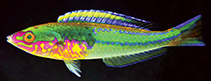
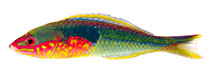
Épines dorsales (Total) : 9; Rayons mous dorsaux (Total) : 11; Épines anales: 3; Rayons mous anaux: 12. This species is distinguished by the following characters: D IX,11; A III,12; pectoral rays 13; lateral-line scales 27 (+1 on tail); head scaleless; gill rakers 14; anteriorly in each jaw is a pair of large, projecting, and slightly recurved canine teeth, the upper pair slightly out-flaring, the lowers curving forward and fitting between uppers when mouth closed; on each side of upper and lower jaws, a short irregular row of 4-7 chisel-like incisiform teeth, no canine posteriorly at corner of mouth; body, body elongated, depth 4.2-4.9 in SL, only slightly compressed, body width 1.4-1.8 in depth; caudal fin truncate in initial phase, with slightly extended upper and lower lobes in terminal-phase male; colour of initial phase reddish orange to pink, often with more yellow tint anteriorly and grading to white ventrally on the head and abdomen; in life, terminal-phase male with rear half of body emerald green with two bright blue stripes, lower along lateral midline, upper along mid-upper body, dorsum above upper blue line olive green; upper head and anterior body olive green, becoming darker to black at mid-body; lower half of head and anterior body with prominent yellow reticulum over magenta background; magenta line extends forward below orbit along upper jaw and back across snout to end over the orbit; dorsal and anal fins with bluish base and edge surrounding midline thick yellow band; caudal fin blue-edged top and bottom with a short blue extension of the mid-lateral stripe onto the fin (Ref. 95804). Body shape (shape guide): fusiform / normal; Cross section: compressed.
Depth range (5-20 m) given by B. Victor (pers. comm. 10/18).
Cycle de vie et comportement reproducteur Maturité | Reproduction | Frai | Œufs | Fécondité | Larves
Oviparous, distinct pairing during breeding (Ref. 205).
Victor, B.C. and J.E. Ranfdall, 2014. Pseudojuloides edwardi, n. sp. (Perciformes: Labridae): an example of evolution of male-display phenotype outpacing divergence in mitochondrial genotype. J. Ocean Sci. Found. 11:1-12. (Ref. 95804)
Statut dans la liste rouge de l'IUCN (Ref. 130435: Version 2025-2 (Global))
Dynamique des populations Paramètres de croissance Âges / tailles maximales Longueur-poids rel. Rel. longueur-longueur. Fréquences de longueurs Conversion de masse Recrutement Abondance
Cycle de vie Reproduction Maturité Maturité/épines rel. Fécondité Frai Agrégats de frai Œufs Développement de l'œuf Larves Dynamique des populations larvaires
Physiologie Composition corporelle Nutriments Consommation d'oxygène Type de natation Vitesse de nage Pigments visuels Son de poisson Maladies et parasites Toxicité (CL50)
Indice de diversité phylogénétique (Réf. 82804): PD50 = 0.5000 [Uniqueness, from 0.5 = low to 2.0 = high].
Bayesian length-weight: a=0.00977 (0.00468 - 0.02039), b=3.07 (2.90 - 3.24), in cm total length, based on LWR estimates for this (Sub)family-body shape (Ref. 93245).
Niveau trophique (Réf. 69278): 3.3 ±0.4 se; based on size and trophs of closest relatives
Résilience (Réf. 120179): Haut, temps minimum de doublement de population inférieur à 15 mois (Preliminary K or Fecundity.).
Vulnérabilité de la pêche (Ref. 59153): Low vulnerability (10 of 100). 🛈