



Gymnotus capitimaculatus Rangel-Pereira, 2014
Adicionar o seu Fotografias e vídeos
Imagem do Google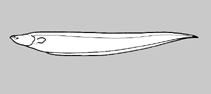 No image available for this species;
drawing shows typical species in Gymnotidae.
Imagem do Google
drawing shows typical species in Gymnotidae.
Classificação / Nomes Nomes comuns | Sinónimos | Catalog of Fishes(Género, Espécies) | ITIS | CoL | WoRMS | Cloffa
> Gymnotiformes (Knifefishes) > Gymnotidae (Naked-back knifefishes) > Gymnotinae
Etymology: Gymnotus: Greek, gymnos = naked (Ref. 45335); capitimaculatus: Derived from the Latin subject capitis (head) and adjective maculatus (blotchy), in reference to the presence of a pair of blotches in the ventral portion of the head.
Etymology: Gymnotus: Greek, gymnos = naked (Ref. 45335); capitimaculatus: Derived from the Latin subject capitis (head) and adjective maculatus (blotchy), in reference to the presence of a pair of blotches in the ventral portion of the head.
Ambiente: milieu / zona climática / intervalo de profundidade / gama de distribuição Ecologia
; Água doce demersal. Tropical
Distribuição Territórios | Áreas FAO | Ecossistemas | Ocorrências | Mapa dos pontos | Introduções | Faunafri
South America: Rio do Ouro, rio Jucuruçu basin in Brazil.
Tamanho / Peso / Idade
Descrição breve Chaves de identificação | Morfologia | Morfometria
Gymnotus capitimaculatus belongs to the Gymnotus pantherinus species-group, characterized by having a slender body (body depth 7.2-8.9 % of TL), proximal portion of the fifth rib with broad triangular ridge, more than three times width of the sixth rib (vs. narrow ridge, less than three times width of the sixth rib) and one laterosensory pore in the dorso-posterior portion of the preopercle, in the preopercular-mandibular canal (vs. two pores). It differs from all congeners by having a pair of round blotches anteriorly positioned or under vertical passing through eye, on ventral portion of the head. It can be diagnosed from all members of the G. pantherinus species-group (sensu) by the following unique combination of characters: tail with a unique series of bands or round spots (vs. tail with randomly disposed spots, never forming a unique series); precaudal portion of the trunk lacks bands or with rounded and/or vermiculated spots scattered all over it (vs. with well defined bands); 45 precaudal vertebrae (vs. 31-43 or 46-51); 9 scales above lateral line at mid-body (vs. 6-8 or 10); anal fin base length 75.2-78.6 % of TL (vs. 62.9-74.7 or 79-83.8 %); anus-anal fin length 101.4-122.8 % of HL (vs. 50-96.3 %); and branchial opening 38.5-45.0 % of HL (vs. 24-35) (Ref. 96661).
Body shape (shape guide): elongated.
Body shape (shape guide): elongated.
Facultative air-breathing in the genus (Ref. 126274); Occurs in clear water stream with topical width of about 1.5 m, depth range from 0.1 to 1 m and bottom consisting of sand and small gravel. Individuals were deeply hidden among marginal vegetation and roots, mostly where the water flow was faster. Inhabits sympatrically with another species of Gymnotus belonging to the G. carapo species group, but not syntopically (Ref. 96661).
Ciclo de vida e comportamento de acasalamento Maturidade | Reprodução | Desova | Ovos | Fecundidade | Larvas
Referência principal
Carregar as suas referências | Referências | Coordenador : Campos-da-Paz, Ricardo | Colaboradores
Rangel-Pereira, F.S., 2014. Gymnotus capitimaculatus, a new species of electric fish from rion Jucuruçu basin, northeastern Brazil (Ostariophysi: Gymnotiformes: Gymnotidae). Vert. Zool. 64(2):169-175. (Ref. 96661)
Categoria na Lista Vermelha da IUCN (Ref. 130435: Version 2025-2 (Global))
Criticamente ameaçada (CR) (B1ab(iii)+2ab(iii)); Date assessed: 03 November 2020
CITES
Not Evaluated
Ameaça para o homem
Harmless
Utilização humana
FAO - Publication: search | FishSource |
Mais informação
Ecologia Trófica
Produtos alimentares (presas)
Composição da dieta
Consumo alimentar
Rações alimentares
Predadores
Produtos alimentares (presas)
Composição da dieta
Consumo alimentar
Rações alimentares
Predadores
Dinâmica das populações
Parâmetros de crescimento
Idades / tamanhos máximos
Comprimento-peso rel.
Comprimento-comprimento rel.
Frequência de comprimento
Conversão de massa
Recrutamento
Abundância
Parâmetros de crescimento
Idades / tamanhos máximos
Comprimento-peso rel.
Comprimento-comprimento rel.
Frequência de comprimento
Conversão de massa
Recrutamento
Abundância
Ciclo de vida
Reprodução
Maturidade
Maturidade/Rel. das guelras
Fecundidade
Desova
Agregações de desova
Ovos
Desenvolvimento dos ovos
Larvas
Dinâmica larvar
Reprodução
Maturidade
Maturidade/Rel. das guelras
Fecundidade
Desova
Agregações de desova
Ovos
Desenvolvimento dos ovos
Larvas
Dinâmica larvar
Anatomia
Área branquial
Cérebro
Otólitos
Área branquial
Cérebro
Otólitos
Fisiologia
Composição corporal
Nutrientes
Consumo de oxigénio
Tipo de natação
Velocidade de natação
Pigmentos visuais
Som de peixe
Doenças e Parasitas
Toxicidade (LC50s)
Composição corporal
Nutrientes
Consumo de oxigénio
Tipo de natação
Velocidade de natação
Pigmentos visuais
Som de peixe
Doenças e Parasitas
Toxicidade (LC50s)
Genética
genoma
Genética
Heterozigotia
Hereditariedade
Diversidade genética
genoma
Genética
Heterozigotia
Hereditariedade
Diversidade genética
Relacionado com o ser humano
Sistemas de aquacultura
Perfis para aquacultura
Estirpes
Casos de Ciguatera
Selos, moedas, diversos.
Sistemas de aquacultura
Perfis para aquacultura
Estirpes
Casos de Ciguatera
Selos, moedas, diversos.
Ferramentas
E-book | Guia de campo | Ferramenta auxiliar de frequências de comprimento | Ferramenta sobre a história de vida | Mapa dos pontos |
Captura-MSY |
Relatórios especiais
Descarregue XML
Fontes da internet
AFORO (otoliths) | Aquatic Commons | BHL | Cloffa | Websites from users | Consultar FishWatcher | CISTI | Catalog of Fishes: Género, Espécies | DiscoverLife | ECOTOX | FAO - Publication: search | Faunafri | Fishipedia | Fishtrace | GloBI | Google Books | Google Scholar | Google | IGFA World Record | OneZoom | Open Tree of Life | Otolith Atlas of Taiwan Fishes | PubMed | Reef Life Survey | Socotra Atlas | TreeBase | Árvore da vida | Wikipedia: ir para, procurar | World Records Freshwater Fishing | Zoobank | Registo zoológico
Estimativas baseadas em modelos
Índice de diversidade filogenética (Ref. 82804): PD50 = 0.5000 [Uniqueness, from 0.5 = low to 2.0 = high].
Bayesian length-weight: a=0.00437 (0.00209 - 0.00911), b=2.98 (2.79 - 3.17), in cm total length, based on LWR estimates for this (Sub)family-body shape (Ref. 93245).
Nível Trófico (Ref. 69278): 3.3 ±0.4 se; based on size and trophs of closest relatives
Resiliência (Ref. 120179): Elevada, tempo mínimo de duplicação da população menor que 15 meses (Preliminary K or Fecundity.).