



Microglanis maculatus Shibatta, 2014
Uploaden van uw Foto's en video's
Google afbeelding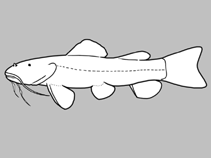 No image available for this species;
drawing shows typical species in Pseudopimelodidae.
Google afbeelding
drawing shows typical species in Pseudopimelodidae.
Classificatie / Namen Lokale namen | Synoniemen | Catalog of Fishes(Genus, Soort(en)) | ITIS | CoL | WoRMS | Cloffa
> Siluriformes (Catfishes) > Pseudopimelodidae (Bumblebee catfishes, dwarf marbled catfishes) > Batrochoglaninae
Etymology: Microglanis: Greek, mikros = small + Greek, glanis = a fish that can eat the bait without touching the hook; a cat fish (Ref. 45335); maculatus: From the Latin adjective macula, meaning spotted, in reference to the dark brown spots on the trunk.
Etymology: Microglanis: Greek, mikros = small + Greek, glanis = a fish that can eat the bait without touching the hook; a cat fish (Ref. 45335); maculatus: From the Latin adjective macula, meaning spotted, in reference to the dark brown spots on the trunk.
Milieu: milieu / Klimaatzone / Diepte / verspreidingsgebied Ecologie
; zoet water demersaal. Tropical; 23°C - ? (Ref. 95500)
Verspreiding Gebieden | FAO regio's | Ecosystemen | Voorkomen | Verspreidingskaart | Introducties | Faunafri
South America: Rio dos Patos basin, upper rio Tocantins basin in Brazil.
Grootte / Gewicht / Leeftijd
Korte beschrijving Determinatiesleutels | Morfologie | Morfometrie
Dorsale stekels (totaal) : 1; Dorsale zachte stralen (totaal) : 6; Wervels: 32. Distinguished from all other species of Microglanis in having rounded spots on the flank. Differs also from its congeners, except M. robustus, by its emarginate caudal fin with upper lobe slightly longer than the lower and light spot in nuchal region very small or absent. Can be diagnosed from M. robustus by the following characters: anterior margin of pectoral-fin spine with single hook (vs. bifurcated hooks between antrorse and retrorse hooks); rays of pectoral fin I, 6 (vs. I, 5); anterior blotch of trunk U shaped (vs. inverted U shaped); dorsal and caudal fins with broad dark stripes (vs. thin); dorsal-fin spine length 6.9-11.1% SL (vs. 11.3-15.4% SL); pectoral-fin spine length 12.9-17.7% SL (vs. 16.4-20.6% SL); orbital diameter 11.5-12.6% SL (vs.14.7-16.4% SL); and mouth width 16.8-17.5% SL (vs. 11.4-13.2% SL) (Ref. 95500).
Body shape (shape guide): elongated.
Body shape (shape guide): elongated.
Collected at the mouth of a creek in ribeirão Pouso Alegre with adventitious roots of riparian trees along the banks. Collections were done on rocky bed above this area but no specimen was captured. The ribeirão Pouso Alegre is characterized by the following conditions: riparian vegetation in good state; bedrock, with sand, clay litter, logs and branches at the mouth; dissolved oxygen 7.8 mg/L; pH 7.65; conductivity 85ì S/cm; water temperature 22.5° C; mean depth 6.5±0.93 cm; mean width 4.1±0.66 m; and mean water speed 0.12±0.02 m/s (Ref. 95500).
Levenscyclus en paargedrag Maturiteit | Voortplanting | Paaien | Eieren | Fecunditeit | Larven
Hoofdreferentie
Upload uw referenties | Referenties | Coördinator : Shibatta, Oscar Akio | Medewerkers
Shibatta, O.A., 2014. A new species of Microglanis (Siluriformes: Pseudomipemodidae) from the upper rio Tocantins basin, Goiás State, Central Brazil. Neotrop. Ichthyol. 12(1):81-87. (Ref. 95500)
Status op de Rode Lijst van het IUCN (Ref. 130435: Version 2025-2 (Global))
Niet bedreigd (LC) ; Date assessed: 07 November 2018
CITES
Not Evaluated
Gevaar voor de mens
Harmless
Gebruik door de mens
FAO - Publication: search | FishSource |
Meer informatie
Trofische ecologie
Voedsel (prooien)
Dieetsamenstelling
Voedselconsumptie
Voedselrantsoenen
Predatoren
Voedsel (prooien)
Dieetsamenstelling
Voedselconsumptie
Voedselrantsoenen
Predatoren
Populatiedynamica
Groeiparameters
Max. leeftijden / maten
Lengte-gewicht rel.
Lengte-lengte rel.
Lengtefrequenties
Massaconversie
Rekrutering
Abundantie
Groeiparameters
Max. leeftijden / maten
Lengte-gewicht rel.
Lengte-lengte rel.
Lengtefrequenties
Massaconversie
Rekrutering
Abundantie
Levenscyclus
Voortplanting
Maturiteit
Rijpheid/kieuwen rel.
Fecunditeit
Paaien
Paaibestanden
Eieren
Ontwikkeling van de eieren
Larven
Larvale populatiedynamiek
Voortplanting
Maturiteit
Rijpheid/kieuwen rel.
Fecunditeit
Paaien
Paaibestanden
Eieren
Ontwikkeling van de eieren
Larven
Larvale populatiedynamiek
Anatomie
Kieuwoppervlak
Hersenen
Otoliet
Kieuwoppervlak
Hersenen
Otoliet
Fysiologie
Lichaamssamenstelling
Voedingsstoffen
Zuurstofverbruik
Type zwemmen
Zwemsnelheid
Visuele pigmenten
Vis geluid
Ziekten en parasieten
Toxiciteit (LC50)
Lichaamssamenstelling
Voedingsstoffen
Zuurstofverbruik
Type zwemmen
Zwemsnelheid
Visuele pigmenten
Vis geluid
Ziekten en parasieten
Toxiciteit (LC50)
Genetica
genoom
Genetica
Heterozygositeit
Erfelijkheid
Genetische diversiteit
genoom
Genetica
Heterozygositeit
Erfelijkheid
Genetische diversiteit
Menselijk gerelateerd
Aquacultuursystemen
Aquacultuurprofielen
Kweeklijnen
Ciguatera gevallen
Postzegels, munten, diversen.
Aquacultuursystemen
Aquacultuurprofielen
Kweeklijnen
Ciguatera gevallen
Postzegels, munten, diversen.
Tools
Speciale rapporten
Bekijk gegevens voor het houden in een aquarium | Bekijk Fact Sheets voor de soort | Bekijk Aquacultuur Fact Sheets
Download XML
Internetbronnen
AFORO (otoliths) | Aquatic Commons | BHL | Cloffa | Websites from users | Bekijk FishWatcher | CISTI | Catalog of Fishes: Genus, Soort(en) | DiscoverLife | ECOTOX | FAO - Publication: search | Faunafri | Fishipedia | Fishtrace | GloBI | Google Books | Google Scholar | Google | IGFA World Record | OneZoom | Open Tree of Life | Otolith Atlas of Taiwan Fishes | PubMed | Reef Life Survey | Socotra Atlas | TreeBase | Tree of Life | Wikipedia: ga naar, zoek | World Records Freshwater Fishing | Zoobank | Zoological Record
Schattingen op basis van modellen
Fylogenetische diversiteitsindex (Ref. 82804): PD50 = 0.5000 [Uniqueness, from 0.5 = low to 2.0 = high].
Bayesian length-weight: a=0.00692 (0.00292 - 0.01638), b=3.12 (2.91 - 3.33), in cm total length, based on LWR estimates for this (Sub)family-body shape (Ref. 93245).
Trofisch niveau (Ref. 69278): 3.2 ±0.4 se; based on size and trophs of closest relatives