Classificação / Names
Nomes comuns | Sinónimos | Catalog of Fishes(Género, Espécies) | ITIS | CoL | WoRMS | Cloffa
>
Ovalentaria/misc (Various families in series Ovalentaria) >
Ambassidae (Asiatic glassfishes)
Etymology: ploegi: Named for Alex Ploeg, a good friend, fellow taxonomist, advisor and fellow conservationist against alien aquatic species; for his services to the ornamental fish trade in this region and abroad in his role as the Secretary General of the Ornamental Fish International; who unfortunately perished in a terrible tragedy over Ukraine on 17 July 2014.
Eponymy: Dr Alex A Ploeg (d: 2014) was a Dutch ichthyologist who was Secretary General of Ornamental Fish International (2004–2014) and Secretary General of the European Pet Organization (2006–2014). [...] (Ref. 128868), visit book page.
Environment: milieu / climate zone / intervalo de profundidade / distribution range
Ecologia
; Água doce bentopelágico. Tropical
Asia: Sanggau and Kapuas Lakes regions in West Kalimantan, Indonesia.
Tamanho / Peso / Idade
Maturidade: Lm ? range ? - ? cm
Max length : 2.8 cm SL macho/indeterminado; (Ref. 97398)
Descrição breve
Chaves de identificação | Morfologia | Morfometria
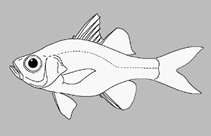
Espinhos dorsais (total) : 8; Raios dorsais moles (total) : 11; Espinhos anais: 3; Raios anais moles: 11; Vértebras: 25. Distinguished from all other species of Gymnochanda by the following characters: mature males have pinkish body with dorsal half suffused with reddish pigments, anal and second dorsal fins expanded with their soft rays also expanded to reach 2/3 of caudal fin forming a crescentic profile, without any individual fin ray free from the interradial fin membrane; anterior part to whole of both anal and second dorsal fins maroon red in life, with posterior portion of distal rays black forming a crescentic pattern (hyaline when preserved); caudal fin entirely lightly suffused with red in life (hyaline when preserved); females possess yellowish body suffused with reddish pigments without any fin elongation (hyaline when preserved), both dorsal fins suffused with reddish pigments (hyaline when preserved) (Ref. 97398).
Body shape (shape guide): fusiform / normal.
Found in pools with still water near swamp forest and riverine systems (Ref. 97398).
Life cycle and mating behavior
Maturidade | Reprodução | Desova | Ovos | Fecundidade | Larvas
Tan, H.H. and K.K.P. Lim, 2014. Gymnochanda ploegi, a new species of ambassid glassperch from West Kalimantan, Indonesia. Raffles Bulletin of Zoology 62:688-695. (Ref. 97398)
Categoria na Lista Vermelha da IUCN (Ref. 130435: Version 2025-1)
Ameaça para o homem
Harmless
Utilização humana
Ferramentas
Relatórios especiais
Descarregue XML
Fontes da internet
Estimates based on models
Phylogenetic diversity index (Ref.
82804): PD
50 = 0.5312 [Uniqueness, from 0.5 = low to 2.0 = high].
Bayesian length-weight: a=0.01175 (0.00496 - 0.02782), b=3.02 (2.82 - 3.22), in cm total length, based on LWR estimates for this (Sub)family-body shape (Ref.
93245).
Nível Trófico (Ref.
69278): 3.2 ±0.4 se; based on size and trophs of closest relatives
Resiliência (Ref.
120179): Elevada, tempo mínimo de duplicação da população menor que 15 meses (Preliminary K or Fecundity.).
Fishing Vulnerability (Ref.
59153): Low vulnerability (10 of 100).
🛈