



Carcharhinus tjutjot (Bleeker, 1852)
Hochladen Photos und videos
Google Bild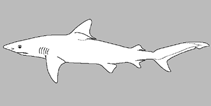 No image available for this species;
drawing shows typical species in Carcharhinidae.
Google Bild
drawing shows typical species in Carcharhinidae.
Klassifizierung / Names Namen | Synonyme | Catalog of Fishes(Gattung, Arten) | ITIS | CoL | WoRMS | Cloffa
Elasmobranchii (Haie und Rochen) (sharks and rays) > Carcharhiniformes (Ground sharks) > Carcharhinidae (Requiem sharks)
Etymology: Carcharhinus: karcharos (Gr.), sharp or jagged; rhinus, an ancient name for sharks, from rhine (Gr.), rasp, both words alluding to a shark's jagged, rasp-like skin (See ETYFish); tjutjot: Indonesian word for shark (pronounced choo-choot) (See ETYFish).
Etymology: Carcharhinus: karcharos (Gr.), sharp or jagged; rhinus, an ancient name for sharks, from rhine (Gr.), rasp, both words alluding to a shark's jagged, rasp-like skin (See ETYFish); tjutjot: Indonesian word for shark (pronounced choo-choot) (See ETYFish).
Umwelt: Milieu / Klimazone / Tiefenbereich / Verbreitungsgebiet Ökologie
seewasser riff-verbunden; tiefenbereich ? - 100 m (Ref. 89954). Tropical
Verbreitung Territorien | FAO Gebiete | Ökosysteme | Vorkommen | Punkt Karte | Einführungen | Faunafri
Western Pacific: from Indonesia and Taiwan, including Borneo but not Australia and New Guinea. Not confirmed west of the Indo-Malay Peninsula.
Länge bei der ersten Reifung / Größe / Gewicht / Alter
Geschlechtsreife: Lm 77.4, range 76 - 79 cm
Max length : 93.7 cm TL Männchen/unbestimmt; (Ref. 89954); 91.8 cm TL (female)
Max length : 93.7 cm TL Männchen/unbestimmt; (Ref. 89954); 91.8 cm TL (female)
Kurzbeschreibung Bestimmungsschlüssel | Morphologie | Morphometrie
Wirbelzahl: 113 - 129. This small species is distinguished by the following characters: snout relatively long and bluntly pointed; upper anterior teeth are oblique and blade-like, coarsely serrated, lateral margin deeply notched and with several large and serrated basal cusplets; lower anterior teeth are narrower, slightly oblique, lateral margins notched and without large basal serrae, finely serrated; total tooth row counts 26-28/24-30 rows or 51-55; interdorsal space often with a moderate to strong ridge, 19.4-22.0% TL; first dorsal fin is relatively low, not falcate, origin over middle of pectoral-fin inner margin, length 14.1-15.6% TL, 1.4-2.0 times height, inner margin 2.0-2.7 in base; second dorsal fin is much smaller, broadly triangular, height 29-37% of first dorsal fin height, origin slightly posterior of anal-fin origin; anal fin is slightly falcate, height 0.9-1.3 times second dorsal-fin height, base 0.9-1.2 times second dorsal-fin base; body colour pale brownish dorsally, whitish ventrally; second dorsal fin with a black blotch on upper third of fin, not extending onto upper surface of body and very well defined from whitish region below; other fins are mostly plain; total vertebral counts 113-129; monospondylous precaudal counts 37-44; diplospondylous precaudal counts 17-19; diplospondylous caudal counts 58-72; precaudal counts 55-63 (Ref. 89954).
Body shape (shape guide): fusiform / normal.
Body shape (shape guide): fusiform / normal.
An inshore species, likely to be found in less than 100 m depth (Ref. 89954). One female specimen contained 2 late-term embryos measuring 27.8 and 28.5 cm TL. Probable size at birth is between 34.0-38.0 cm TL (Ref. 89954).
Lebenszyklus und Paarungsverhalten Geschlechtsreife | Fortpflanzung | Ablaichen | Eier | Fruchtbarkeit | Larven
Hauptreferenz
Laden Sie Ihre Referenzen hoch | Referenzen | Koordinator : Compagno, Leonard J.V. | Partner
White, W.T., 2012. A redescription of Carcharhinus dussumieri and C. sealei, with resurrection of C. coatesi and C. tjutjot as valid species (Chondrichthyes: Carcharhinidae). Zootaxa 3241:1-34. (Ref. 89954)
IUCN Rote Liste Status (Ref. 130435: Version 2025-2 (Global))
Verwundbar (VU) (A2cd+3cd); Date assessed: 14 August 2018
Bedrohung für Menschen
Harmless
Nutzung durch Menschen
FAO - Publication: search | FishSource |
Mehr Information
Trophische Ökologie
Lebensmittel (Beutetiere)
Nahrungszusammensetzung
Nahrungsaufnahme
Lebensmittelrationen
Räuber
Lebensmittel (Beutetiere)
Nahrungszusammensetzung
Nahrungsaufnahme
Lebensmittelrationen
Räuber
Ökologie
Ökologie
Ökologie
Populationsdynamik
Wachstumsparameter
Max. Alter/Größen
Länge-Gewicht-Rel.
Länge-Länge-Verhältnis.
Längenhäufigkeiten
Massenkonvertierung
Rekrutierung
Dichte
Wachstumsparameter
Max. Alter/Größen
Länge-Gewicht-Rel.
Länge-Länge-Verhältnis.
Längenhäufigkeiten
Massenkonvertierung
Rekrutierung
Dichte
Lebenszyklus
Fortpflanzung
Geschlechtsreife
Reifung/Kiemen rel.
Fruchtbarkeit
Ablaichen
Laichaggregationen
Eier
Eientwicklung
Larven
Larven Pop.Dyn.
Fortpflanzung
Geschlechtsreife
Reifung/Kiemen rel.
Fruchtbarkeit
Ablaichen
Laichaggregationen
Eier
Eientwicklung
Larven
Larven Pop.Dyn.
Anatomie
Kiemenoberfläche
Gehirn
Otolith
Kiemenoberfläche
Gehirn
Otolith
Physiologie
Körperliche Zusammensetzung
Nährstoffe
Sauerstoffverbrauch
Schwimmart
Schwimmgeschwindigkeit
Visuelle Pigmente
Fischgeräusche
Krankheiten und Parasiten
Toxizität (LC50s)
Körperliche Zusammensetzung
Nährstoffe
Sauerstoffverbrauch
Schwimmart
Schwimmgeschwindigkeit
Visuelle Pigmente
Fischgeräusche
Krankheiten und Parasiten
Toxizität (LC50s)
Menschenbezogen
Aquakultur-Systeme
Aquakultur Profile
Zuchtlinien
Ciguatera-Fälle
Briefmarken, Münzen, Verschiedenes.
Aquakultur-Systeme
Aquakultur Profile
Zuchtlinien
Ciguatera-Fälle
Briefmarken, Münzen, Verschiedenes.
Tools
Zusatzinformationen
Download XML
Zusammenfassung | Punktdaten | Namen | Photos
Internet Quellen
AFORO (otoliths) | Aquatic Commons | BHL | Cloffa | Websites from users | FishWatcher Einträge suchen | CISTI | Catalog of Fishes: Gattung, Arten | DiscoverLife | ECOTOX | FAO - Publication: search | Faunafri | Fishipedia | Fishtrace | GloBI | Google Books | Google Scholar | Google | IGFA World Record | Nationale Datenbanken | OneZoom | Open Tree of Life | Otolith Atlas of Taiwan Fishes | PubMed | Reef Life Survey | Socotra Atlas | TreeBase | Tree of Life | Wikipedia: Gehe zu, Suchen | World Records Freshwater Fishing | Zoologischer Rekord
Schätzungen auf der Grundlage von Modellen
Phylogenetischer Diversitätsindex (Ref. 82804): PD50 = 0.5000 [Uniqueness, from 0.5 = low to 2.0 = high].
Bayesian length-weight: a=0.00525 (0.00244 - 0.01130), b=3.07 (2.90 - 3.24), in cm total length, based on LWR estimates for this Genus-body shape (Ref. 93245).
Trophische Ebene (Ref. 69278): 4.0 ±0.6 se; based on size and trophs of closest relatives
Widerstandsfähigkeit (Ref. 120179): niedrig, Verdopplung der Population dauert 4,5 - 14 Jahre. (Preliminary low fecundity).