



Hemigymnus sexfasciatus (Rüppell, 1835)
Beobachtung melden im Fish Watcher
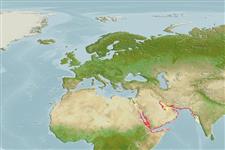
| Native range | All suitable habitat | Point map | Year 2050 |
|
| This map was computer-generated and has not yet been reviewed. |
| Hemigymnus sexfasciatus AquaMaps Data sources: GBIF OBIS |
Hochladen Photos und videos
Bilder | Google Bild Hemigymnus sexfasciatus
Photo von Faria, C.
Bilder | Google Bild
Photo von Faria, C.
Klassifizierung / Names Namen | Synonyme | Catalog of Fishes(Gattung, Arten) | ITIS | CoL | WoRMS | Cloffa
> Eupercaria/misc (Various families in series Eupercaria) > Labridae (Wrasses) > Julidinae
Etymology: Hemigymnus: Greek, hemi = half + Greek, gymnos = naked (Ref. 45335).
Etymology: Hemigymnus: Greek, hemi = half + Greek, gymnos = naked (Ref. 45335).
Umwelt: Milieu / Klimazone / Tiefenbereich / Verbreitungsgebiet Ökologie
seewasser riff-verbunden; tiefenbereich 1 - 20 m (Ref. 93095). Tropical
Verbreitung Territorien | FAO Gebiete | Ökosysteme | Vorkommen | Punkt Karte | Einführungen | Faunafri
Western Indian Ocean: Red Sea, Gulf of Tadjoura, east in the Gulf of Aden at least to Sikha Island, southwest of Al Mukallah, Yemen.
Größe / Gewicht / Alter
Kurzbeschreibung Bestimmungsschlüssel | Morphologie | Morphometrie
This species is distinguished by the following set of characters: gill rakers 20-23 (rarely 23); long pelvic fins, reaching anus in mature females and to or beyond origin of anal fin in males, one to spinous portion of fin; small juveniles are dark green, mottled with light yellowish green, with a white bar from anterior part of dorsal fin to abdomen, 4 faint narrower bars posteriorly, a pale bar on nape, 2 ventrally on chest; larger juveniles are dark brown with more distinct pale yellow bars; body of small females black with 5 white bars, progressively narrower posteriorly, the last posteriorly on caudal peduncle faint, the first two expanding ventrally; head white with a curving black bar from nape to eye; snout and interorbital are green with irregular pink bands radiating from eye; pectoral-fin rays yellow, membranes transparent; female in the process of sex change, indicated by the golden scale centers dorsally on the first dark bar of the body and on the dark olive bar of the nape; pelvic fins pale blue with orange streaks; body of males dark green, with spindle-shaped scales edged in light green; three pale gray bars on anterior two-thirds of body that broaden ventrally, the scale edges narrowly light green; first dark bar on body, ending at base of pectoral fin, with green margins and vertically elongate golden centers, many merging above and below, more as irregular vertical green and golden lines than as scale patterns; curving dark green bar of nape with golden scale centers, merging with a broad light yellowish brown band with irregular green bands that passes through eye onto snout; cheek with a broad near-white area, sparsely and faintly spotted with green, shading ventrally to blue; upper lip mainly greenish yellow; chest and abdomen pale blue with orange scale centers; pectoral-fin base in a large deep blue spot (Ref. 93095).
Body shape (shape guide): fusiform / normal; Cross section: compressed.
Body shape (shape guide): fusiform / normal; Cross section: compressed.
Occurs on coral reefs and adjacent habitats, on sand and coral rubble. The fish take a mouthful of sand and gravel from the substratum, where small fossorial prey are sorted out within the mouth and pharynx, and inorganic fragments are forcefully ejected from of the mouth. May also feed opportunistically on larger prey (crabs, echinoids, molluscs, ophiuroids, polychaetes) (Ref. 93095). Large breeding males in the Red Sea observed to exhibit h a reversal of the black-and-white barred color pattern of the body similar to H. fasciatus (Ref. 34222).
Lebenszyklus und Paarungsverhalten Geschlechtsreife | Fortpflanzung | Ablaichen | Eier | Fruchtbarkeit | Larven
Oviparous, with distinct pairing during breeding (Ref. 205).
Hauptreferenz
Laden Sie Ihre Referenzen hoch | Referenzen | Koordinator : Westneat, Mark | Partner
Randall, J.E., 2013. Review of the Indo-Pacific labrid fish genus Hemigymnus. J. Ocean Sci. Found. 6:2-18. (Ref. 93095)
IUCN Rote Liste Status (Ref. 130435: Version 2025-2 (Global))
Daten mangelhaft (DD) ; Date assessed: 12 June 2008
CITES
Not Evaluated
Bedrohung für Menschen
Harmless
Nutzung durch Menschen
FAO - Publication: search | FishSource |
Mehr Information
Trophische Ökologie
Lebensmittel (Beutetiere)
Nahrungszusammensetzung
Nahrungsaufnahme
Lebensmittelrationen
Räuber
Lebensmittel (Beutetiere)
Nahrungszusammensetzung
Nahrungsaufnahme
Lebensmittelrationen
Räuber
Ökologie
Ökologie
Ökologie
Populationsdynamik
Wachstumsparameter
Max. Alter/Größen
Länge-Gewicht-Rel.
Länge-Länge-Verhältnis.
Längenhäufigkeiten
Massenkonvertierung
Rekrutierung
Dichte
Wachstumsparameter
Max. Alter/Größen
Länge-Gewicht-Rel.
Länge-Länge-Verhältnis.
Längenhäufigkeiten
Massenkonvertierung
Rekrutierung
Dichte
Lebenszyklus
Fortpflanzung
Geschlechtsreife
Reifung/Kiemen rel.
Fruchtbarkeit
Ablaichen
Laichaggregationen
Eier
Eientwicklung
Larven
Larven Pop.Dyn.
Fortpflanzung
Geschlechtsreife
Reifung/Kiemen rel.
Fruchtbarkeit
Ablaichen
Laichaggregationen
Eier
Eientwicklung
Larven
Larven Pop.Dyn.
Anatomie
Kiemenoberfläche
Gehirn
Otolith
Kiemenoberfläche
Gehirn
Otolith
Physiologie
Körperliche Zusammensetzung
Nährstoffe
Sauerstoffverbrauch
Schwimmart
Schwimmgeschwindigkeit
Visuelle Pigmente
Fischgeräusche
Krankheiten und Parasiten
Toxizität (LC50s)
Körperliche Zusammensetzung
Nährstoffe
Sauerstoffverbrauch
Schwimmart
Schwimmgeschwindigkeit
Visuelle Pigmente
Fischgeräusche
Krankheiten und Parasiten
Toxizität (LC50s)
Genetik
Genom
Genetik
Heterozygotie
Vererbbarkeit
Genetische Vielfalt
Genom
Genetik
Heterozygotie
Vererbbarkeit
Genetische Vielfalt
Menschenbezogen
Aquakultur-Systeme
Aquakultur Profile
Zuchtlinien
Ciguatera-Fälle
Briefmarken, Münzen, Verschiedenes.
Aquakultur-Systeme
Aquakultur Profile
Zuchtlinien
Ciguatera-Fälle
Briefmarken, Münzen, Verschiedenes.
Tools
Zusatzinformationen
Download XML
Zusammenfassung | Punktdaten | Namen | Photos
Internet Quellen
AFORO (otoliths) | Aquatic Commons | BHL | Cloffa | Websites from users | FishWatcher Einträge suchen | CISTI | Catalog of Fishes: Gattung, Arten | DiscoverLife | ECOTOX | FAO - Publication: search | Faunafri | Fishipedia | Fishtrace | GloBI | Google Books | Google Scholar | Google | IGFA World Record | OneZoom | Open Tree of Life | Otolith Atlas of Taiwan Fishes | PubMed | Reef Life Survey | Socotra Atlas | TreeBase | Tree of Life | Wikipedia: Gehe zu, Suchen | World Records Freshwater Fishing | Zoologischer Rekord
Schätzungen auf der Grundlage von Modellen
Bevorzugte Temperatur (Ref. 123201): 26.9 - 29.2, mean 28.2 °C (based on 249 cells).
Phylogenetischer Diversitätsindex (Ref. 82804): PD50 = 0.6250 [Uniqueness, from 0.5 = low to 2.0 = high].
Bayesian length-weight: a=0.00977 (0.00468 - 0.02039), b=3.07 (2.90 - 3.24), in cm total length, based on LWR estimates for this (Sub)family-body shape (Ref. 93245).
Trophische Ebene (Ref. 69278): 3.5 ±0.4 se; based on size and trophs of closest relatives
Widerstandsfähigkeit (Ref. 120179): mittel, Verdopplung der Population dauert 1,4 - 4,4 Jahre. (Preliminary K or Fecundity.).