



Envoyez vos Photos et vidéos
Images | Images Google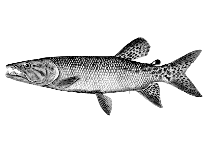 Hepsetus cuvieri
Photo de Mertens, P.
Images | Images Google
Photo de Mertens, P.
Classification / Noms Noms communs | Synonymes | Catalog of Fishes(Genre, Espèce) | ITIS | CoL | WoRMS | Cloffa
> Characiformes (Characins) > Hepsetidae (African pikes)
Etymology: Hepsetus: Greek, epsetas, -e, -on = boiled, but there is the following sentence: "oí epsetoi" = certain fishes, and also could be related to "psetta" = grouper (Ref. 45335).
Eponymy: Georges Léopold Chrétien Frédéric Dagobert Baron Cuvier (1769–1832), better known by his pen name Georges Cuvier, was a French naturalist and one of the scientific giants of his age. [...] (Ref. 128868), visit book page.
Etymology: Hepsetus: Greek, epsetas, -e, -on = boiled, but there is the following sentence: "oí epsetoi" = certain fishes, and also could be related to "psetta" = grouper (Ref. 45335).
Eponymy: Georges Léopold Chrétien Frédéric Dagobert Baron Cuvier (1769–1832), better known by his pen name Georges Cuvier, was a French naturalist and one of the scientific giants of his age. [...] (Ref. 128868), visit book page.
Environnement : milieu / zone climatique / profondeur / gamme de distribution Écologie
; eau douce démersal. Tropical
Distribution Territoires | Zones FAO | Écosystèmes | Occurrences | Carte par point | Introductions | Faunafri
Africa: Quanza, Cunene, Okavango, upper Zambezi and Kafue River systems; in the Congo River basin present in the southernmost part of the Kasai basin and in the lower Luapula River (Ref. 93907).
Longueur à la première maturité / Taille / Poids / Âge
Maturité: Lm 25.0 range ? - ? cm
Max length : 37.0 cm SL mâle / non sexé; (Ref. 30518); âge max. reporté: 5 années (Ref. 2750)
Max length : 37.0 cm SL mâle / non sexé; (Ref. 30518); âge max. reporté: 5 années (Ref. 2750)
Description synthétique Clés d'identification | Morphologie | Morphométrie
Épines dorsales (Total) : 0; Rayons mous dorsaux (Total) : 9; Épines anales: 0; Rayons mous anaux: 12. Diagnosis: Hepsetus cuvieri can be distinguished from Hepsetus odoe based on a lower total number of gill rakers on the first gill arch, being 8–13 versus 14–21; a generally higher number of scales between the dorsal fin and the lateral line, 10.5–11.5 versus 7.5–10.5; a typically higher number of scales between the adipose fin and the lateral line, 6.5–7.5 versus 4.5–6.5; and a unique colour pattern characterized by a mottled appearance of the dark brown blotches on the lateral surface of the body versus the presence of vertical brown stripes/bars in that region in Hepsetus odoe (Ref. 93907).
Body shape (shape guide): elongated.
Body shape (shape guide): elongated.
Prefers quiet, deep water, like channels and lagoons of large floodplains; juveniles and fry inhabit well-vegetated marginal habitats (Ref. 7248). Adults feed on fish, juveniles feed on small invertebrates and fish (Ref. 7248). Multiple spawner; breeds over the summer months; relatively short-lived, only 4-5 years; also caught with drawnets (Ref. 7248).
Cycle de vie et comportement reproducteur Maturité | Reproduction | Frai | Œufs | Fécondité | Larves
Builds a free-floating bubblenest.
Référence principale
Téléchargez vos références | Références | Coordinateur | Collaborateurs
Zengeya, T.A., E. Decru and E. Vreven, 2011. Revalidation of Hepsetus cuvieri (Castelnau, 1861) (Characiformes: Hepsetidae) from the Quanza, Zambezi and southern part of the Congo ichthyofaunal provinces. J. Nat. Hist. 45(27-28):1723-1744. (Ref. 93907)
Statut dans la liste rouge de l'IUCN (Ref. 130435: Version 2025-2 (Global))
Préoccupation mineure (LC) ; Date assessed: 28 July 2019
CITES
Not Evaluated
Menace pour l'homme
Harmless
Utilisations par l'homme
Pêche sportive: oui
FAO - Publication: search | FishSource |
Plus d'informations
Écologie trophique
Aliments (proies)
Composition du régime alimentaire
Consommation alimentaire
Rations alimentaires
Prédateurs
Aliments (proies)
Composition du régime alimentaire
Consommation alimentaire
Rations alimentaires
Prédateurs
Dynamique des populations
Paramètres de croissance
Âges / tailles maximales
Longueur-poids rel.
Rel. longueur-longueur.
Fréquences de longueurs
Conversion de masse
Recrutement
Abondance
Paramètres de croissance
Âges / tailles maximales
Longueur-poids rel.
Rel. longueur-longueur.
Fréquences de longueurs
Conversion de masse
Recrutement
Abondance
Cycle de vie
Reproduction
Maturité
Maturité/épines rel.
Fécondité
Frai
Agrégats de frai
Œufs
Développement de l'œuf
Larves
Dynamique des populations larvaires
Reproduction
Maturité
Maturité/épines rel.
Fécondité
Frai
Agrégats de frai
Œufs
Développement de l'œuf
Larves
Dynamique des populations larvaires
Anatomie
Surface branchiale
Cerveau
Otolithe
Surface branchiale
Cerveau
Otolithe
Physiologie
Composition corporelle
Nutriments
Consommation d'oxygène
Type de natation
Vitesse de nage
Pigments visuels
Son de poisson
Maladies et parasites
Toxicité (CL50)
Composition corporelle
Nutriments
Consommation d'oxygène
Type de natation
Vitesse de nage
Pigments visuels
Son de poisson
Maladies et parasites
Toxicité (CL50)
Génétique
génôme
Génétique
Hétérozygotie
Héritabilité
Diversité génétique
génôme
Génétique
Hétérozygotie
Héritabilité
Diversité génétique
Liées à l'homme
Systèmes d'aquaculture
Profils d'aquaculture
Souches
Cas de ciguatera
Timbres, pièces de monnaie, divers
Systèmes d'aquaculture
Profils d'aquaculture
Souches
Cas de ciguatera
Timbres, pièces de monnaie, divers
Outils
E-book | Guide de terrain | Générateur de fréquences de longueur | Outil de dynamique de population | Carte par point |
Capture-MSY |
Articles particuliers
Télécharger en XML
Sources Internet
AFORO (otoliths) | Aquatic Commons | BHL | Cloffa | Websites from users | FishWatcher | CISTI | Catalog of Fishes: Genre, Espèce | DiscoverLife | ECOTOX | FAO - Publication: search | Faunafri | Fishipedia | Fishtrace | GloBI | Google Books | Google Scholar | Google | IGFA World Record | OneZoom | Open Tree of Life | Otolith Atlas of Taiwan Fishes | PubMed | Reef Life Survey | Socotra Atlas | TreeBase | Arbre de Vie | Wikipedia: aller à, chercher | World Records Freshwater Fishing | Zoological Record
Estimations basées sur des modèles
Indice de diversité phylogénétique (Réf. 82804): PD50 = 0.5312 [Uniqueness, from 0.5 = low to 2.0 = high].
Bayesian length-weight: a=0.00479 (0.00201 - 0.01138), b=3.17 (2.96 - 3.38), in cm total length, based on LWR estimates for this (Sub)family-body shape (Ref. 93245).
Niveau trophique (Réf. 69278): 3.0 ±0.4 se; based on size and trophs of closest relatives
Generation time: 4.1 ( na - na) years. Estimated as median ln(3)/K based on 2 growth studies.
Résilience (Réf. 120179): Milieu, temps minimum de doublement de population : 1,4 à 4,4 années (Preliminary K or Fecundity.).