Klassifizierung / Names
Namen | Synonyme | Catalog of Fishes(Gattung, Arten) | ITIS | CoL | WoRMS | Cloffa
>
Siluriformes (Catfishes) >
Loricariidae (Armored catfishes) > Hypostominae
Etymology: Spectracanthicus: Latin, spectrum = look, apparition + Greek, akantha = thorn (Ref. 45335); immaculatus: Derived from the Latin adjective, immaculatus, meaning unspotted or unstained, in allusion to the coloration pattern of the species, lacking dots or spots.
Environment: milieu / climate zone / Tiefenbereich / distribution range
Ökologie
; süßwasser demersal. Tropical
South America: Rio Tapajós basin in Brazil.
Size / Gewicht / Alter
Geschlechtsreife: Lm ? range ? - ? cm
Max length : 8.2 cm SL Männchen/unbestimmt; (Ref. 95496)
Kurzbeschreibung
Bestimmungsschlüssel | Morphologie | Morphometrie
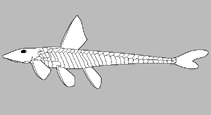
Rückenflossenweichstrahlen (insgesamt) : 8; Afterflossenweichstrahlen: 5; Wirbelzahl: 26. This species is distinguished from all species of Spectracanthicus by its color pattern consisting of a dark gray body, without dots or spots, and by having very slender teeth (vs. with small to mid-sized yellowish dots in S. punctatissimus, S. murinus, and S. tocantinensis; and large white spots in S. zuanoni. This can be further differentiated from S. punctatissimus and S. zuanoni by having pointed snout in dorsal view (vs. snout rounded). Additional characters useful to separate this species from other congeners include the following: nasal quadrangular (vs. nasal L-shaped); posterior margin of pterotic-supracleithrum without contact with posterior margin of orbit (vs. with large contact with orbit in S. murinus and small contact in remaining species); cartilage area of basipterygia short (vs. elongate in remaining species, except in S. murinus); anterior fenestrae of cartilage area of basipterygia large in size (vs. small to median size in remaining species, except in S. tocantinensis) (Ref. 95496).
Body shape (shape guide): fusiform / normal.
Life cycle and mating behavior
Geschlechtsreife | Fortpflanzung | Ablaichen | Eier | Fecundity | Larven
Chamon, C.C. and L.H. Rapp Py-Daniel, 2014. Taxonomic revision of Spectracanthicus Nijssen & Isbrücker (Loricariidae: Hypostominae: Ancistrini), with description of three new species. Neotrop. Ichthyol. 12(1):1-25. (Ref. 95496)
IUCN Rote Liste Status (Ref. 130435: Version 2025-1)
Bedrohung für Menschen
Harmless
Nutzung durch Menschen
Fischereien: kommerziell; Aquarium: Kommerziell
Tools
Zusatzinformationen
Download XML
Internet Quellen
Estimates based on models
Phylogenetic diversity index (Ref.
82804): PD
50 = 0.5312 [Uniqueness, from 0.5 = low to 2.0 = high].
Bayesian length-weight: a=0.01096 (0.00500 - 0.02405), b=3.04 (2.84 - 3.24), in cm total length, based on LWR estimates for this (Sub)family-body shape (Ref.
93245).
Widerstandsfähigkeit (Ref.
120179): hoch, Verdopplung der Population dauert weniger als 15 Monate. (Preliminary K or Fecundity.).
Fishing Vulnerability (Ref.
59153): Low vulnerability (10 of 100).
🛈