This website uses cookies to enhance your browsing experience and ensure the functionality of our site. For more detailed information about the types of cookies we use and how we protect your privacy, please visit our Privacy Information page.
×
Cookie Settings
This website uses different types of cookies to enhance your experience. Please select your preferences below:
Clasificación / Nombres Nombres comunes | Sinónimos | Catalog of Fishes(Género, Especie) | ITIS | CoL | WoRMS | Cloffa
> Gymnotiformes (Knifefishes) > Hypopomidae (Bluntnose knifefishes)
Etymology: Brachyhypopomus:Greek, brachys, eia = short + Greek, hypo = under + Greek, poma, -atos = cover (Ref. 45335); walteri:Named for Walter Heiligenberg in honor of his discoveries in electric fish neurophysiology and behavior made at the Scripps Institute of Oceanography.
Institute of Oceanography. Eponymy: Dr Walter F Heiligenberg (1938–1994) was an ethologist who was (1976–1994) Professor of Behavioural Physiology, Scripps Institute of Oceanography, University of California, San Diego, having joined earlier (1973). [...] (Ref. 128868), visit book page.
Entorno: milieu / zona climática / rango de profundidad / gama de distribución Ecología
Madurez: Lm? range ? - ? cm Max length : 17.5 cm TL macho / no sexado; (Ref. 94132)
Descripción breve Claves de identificación | Morfología | Morfometría
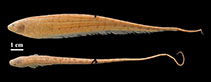
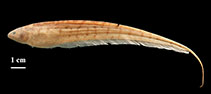
This species can be distinguished by having the following combination of characters: distinct patch of brown pigment below skin at base of orbit; body yellow and semi-translucent in living specimens; caudal filament long and fine, greater than 20% of LEA (length from the tip of the
snout to the posterior end of the anal-fin base) in intact specimens; electric discharge organ (EOD ) pulse duration very long (between 3.5 and 4 milliseconds at 25° C) with head-positive first phase of longer duration than second head-negative phase in both sexes (Ref. 94132). Body shape (shape guide): elongated.
Facultative air-breathing in the genus (Ref. 126274); Usually found in floating meadow habitats, composed mostly of the grass Paspalum repens, Poaceae. Occurs mainly in white water, but also in areas near the confluence of black water rivers with the Amazonas/Solimões ranging from low to medium conductivity. Syntopic with the species of Eigenmannia, Gymnotus, the apteronotid Parapteronotus hasemani and the electric eel Electrophorus electricus in the floating meadow habitats (Ref. 94132).
Ciclo vital y comportamiento de apareamiento Madurez | Reproducción | Puesta | Huevos | Fecundidad | Larva
Sullivan, J.P., J. Zuanon and C. Cox Fernandes, 2013. Two new species and new subgenus of toothed Brachyhypopomus electric knifefishes (Gymnotiformes, Hypopomidae) from the central Amazon and considerations pertaining to the evolution of a monophasic electric organ discharge. Zookeys 327:1-34. (Ref. 94132)
Situación en la Lista Roja de la UICN (Ref. 130435: Version 2025-2 (Global))
Ecología Trófica Alimentos (presas) Composición de la dieta consumo de alimento Raciones de comida Despredadores
Ecología Ecología
Dinámica de la población Coeficiente del crecimiento para Edades / tallas máximas Longitud-peso rel. Longitud-longitud rel. Longitud-frecuencias Conversión de masas Reclutamiento Abundancia
Ciclo de vida Reproducción Madurez Madurez/Gills rel. Fecundidad Puesta Agregaciones de desove Huevos Desarrollo de los huevos Larva Dinámica larvaria
Fisiología Composición corporal Nutrientes Consumo del oxígeno Tipo de natación Velocidad de natación Pigmentos visuales Sonido de peces Enfermedades y parásitos Toxicidad (CL50)
Índice de diversidad filogenética (Referencia 82804): PD50 = 0.5000 [Uniqueness, from 0.5 = low to 2.0 = high].
Bayesian length-weight: a=0.00372 (0.00141 - 0.00980), b=3.06 (2.83 - 3.29), in cm total length, based on LWR estimates for this (Sub)family-body shape (Ref. 93245).
Nivel trófico (Referencia 69278): 3.1 ±0.4 se; based on size and trophs of closest relatives
Vulnerabilidad pesquera (Ref. 59153): Low vulnerability (10 of 100). 🛈