>
Gobiiformes (Gobies) >
Gobiidae (Gobies) > Gobiinae
Etymology: Gobiodon: Latin, gobius = gudgeon + Greek, odous = teeth (Ref. 45335); aoyagii: Named for Hyoji Aoyagi (1912-1971), a Japanese ichthyologist.
Eponymy: Dr Hyoji Aoyagi (1912–1971) was a Japanese ichthyologist. [...] (Ref. 128868), visit book page.
Environment: milieu / climate zone / пределы глубины / distribution range
экология
морской донно-пелагический; пределы глубины 2 - 10 m (Ref. 94251). Subtropical
Western Pacific: Japan to Australia, including the Philippines, East Indies (Cocos Is. Or Indonesia) and Papua New Guinea.
Size / Вес / Возраст
половая зрелость: Lm ? range ? - ? cm
Max length : 3.5 cm SL самец/пол неопределен; (Ref. 94251)
Краткое описание
определительные ключи | морфология | морфометрия
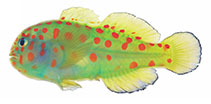
колючие лучи спинного плавника (общее число) : 7; членистые (мягкие) лучи спинного плавника (общее число) : 9 - 11; колючие лучи анального плавника: 1; членистые (мягкие) лучи анального плавника: 8 - 9; позвонки: 25 - 27. This species is distinguished by the following characters: many reddish spots/stripes on a yellow-green or sky-blue body; when alive or freshly-collected, it differs from similar reddish-spotted/lined congeners, G. erythrospilus and G. histrio, by having the following unique coloration: 2 reddish circular spots (rather than linear spots) on pectoral-fin base (vs. reddish markings on pectoral-fin base usually forming vertical bars in G. erythrospilus and G. histrio, except for small specimens of the former with discontinuous bars); reddish spots on ventral surface of head (vs. none); reddish crescent-like bar along bases of pectoral fin rays absent (vs. present); in in alcohol-preserved specimens, all reddish spots are largely or entirely faded, but this species can be readily identified by having its unique squamation, i.e., 3-4 rows of weakly ctenoid and/or cycloid scales on caudal peduncle (vs. no scales or a single row of minute cycloid scales on caudal peduncle in the congeners); with a deep, inflected interopercular-isthmus groove; unsegmented caudal-fin rays, upper with 5-6, lower with 4-6; no distinct dusky spot at dorsoposterior corner of operculum (Ref. 94251).
Body shape (shape guide): short and / or deep; Cross section: oval.
Facultative air-breathing in the genus (Ref. 126274); Observed in protected bays and reef edges and slopes of Japan, in the interstices among branches of corals of the genus Acropora. In Papua New Guinea and the Great Barrier Reef, it is reported to almost totally be confined to Acropora tenuis (Ref. 94251).
Life cycle and mating behavior
половая зрелость | размножение | нерест | икра | Fecundity | личинки
Shibukawa, K., Suzuki, T. and M. Aizawa, 2013. Gobiodon aoyagii, a new coral goby (Actinopterygii, Gobiidae, Gobiinae) from the West Pacific, with redescription of a similarly colored Congener Gobiodon erythrospilus Bleeker, 1875. Bull. Nat. Mus. Nat. Sci. 39(3):143-165. (Ref. 94251)
Статус Красного Списка МСОП (Ref. 130435: Version 2025-1)
Угроза для людей
Harmless
Использование человеком
дополнительная информация
инструменты
Специальные отчеты
Скачать в формате XML
ресурсы в Интернет
Estimates based on models
Preferred temperature (ссылка
123201): 24.9 - 29.3, mean 28.6 °C (based on 1154 cells).
Phylogenetic diversity index (ссылка
82804): PD
50 = 0.5000 [Uniqueness, from 0.5 = low to 2.0 = high].
Bayesian length-weight: a=0.01995 (0.00906 - 0.04395), b=3.01 (2.83 - 3.19), in cm total length, based on all LWR estimates for this body shape (Ref.
93245).
Trophic level (ссылка
69278): 3.3 ±0.4 se; based on size and trophs of closest relatives
устойчивость к внешним воздействиям (ссылка
120179): высокий, минимальное время удвоения популяции до 15 месяцев (Preliminary K or Fecundity.).
Fishing Vulnerability (Ref.
59153): Low vulnerability (10 of 100).
🛈