



Hassar shewellkeimi Sabaj Pérez & Birindelli, 2013
Hochladen Photos und videos
Bilder | Google Bild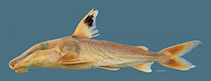 Hassar shewellkeimi
Photo von Sabaj Pérez, M.H.
Bilder | Google Bild
Photo von Sabaj Pérez, M.H.
Klassifizierung / Names Namen | Synonyme | Catalog of Fishes(Gattung, Arten) | ITIS | CoL | WoRMS | Cloffa
> Siluriformes (Catfishes) > Doradidae (Thorny catfishes) > Doradinae
Etymology: Hassar: Origin of the name was not specified by the author, but it is possible that it refers to the name commonly applied to certain catfishes in Guyana, such as Hoplosternum littorale or Hypostomus watawata; shewellkeimi: Named for Mr. Shewell 'Bud' DeBenneville Keim, a nephew of Henry W. Fowler, who was the first full-time curator of fishes at the Academyof Natural Sciences from 1902-1965, for his generous support to Academy ichthyology, including the preservation of Fowler's legacy and the stewardships of his uncle's fishes.
Eponymy: Shewell ‘Bud’ DeBenneville Keim (1918–2014), after serving in the US Army in WW2, graduated as an electrical engineer (1949) and spent his working life as an electronics engineer in the US Defense Department. [...] (Ref. 128868), visit book page.
Etymology: Hassar: Origin of the name was not specified by the author, but it is possible that it refers to the name commonly applied to certain catfishes in Guyana, such as Hoplosternum littorale or Hypostomus watawata; shewellkeimi: Named for Mr. Shewell 'Bud' DeBenneville Keim, a nephew of Henry W. Fowler, who was the first full-time curator of fishes at the Academyof Natural Sciences from 1902-1965, for his generous support to Academy ichthyology, including the preservation of Fowler's legacy and the stewardships of his uncle's fishes.
Eponymy: Shewell ‘Bud’ DeBenneville Keim (1918–2014), after serving in the US Army in WW2, graduated as an electrical engineer (1949) and spent his working life as an electronics engineer in the US Defense Department. [...] (Ref. 128868), visit book page.
Umwelt: Milieu / Klimazone / Tiefenbereich / Verbreitungsgebiet Ökologie
; süßwasser demersal. Tropical
Verbreitung Territorien | FAO Gebiete | Ökosysteme | Vorkommen | Punkt Karte | Einführungen | Faunafri
South America: rio Teles Pires and one or more sites in the upper rio Juruena in Brazil.
Größe / Gewicht / Alter
Kurzbeschreibung Bestimmungsschlüssel | Morphologie | Morphometrie
Rückenflossenstacheln (insgesamt) : 2; Rückenflossenweichstrahlen (insgesamt) : 6; Afterflossenweichstrahlen: 12 - 15. This species differs from other species of Hassar by its relatively narrow interorbital and long snout, interorbital width 32.2-44.7% distance from snout tip to anterior naris (vs. 45.0-89.4%). It is most similar to H. orestis, but it can be further separated from that species by having gas bladder with few, weakly developed peripheral diverticula restricted to anterolateral shoulder and posterolateral face of anterior chamber, and sometimes anterolateral face of posterior chamber (vs. well developed diverticula with multiple branches and grouped into fascicles encircling horizontal periphery of gas bladder in H. orestis), and posterior face of gas bladder smooth, broadly to narrowly rounded (vs. posterior chambers expanded posteriorly into medially conjoined ternimal diverticula, effecting acutely subtriangular, cone-shaped posterior face). This species also differs from H. affinis and H. gabiru by its snout, distance snout tip to anterior naris 9.5-12% SL (vs. 6.9-9.7% SL), interorbital width 3.4-4.8% SL and 9.8-14.7% HL (5.9-8.0% SL and 17.3-24.3% HL), and caudal peduncle depth 4.8-5.6% SL (vs. 6.6-8.0% SL). It is diagnosed from all congeners except H. orestis by the distal half of soft dorsal fin consisting of distinct dark subtriangular blotch not extending to distal margin, pale margin complete, its width approaching that of blotch (vs. distal half of soft dorsal dfn dusky to margin in H. affinis; or with dark blotch leaving narrow pale distal margin, width less than half that of dark blotch, in H. gabiru, H. wilderi and sometimes H. orestis) (Ref. 93284).
Body shape (shape guide): elongated.
Body shape (shape guide): elongated.
Lebenszyklus und Paarungsverhalten Geschlechtsreife | Fortpflanzung | Ablaichen | Eier | Fruchtbarkeit | Larven
Hauptreferenz
Laden Sie Ihre Referenzen hoch | Referenzen | Koordinator : Ferraris, Jr., Carl J. | Partner
Sabaj Pérez, M.H. and J.L.O. Birindelli, 2013. Hassar shewellkeimi, a new species of thorny catfish (Siluriformes: Doradidae) from the upper Tapajós basin, Brazil. Proc. Acad. Nat. Sci. Philadelphia 162:133-156. (Ref. 93284)
IUCN Rote Liste Status (Ref. 130435: Version 2025-2 (Global))
Verwundbar (VU) (B1ab(iii)+2ab(iii)); Date assessed: 21 July 2020
CITES
Not Evaluated
Bedrohung für Menschen
Harmless
Nutzung durch Menschen
FAO - Publication: search | FishSource |
Mehr Information
Trophische Ökologie
Lebensmittel (Beutetiere)
Nahrungszusammensetzung
Nahrungsaufnahme
Lebensmittelrationen
Räuber
Lebensmittel (Beutetiere)
Nahrungszusammensetzung
Nahrungsaufnahme
Lebensmittelrationen
Räuber
Ökologie
Ökologie
Ökologie
Populationsdynamik
Wachstumsparameter
Max. Alter/Größen
Länge-Gewicht-Rel.
Länge-Länge-Verhältnis.
Längenhäufigkeiten
Massenkonvertierung
Rekrutierung
Dichte
Wachstumsparameter
Max. Alter/Größen
Länge-Gewicht-Rel.
Länge-Länge-Verhältnis.
Längenhäufigkeiten
Massenkonvertierung
Rekrutierung
Dichte
Lebenszyklus
Fortpflanzung
Geschlechtsreife
Reifung/Kiemen rel.
Fruchtbarkeit
Ablaichen
Laichaggregationen
Eier
Eientwicklung
Larven
Larven Pop.Dyn.
Fortpflanzung
Geschlechtsreife
Reifung/Kiemen rel.
Fruchtbarkeit
Ablaichen
Laichaggregationen
Eier
Eientwicklung
Larven
Larven Pop.Dyn.
Anatomie
Kiemenoberfläche
Gehirn
Otolith
Kiemenoberfläche
Gehirn
Otolith
Physiologie
Körperliche Zusammensetzung
Nährstoffe
Sauerstoffverbrauch
Schwimmart
Schwimmgeschwindigkeit
Visuelle Pigmente
Fischgeräusche
Krankheiten und Parasiten
Toxizität (LC50s)
Körperliche Zusammensetzung
Nährstoffe
Sauerstoffverbrauch
Schwimmart
Schwimmgeschwindigkeit
Visuelle Pigmente
Fischgeräusche
Krankheiten und Parasiten
Toxizität (LC50s)
Genetik
Genom
Genetik
Heterozygotie
Vererbbarkeit
Genetische Vielfalt
Genom
Genetik
Heterozygotie
Vererbbarkeit
Genetische Vielfalt
Menschenbezogen
Aquakultur-Systeme
Aquakultur Profile
Zuchtlinien
Ciguatera-Fälle
Briefmarken, Münzen, Verschiedenes.
Aquakultur-Systeme
Aquakultur Profile
Zuchtlinien
Ciguatera-Fälle
Briefmarken, Münzen, Verschiedenes.
Tools
Zusatzinformationen
Download XML
Zusammenfassung | Punktdaten | Namen | Photos
Internet Quellen
AFORO (otoliths) | Aquatic Commons | BHL | Cloffa | Websites from users | FishWatcher Einträge suchen | CISTI | Catalog of Fishes: Gattung, Arten | DiscoverLife | ECOTOX | FAO - Publication: search | Faunafri | Fishipedia | Fishtrace | GloBI | Google Books | Google Scholar | Google | IGFA World Record | OneZoom | Open Tree of Life | Otolith Atlas of Taiwan Fishes | PubMed | Reef Life Survey | Socotra Atlas | TreeBase | Tree of Life | Wikipedia: Gehe zu, Suchen | World Records Freshwater Fishing | Zoobank | Zoologischer Rekord
Schätzungen auf der Grundlage von Modellen
Phylogenetischer Diversitätsindex (Ref. 82804): PD50 = 0.5312 [Uniqueness, from 0.5 = low to 2.0 = high].
Bayesian length-weight: a=0.01230 (0.00587 - 0.02579), b=2.96 (2.78 - 3.14), in cm total length, based on LWR estimates for this (Sub)family-body shape (Ref. 93245).
Trophische Ebene (Ref. 69278): 2.8 ±0.4 se; based on size and trophs of closest relatives
Widerstandsfähigkeit (Ref. 120179): hoch, Verdopplung der Population dauert weniger als 15 Monate. (Preliminary K or Fecundity.).