Classification / Names
Noms communs | Synonymes | Catalog of Fishes(Genre, Espèce) | ITIS | CoL | WoRMS | Cloffa
Issue
This species may be a synonym of L. richardsoni, the lower number of trunk myomeres in the former reflecting a latidutinal cline. This requires further investigation.
Environment: milieu / climate zone / profondeur / distribution range
Écologie
; eau douce démersal; non migrateur. Temperate
North America: USA, restricted to Columbia River drainage, Oregon,
Taille / Poids / Âge
Maturité: Lm ? range ? - ? cm
Max length : 17.5 cm TL mâle / non sexé; (Ref. 89241); common length : 12.5 cm TL mâle / non sexé; (Ref. 12193)
Description synthétique
Clés d'identification | Morphologie | Morphométrie
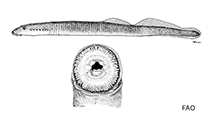
Adults: 9.8-17.5 cm TL. Body proportions, as percentage of TL (based on 39 specimens measuring 9.8-17.3 cm TL): prebranchial length, 8.9-12.8; branchial length, 8.9-11.3; trunk length, 44.7-53.5; tail length, 24.3-35.0; eye length, 1.4-3.0; disc length, 4.1-7.2. Urogenital papilla length, as a percentage of branchial length, in ten spawning males measuring 11.2-13.3 cm TL, 17.8-36.4. Trunk myomeres, 53-58. Dentition: supraoral lamina, 2 unicuspid teeth; infraoral lamina, 6-9 unicuspid teeth, usually 8; usually 3 endolaterals on each side, occasionally 2 on one side; endolateral formulae highly variable with the first two teeth 1-3 and the third 1-2; 1-2 rows of anterials; first row of anterials, 6 unicuspid teeth (in spawning specimens, the teeth in the anterior field may be lost); exolaterals absent; posterials absent; transverse lingual lamina, undetermined number of minute unicuspid teeth on either side of an enlarged median one; longitudinal lingual laminae cusps too small to count. Velar tentacles, 3-6, with tubercles. Body coloration (preserved), dark gray on dorsal and lateral aspects, whitish on ventral aspect. Lateral line neuromasts unpigmented. Extent of caudal fin pigmentation, 1% to <25% (in prespawning individuals) or, 75% or more (in spawning individuals). Fleshy tissues around the lingual laminae darkly pigmented. Caudal fin shape, rounded. Oral fimbriae, 83 (holotype).
Body shape (shape guide): eel-like.
Freshwater; creeks and rivers. Metamorphosis occurs in October in Oregon and California.
Adults nonparasitic. Based on the dates of collection of spawning individuals in the original description, the spawning period probably occurs between mid-April and August in Oregon, while in California spawning probably occurs between the end of April and the beginning of May (Ref. 89241).
Life cycle and mating behavior
Maturité | Reproduction | Frai | Œufs | Fécondité | Larves
Renaud, C.B., 2011. Lampreys of the world. An annotated and illustrated catalogue of lamprey species known to date. FAO Species Catalogue for Fishery Purposes. No. 5. Rome, FAO. 109 pp. (Ref. 89241)
Statut dans la liste rouge de l'IUCN (Ref. 130435: Version 2025-1)
Menace pour l'homme
Harmless
Utilisations par l'homme
Outils
Articles particuliers
Télécharger en XML
Sources Internet
Estimates based on models
Phylogenetic diversity index (Réf.
82804): PD
50 = 0.6250 [Uniqueness, from 0.5 = low to 2.0 = high].
Bayesian length-weight: a=0.00138 (0.00062 - 0.00310), b=2.97 (2.78 - 3.16), in cm total length, based on LWR estimates for this (Sub)family-body shape (Ref.
93245).
Niveau trophique (Réf.
69278): 3.8 ±0.8 se; based on size and trophs of closest relatives
Résilience (Réf.
120179): Faible, temps minimum de doublement de population : 4,5 à 14 années (Semelparous species, assuming tm (= tmax) > 4).
Fishing Vulnerability (Ref.
59153): Low vulnerability (10 of 100).
🛈