klasifikasi / Names
Nama-nama umum | Sinonim (persamaan) | Catalog of Fishes(Marga, Jenis) | ITIS | CoL | WoRMS | Cloffa
>
Siluriformes (Catfishes) >
Loricariidae (Armored catfishes) > Hypoptopomatinae
Etymology: Pareiorhaphis: Greek, pareia = jaw + Greek, rhaphis = needle (Ref. 45335); proskynita: The specific name is from the Greek proskynitís (Proskungtg´z), which means ‘‘pilgrim,’’ in allusion
to the pilgrimage activity associated with The Santuário do Caraça (‘‘Caraça’s Sanctuary’’).
Environment: milieu / climate zone / kisaran kedalaman / distribution range
Ekologi
; air tawar dasar (demersal); pH range: 4.5 - 5.5. Tropical
South America: upper portion of the Ribeirão Caraça, tributary to Rio Piracicaba in Brazil.
Size / Weight / umur
Kematangan: Lm ? range ? - ? cm
Max length : 9.6 cm SL jantan/; (Ref. 91754)
deskripsi pendek
Kunci identifiaksi (pengenalan) | Morfologi | Morfometrik
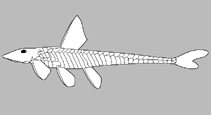
duri punggung lunak (Keseluruhan (total)) : 8; Sirip dubur lunak: 6. Distinguished from all congeners by its unique color pattern consisting of large and conspicuous dark brown blotches irregularly scattered over a yellowish tan background on head, along the dorsal surface of body and flanks, and shallow depression at posterior unpaired plates covering the area otherwise occupied by the adipose fin. Differs from all congeners except Pareiorhaphis nudulus, P. eurycephalus, and P. vestigipinnis by the usual absence of the adipose fin; and from P. nudulus, P. eurycephalus, and P. vestigipinnis by having a shorter pectoral-fin spine 13.9-18.4% SL (vs. 19.3-24.2, 20.0-24.7, and 18.2-21.4% SL, respectively) (Ref. 91754).
Facultative air-breathing in the genus (Ref. 126274); Occurs in tributaries of the upper Ribeirão Caraça as well as in the main course of Ribeirão Caraça. These tributaries are blackwater rivers with translucent and fast flowing water and bottom consisting of very large rocks sparsely covered by iron-ore pebbles and gravel. These rocks are covered by a thin layer of periphyton and green algae. Found in medium-sized streams, relatively shallow (0.5 to 1.5 m deep). Small specimens and juveniles were collected in stretches of relative-slow water currents, associated with loose stones and pebbles deposits. Food items found in the guts of 2 specimens (3.91-8.26 cm SL) were mainly filamentous algae. Collected together with Oligosarcus sp. and Hoplias cf. malabaricus in stretches of slow-water pools (Ref. 91754).
Life cycle and mating behavior
Kematangan | Reproduksi, perkembang biakan | Pemijahan | telur-telur | Fecundity | Larva
Pereira, E.H.L. and M.R. Britto, 2012. A new distinctively colored catfish of the genus Pareiorhaphis (Siluriformes: Loricariidae) from the Rio Piracicaba, Upper Rio Doce Basin, Brazil. Copeia 2012(3):519-526. (Ref. 91754)
Status IUCN Red List (Ref. 130435: Version 2025-1)
ancaman kepada manusia
Harmless
penggunaan manusia
Alat, peralatan
laporan khas
muat turun XML
Sumber internet
Estimates based on models
Phylogenetic diversity index (Acuan
82804): PD
50 = 0.5000 [Uniqueness, from 0.5 = low to 2.0 = high].
Bayesian length-weight: a=0.02138 (0.00778 - 0.05875), b=2.93 (2.70 - 3.16), in cm total length, based on LWR estimates for this (Sub)family-body shape (Ref.
93245).
Daya lenting (Acuan
120179): Tinggi, Waktu penggandaan populasi minimum kurang dari 15 bulan (Preliminary K or Fecundity.).
Fishing Vulnerability (Ref.
59153): Low vulnerability (10 of 100).
🛈