>
Gobiiformes (Gobies) >
Gobiidae (Gobies) > Gobiinae
Etymology: Gobiodon: Latin, gobius = gudgeon + Greek, odous = teeth (Ref. 45335); fuscoruber: Named for its uniformly reddish-brown life colouration; name from Latin words 'fuscus' for brown and 'rubrum' for red; typical colouration throughout its distribution despite its geographic colour variants.
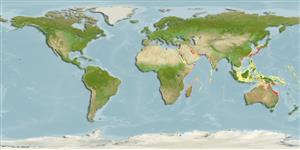
Environment: milieu / Zona climática / intervalo de profundidade / distribution range
Ecologia
marinhas associadas(os) a recifes. Tropical
Indo-West Pacific: Red Sea to Japan and Australia (GBR).
Tamanho / Peso / Idade
Maturidade: Lm ? range ? - ? cm
Max length : 3.7 cm SL macho/indeterminado; (Ref. 94082)
Descrição suscinta
Chaves de identificação | Morfologia | Morfometria
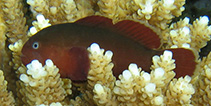
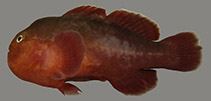
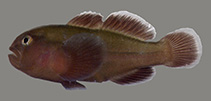
Espinhos dorsais (total) : 7; Raios dorsais (total) : 10; Espinhos anais: 1; Raios anais : 8; Vértebras: 26. This species is distinguished by the following characters: D Vi+I,0; A I,8; both head and body naked; distinct groove between isthmus and interopercle; deep body (the depth at pelvic-fin origin 40.4-44.3 % SL) and strongly compressed; juveniles with rounded head, large adults with steep profile, slightly hump-headed; caudal peduncle relatively slender (depth 14.8-16.0% SL); colour of juveniles and adults dark reddish brown with greenish subcutaneous gleam on dorsal part of body; median fins plain (western Pacific Oceans) or with pale margin (Red Sea and Indian Ocean); iris plain light blue (Red Sea) or scattered with red-brown dots on the outer margin (Ref. 94082).
Body shape (shape guide): short and / or deep; Cross section: compressed.
Facultative air-breathing in the genus (Ref. 126274); Occurs on reef flats, crests and upper reef slopes in less exposed areas; and prefers Acropora selago, but also occurs in a number of other, narrowly branched Acropora species such as A. acuminata and A. hyacinthus (Ref. 94082).
Ciclo de vida ou comportamento de acasalamento
Maturidade | Reprodução | Desova | Ovos | Fecundidade | Larvas
Herler, J., S.V. Bogorodsky and T. Suzuki, 2013. Four new species of coral gobies (Teleostei: Gobiidae: Gobiodon), with comments on their relationships within the genus. Zootaxa 3709(4):301-329. (Ref. 94082)
Status na Lista Vermelha da UICN (Ref. 130435: Version 2025-1)
Ameaça para os humanos
Harmless
Uso pelos humanos
Ferramentas
Relatórios especiais
Baixar XML
Fontes da internet
Estimates based on models
Preferred temperature (Ref.
123201): 21.8 - 27.7, mean 26.2 °C (based on 807 cells).
Índice de diversidade filogenética (Ref.
82804): PD
50 = 0.5000 [Uniqueness, from 0.5 = low to 2.0 = high].
Bayesian length-weight: a=0.01995 (0.00906 - 0.04395), b=3.01 (2.83 - 3.19), in cm total length, based on all LWR estimates for this body shape (Ref.
93245).
Nível Trófico (Ref.
69278): 3.4 ±0.4 se; based on size and trophs of closest relatives
Resiliência (Ref.
120179): Elevada, tempo mínimo de duplicação da população menor que 15 meses (Preliminary K or Fecundity.).
Fishing Vulnerability (Ref.
59153): Low vulnerability (10 of 100).
🛈