This website uses cookies to enhance your browsing experience and ensure the functionality of our site. For more detailed information about the types of cookies we use and how we protect your privacy, please visit our Privacy Information page.
×
Cookie Settings
This website uses different types of cookies to enhance your experience. Please select your preferences below:
> Gobiiformes (Gobies) > Gobiidae (Gobies) > Gobiinae
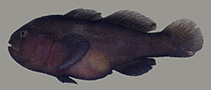
Etymology: Gobiodon:Latin, gobius = gudgeon + Greek, odous = teeth (Ref. 45335); ater:Named for its uniformly black life colouration, including the eye; from the Latin words 'ater' for black.
Ambiente: milieu / zona climática / intervalo de profundidade / gama de distribuição Ecologia
Maturidade: Lm? range ? - ? cm Max length : 2.7 cm SL macho/indeterminado; (Ref. 94082)
Descrição breve Chaves de identificação | Morfologia | Morfometria
Espinhos dorsais (total) : 7; Raios dorsais moles (total) : 10; Espinhos anais: 1; Raios anais moles: 8. This species is distinguished by the following characters: D VI+I,10; A I,8; head and body are naked; presence of a deep curved groove on isthmus; body and caudal peduncle slender (depth 37-41.2% and 13.8-14.7% SL, respectively); juveniles with rounded head, large adults slightly hump-headed; colour in juveniles and adults uniformly black, including iris; very small species (< 2.8 cm SL); females of breeding pairs usually significantly larger than males, recorded smallest highly gravid female is 1.85 cm SL (Ref. 94082). Body shape (shape guide): short and / or deep; Cross section: compressed.
Facultative air-breathing in the genus (Ref. 126274); This species is found in shallow water regions such as protected reef flats and reef crests. It is highly specialized and prefers fine-branched corals such as Acropora selago and small tabulate colonies of Acropora hyacinthus. Seldom occurs in other Acropora species, such as A. acuminata, A. samoensis, A. eurystoma and A. valida. Due to its black colouration it is sometimes difficult to detect within the dark interstices of narrow-branched Acropora colonies (Ref. 94082).
Ciclo de vida e comportamento de acasalamento Maturidade | Reprodução | Desova | Ovos | Fecundidade | Larvas
Herler, J., S.V. Bogorodsky and T. Suzuki, 2013. Four new species of coral gobies (Teleostei: Gobiidae: Gobiodon), with comments on their relationships within the genus. Zootaxa 3709(4):301-329. (Ref. 94082)
Categoria na Lista Vermelha da IUCN (Ref. 130435: Version 2025-2 (Global))
Ecologia Trófica Produtos alimentares (presas) Composição da dieta Consumo alimentar Rações alimentares Predadores
Ecologia Ecologia
Dinâmica das populações Parâmetros de crescimento Idades / tamanhos máximos Comprimento-peso rel. Comprimento-comprimento rel. Frequência de comprimento Conversão de massa Recrutamento Abundância
Ciclo de vida Reprodução Maturidade Maturidade/Rel. das guelras Fecundidade Desova Agregações de desova Ovos Desenvolvimento dos ovos Larvas Dinâmica larvar
Fisiologia Composição corporal Nutrientes Consumo de oxigénio Tipo de natação Velocidade de natação Pigmentos visuais Som de peixe Doenças e Parasitas Toxicidade (LC50s)
Temperatura preferida (Ref. 123201): 24.9 - 27.2, mean 26.7 °C (based on 18 cells).
Índice de diversidade filogenética (Ref. 82804): PD50 = 0.5000 [Uniqueness, from 0.5 = low to 2.0 = high].
Bayesian length-weight: a=0.01995 (0.00906 - 0.04395), b=3.01 (2.83 - 3.19), in cm total length, based on all LWR estimates for this body shape (Ref. 93245).
Nível Trófico (Ref. 69278): 3.2 ±0.4 se; based on size and trophs of closest relatives
Resiliência (Ref. 120179): Elevada, tempo mínimo de duplicação da população menor que 15 meses (Preliminary K or Fecundity.).
Vulnerabilidade da pesca (Ref. 59153): Low vulnerability (10 of 100). 🛈