



Nannoperca pygmaea Morgan, Beatty & Adams, 2013
Little Pygmy Perch
Envoyez vos Photos et vidéos
Images Google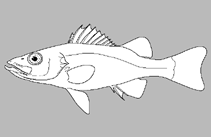 No image available for this species;
drawing shows typical species in Percichthyidae.
Images Google
drawing shows typical species in Percichthyidae.
Classification / Noms Noms communs | Synonymes | Catalog of Fishes(Genre, Espèce) | ITIS | CoL | WoRMS | Cloffa
> Centrarchiformes (Basses) > Percichthyidae (Temperate perches) > Percichthyinae
Etymology: Nannoperca: Latin, nannus = small + Greek, perke = perch (Ref. 45335); pygmaea: The specific epithet is the feminised form of the Latin noun 'pygmaeus' meaning 'dwarf', referring to it being the smallest of the pygmy perches; noun in apposition. applied as a noun in apposition, and in Common name Little Pygmy Perch applied in recognition of the relative small size.
Etymology: Nannoperca: Latin, nannus = small + Greek, perke = perch (Ref. 45335); pygmaea: The specific epithet is the feminised form of the Latin noun 'pygmaeus' meaning 'dwarf', referring to it being the smallest of the pygmy perches; noun in apposition. applied as a noun in apposition, and in Common name Little Pygmy Perch applied in recognition of the relative small size.
Environnement : milieu / zone climatique / profondeur / gamme de distribution Écologie
; eau douce; saumâtre benthopélagique. Subtropical; 34°S - 35°S, 117°E - 118°E (Ref. 93277)
Distribution Territoires | Zones FAO | Écosystèmes | Occurrences | Carte par point | Introductions | Faunafri
Oceania: Western Australia. The rarity of the species and restricted range requires urgent protection at the state and federal level.
Taille / Poids / Âge
Description synthétique Clés d'identification | Morphologie | Morphométrie
Épines dorsales (Total) : 7 - 9; Rayons mous dorsaux (Total) : 8; Épines anales: 3; Rayons mous anaux: 6 - 7. This species is distinguished by the following characters: small mouth; deeply notched dorsal fin; poorly developed two-part and interrupted lateral line; differs from N. australis, N. oxleyana and N. variegata in having an exposed and serrated preorbital bone and jaws just reaching to below the anterior margin of the eye (vs. a smooth and hidden preorbital and the jaws reaching to at least the pupil); from N. vittata by having 5-10 thin lateral stripes most obvious below lateral line and poorly developed tube scales (vs. well developed), a more distinct haloed blackish spot resembling an ocellus at the base of the caudal fin, the hind margin of the scales on the caudal peduncle are without distinct pigment, and the belly is without a colour pattern; from N. obscura in having a distinct ocellus at the base of caudal fin (vs. an indistinct barring), as well as a dark spot behind operculum and lack of dusky scale margins; from N. balstoni, in having an exposed rear edge of the preorbital (vs. hidden under the skin), fewer transverse scale rows (13 vs. 15-16), a smaller mouth (rarely reaching eye vs. reaching well beyond the eye), ctenoid body scales (vs. cycloid), generally fewer pectoral rays and a smaller maximum size (Ref. 93277).
Body shape (shape guide): fusiform / normal; Cross section: compressed.
Body shape (shape guide): fusiform / normal; Cross section: compressed.
The species is rare and restricted in its range. Inhabits tannin stained, acidic and shallow Melaleuca rhaphiophylla streams (Ref. 93277).
Cycle de vie et comportement reproducteur Maturité | Reproduction | Frai | Œufs | Fécondité | Larves
Référence principale
Téléchargez vos références | Références | Coordinateur : Arratia, Gloria | Collaborateurs
Morgan, D.L., S.J. Beatty and M. Adams, 2013. Nannoperca pygmaea, a new species of pygmy perch (Teleostei: Percichthyidae). Zootaxa 3637(4):401-411. (Ref. 93277)
Statut dans la liste rouge de l'IUCN (Ref. 130435: Version 2025-2 (Global))
Menacé (EN) (B1ab(i,ii,iii,v)+2ab(i,ii,iii,v)); Date assessed: 09 January 2019
CITES
Not Evaluated
Menace pour l'homme
Harmless
Utilisations par l'homme
FAO - Publication: search | FishSource |
Plus d'informations
Écologie trophique
Aliments (proies)
Composition du régime alimentaire
Consommation alimentaire
Rations alimentaires
Prédateurs
Aliments (proies)
Composition du régime alimentaire
Consommation alimentaire
Rations alimentaires
Prédateurs
Écologie
Écologie
Écologie
Dynamique des populations
Paramètres de croissance
Âges / tailles maximales
Longueur-poids rel.
Rel. longueur-longueur.
Fréquences de longueurs
Conversion de masse
Recrutement
Abondance
Paramètres de croissance
Âges / tailles maximales
Longueur-poids rel.
Rel. longueur-longueur.
Fréquences de longueurs
Conversion de masse
Recrutement
Abondance
Cycle de vie
Reproduction
Maturité
Maturité/épines rel.
Fécondité
Frai
Agrégats de frai
Œufs
Développement de l'œuf
Larves
Dynamique des populations larvaires
Reproduction
Maturité
Maturité/épines rel.
Fécondité
Frai
Agrégats de frai
Œufs
Développement de l'œuf
Larves
Dynamique des populations larvaires
Anatomie
Surface branchiale
Cerveau
Otolithe
Surface branchiale
Cerveau
Otolithe
Physiologie
Composition corporelle
Nutriments
Consommation d'oxygène
Type de natation
Vitesse de nage
Pigments visuels
Son de poisson
Maladies et parasites
Toxicité (CL50)
Composition corporelle
Nutriments
Consommation d'oxygène
Type de natation
Vitesse de nage
Pigments visuels
Son de poisson
Maladies et parasites
Toxicité (CL50)
Génétique
génôme
Génétique
Hétérozygotie
Héritabilité
Diversité génétique
génôme
Génétique
Hétérozygotie
Héritabilité
Diversité génétique
Liées à l'homme
Systèmes d'aquaculture
Profils d'aquaculture
Souches
Cas de ciguatera
Timbres, pièces de monnaie, divers
Systèmes d'aquaculture
Profils d'aquaculture
Souches
Cas de ciguatera
Timbres, pièces de monnaie, divers
Outils
E-book | Guide de terrain | Générateur de fréquences de longueur | Outil de dynamique de population | Carte par point |
Capture-MSY |
Articles particuliers
Télécharger en XML
Sources Internet
AFORO (otoliths) | Aquatic Commons | BHL | Cloffa | Websites from users | FishWatcher | CISTI | Catalog of Fishes: Genre, Espèce | DiscoverLife | ECOTOX | FAO - Publication: search | Faunafri | Fishipedia | Fishtrace | GloBI | Google Books | Google Scholar | Google | IGFA World Record | OneZoom | Open Tree of Life | Otolith Atlas of Taiwan Fishes | PubMed | Reef Life Survey | Socotra Atlas | TreeBase | Arbre de Vie | Wikipedia: aller à, chercher | World Records Freshwater Fishing | Zoobank | Zoological Record
Estimations basées sur des modèles
Indice de diversité phylogénétique (Réf. 82804): PD50 = 0.5156 [Uniqueness, from 0.5 = low to 2.0 = high].
Bayesian length-weight: a=0.01047 (0.00397 - 0.02763), b=3.01 (2.78 - 3.24), in cm total length, based on LWR estimates for this (Sub)family-body shape (Ref. 93245).
Niveau trophique (Réf. 69278): 3.1 ±0.4 se; based on size and trophs of closest relatives
Résilience (Réf. 120179): Haut, temps minimum de doublement de population inférieur à 15 mois (Preliminary K or Fecundity.).