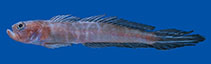
>
Gobiiformes (Gobies) >
Gobiidae (Gobies) > Gobiinae
Etymology: Microgobius: Greek, mikros = small + Latin, gobius = gudgeon (Ref. 45335); urraca: Named after the Smithsonian Tropical Research Institute’s research vessel the Urraca, which served the institute between 1994-2007; noun in apposition.
Eponymy: Not an eponym but named for the Smithsonian Tropical Research Institute’s research vessel ‘Urraca’, which contributed a wealth of information on fish diversity in the tropical Americas (1994–2007) and from which the type was collected (2003). (Ref. 128868), visit book page.
Environment: milieu / climate zone / εύρος βάθους / distribution range
Οικολογία
Θαλασσινό(ά) pelagic-neritic; εύρος βάθους 12 - 20 m (Ref. 91780). Tropical
Eastern Pacific, Panama.
Μέγεθος / Βάρος / Age
Γεννητική Ωρίμανση: Lm ? range ? - ? cm
Max length : 6.9 cm SL αρσενικό/απροσδιόριστο; (Ref. 91780); 6.2 cm SL (female)
Short description
Κλείδες προσδιορισμού | Μορφολογία | Μορφομετρία
Ραχιαίες άκανθες (συνολικά) : 8; Μαλακές ραχιαίες ακτίνες (συνολικά) : 14; Εδρικές άκανθες: 1; Μαλακές εδρικές ακτίνες: 14; Σπόνδυλοι: 27. This species is distinguished from Microgobius urraca in having the following characters: lateral scale rows 67-76; patch of ctenoid scales under the pectoral fin absent; unpigmented epaxial myosepta; first dorsal fin with a distinct oval-shaped dark blotch; three blue-white stripes on a dark caudal fin. It differs from the remaining eastern Pacific congeners in the number and type of scales (pectoral- and pelvic fin base without scales; pre-anal region with small embedded cycloid scales; small scales on anterior and ventral portions of trunk, partially imbedded, and in irregular rows, becoming larger and arranged in distinct rows dorsally and posteriorly; no small patch of ctenoid scales beneath pectoral fin); D1 VII, D2 I,14; A I,14; fleshy dorsal crest poorly developed and overall color pattern (Ref. 91780).
Body shape (shape guide): elongated; Cross section: oval.
Found over sand or sand and leaf litter bottoms; where collections are found in the latter, this species was collected with several specimens of Ptereleotris carinata and M. erectus. Presumed to be a burrowing species (Ref. 91780).
Life cycle and mating behavior
Γεννητική Ωρίμανση | Αναπαραγωγή | Γεννοβολία | Αβγά | Γονιμότητα | Προνύμφες
Tornabene, L., J.L. Van Tassel and D.R. Robertson, 2012. Microgobius urraca (Teleostei: Gobiidae), a new species of goby from the tropical eastern Pacific. Zootaxa 3447:41-55. (Ref. 91780)
IUCN Red List Status (Ref. 130435: Version 2025-1)
Threat to humans
Harmless
Human uses
αλιεία: bycatch
Εργαλεία
Special reports
Download XML
Διαδικτυακές πηγές
Estimates based on models
Phylogenetic diversity index (Αναφ.
82804): PD
50 = 0.5000 [Uniqueness, from 0.5 = low to 2.0 = high].
Bayesian length-weight: a=0.00724 (0.00339 - 0.01546), b=3.10 (2.92 - 3.28), in cm total length, based on LWR estimates for this (Sub)family-body shape (Ref.
93245).
Τροφικό Επίπεδο (Αναφ.
69278): 3.3 ±0.3 se; based on size and trophs of closest relatives
Ελαστικότητα (Αναφ.
120179): Υψηλό, ελάχιστος χρόνος για διπλασιασμό πληθυσμού < 15 μήνες (Preliminary K or Fecundity.).
Fishing Vulnerability (Ref.
59153): Low vulnerability (10 of 100).
🛈