Classificatie / Namen
Lokale namen | Synoniemen | Catalog of Fishes(Genus, Soort(en)) | ITIS | CoL | WoRMS | Cloffa
>
Siluriformes (Catfishes) >
Amphiliidae (Loach catfishes) > Doumeinae
Etymology: howesi: The species name, howesi, is in honor of Gordon J. Howes, formerly of the Natural History Museum, London, in recognition of his many contributions to ichthyology (Ref. 92838).
Eponymy: Dr Gordon John ‘Gordi’ Howes (1938–2013) was an ichthyologist and fish systematist at the BMNH, which he joined as a scientific assistant (1968). [...] (Ref. 128868), visit book page.
Environment: milieu / Klimaatzone / Diepte / distribution range
Ecologie
; zoet water demersaal. Tropical
Africa: Luachimo River and its rapids (Kasai River drainage, middle Congo River basin) in Angola (Ref. 92838).
Grootte / Gewicht / Leeftijd
Maturiteit: Lm ? range ? - ? cm
Max length : 11.3 cm SL mannelijk / geslacht onbekend; (Ref. 92838)
Korte beschrijving
Determinatiesleutels | Morfologie | Morfometrie
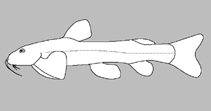
Dorsale stekels (totaal) : 0; Dorsale zachte stralen (totaal) : 8; Anale stekels: 0; Anale zachte stralen: 8 - 10; Wervels: 38 - 39. Congoglanis howesi differs from C. alula in the caudal-peduncle length relative to the caudal-peduncle depth (360%-380% vs. 260%-330%), the head depth (46-57% of head length vs. 38-45%), and the more attenuate head (Ref. 92838). It differs from C. inga in the length of the maxillary barbel, which is extending beyond posterior nostril but falling distinctly short of vertical through anterior margin of orbit vs. extending well beyond anterior margin of orbit, the body width at the dorsal-fin origin (14-16% of standard length vs. 17-20%), the postorbital length (29-32% of head length vs. 32-35%), the caudal peduncle length relative to the caudal-peduncle depth (360-380% vs. 210-290%), the number of vertebrae (38-39 vs. 35-37), and the length of the caudal peduncle, being 20-24% of standard length vs. 16-21% (Ref. 92838). It differs from C. sagitta in the length of the pelvic fin (22-28% of standard length vs. 19-21%), the head width (75-78% of head length vs. 63-73%), the length of the adpressed anal fin, reaching beyond the vertical through the posterior terminus of the adipose fin vs. reaching to or falling short of that vertical, and the length of the pectoral fin, being 26-32% of standard length vs. 23-27% (Ref. 92838).
Body shape (shape guide): elongated.
Found in the rapids of the Luachimo River (Ref. 92838).
Levenscyclus en paargedrag
Maturiteit | Voortplanting | Paaien | Eieren | Fecunditeit | Larven
Vari, R.P., C.J. Ferraris Jr. and P.H. Skelton, 2012. New species of Congoglanis (Siluriformes: Amphiliidae) from the southern Congo River basin. Copeia 2012(4):626-630. (Ref. 92838)
Status op de Rode Lijst van het IUCN (Ref. 130435: Version 2025-1)
Gevaar voor de mens
Harmless
Gebruik door de mens
Tools
Speciale rapporten
Download XML
Internetbronnen
Estimates based on models
Fylogenetische diversiteitsindex (Ref.
82804): PD
50 = 0.5625 [Uniqueness, from 0.5 = low to 2.0 = high].
Bayesian length-weight: a=0.00389 (0.00180 - 0.00842), b=3.12 (2.94 - 3.30), in cm total length, based on all LWR estimates for this body shape (Ref.
93245).
Trofisch niveau (Ref.
69278): 3.1 ±0.4 se; based on size and trophs of closest relatives
Weerstandsvermogen (Ref.
120179): Gemiddeld, minimale populatieverdubbelingstijd 1,4-4,4 jaar (Preliminary K or Fecundity.).
Fishing Vulnerability (Ref.
59153): Low vulnerability (10 of 100).
🛈