



Plesioptopoma curvidens Reis, Pereira & Lehmann A., 2012
Ladda upp din foton och Videor
Google image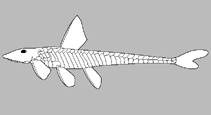 No image available for this species;
drawing shows typical species in Loricariidae.
Google image
drawing shows typical species in Loricariidae.
Klassificering / Namn Populärnamn | synonymer | Catalog of Fishes(Släkte, Arter) | ITIS | CoL | WoRMS | Cloffa
> Siluriformes (Catfishes) > Loricariidae (Armored catfishes) > Hypoptopomatinae
Etymology: curvidens: The specific epithet 'curvidens' is derived from the Latin curvus, meaning curved, bent, and dens, meaning tooth, in allusion to the strongly curved tooth series in both the premaxilla and dentary. A noun in apposition.
More on authors: Reis, Pereira & LehmannA..
Etymology: curvidens: The specific epithet 'curvidens' is derived from the Latin curvus, meaning curved, bent, and dens, meaning tooth, in allusion to the strongly curved tooth series in both the premaxilla and dentary. A noun in apposition.
More on authors: Reis, Pereira & LehmannA..
Miljö: miljö / Klimatzon / djupintervall / distributionsområde Ekologi
; sötvatten bottenlevande. Tropical
Utbredning Territorier | FAO områden | Ekosystem | Förekomster | Prickkarta | Utplanteringar | Faunafri
South America: Known from the type locality, the upper portion of the Rio Paraopeba, a tributary to the upper Rio São Francisco in Minas Gerais, Brazil.
Storlek / Vikt / Ålder
Kort beskrivning Bestämningsnycklar | Morfologi | Morfometri
Taggstrålar i ryggfenan (totalt) : 1; Mjukstrålar i ryggfenan (totalt) : 7; Mjukstrålar i analfenan: 6. Can be diagnosed from non-Hypoptopomatinae loricariids by having the ventral surface of the coracoid with an exposed area supporting a few odontodes laterally, close to the pectoral-fin insertion, and, except from Kronichthys, by having the odontodes on the ventral surface of the pelvic-fin unbranched ray distinctly bent and turned mesially. Differs from all hypoptopomatines, except Parotocinclus prata, by having the premaxilla and dentary tooth series strongly curved mesially, in such a way that the mesial portion of the tooth series in both sides are turned and run parallel to each other vs. tooth series straight or slightly curved). It is also distinguished from the remaining hypoptopomatines, except Pseudotocinclus, by having the caudal peduncle distinctly quadrangular in cross-section (vs. caudal peduncle ovoid in cross-section), and except from Gymnotocinclus by having the anterior margin of the snout devoid of dermal plates (Ref. 90155).
Body shape (shape guide): elongated.
Body shape (shape guide): elongated.
The type locality is a small stream of about 2-4 meters wide and up to 0.5 meters deep with clear water but heavily polluted by organic sewage and with fair amounts of marginal, submerged, and emergent vegetation, and with bottom mostly sandy with patches of gravel and pebbles (Ref. 90155).
Livscykel och parningsbeteende Könsmognad | Reproduktion | Lek | Ägg | Fekunditet | Larver
Huvudreferens
Ladda upp dina referenser | referenser | Koordinator : Fisch-Muller, Sonia | Medarbetare
Reis, R.E., E.H.L. Pereira and P. Lehmann A., 2012. A new genus and species of Hypoptopomatine catfish (Siluriformes: Loricariidae) from the Upper Rio São Francisco Basin, Brazil. Copeia 2012(1):6-11. (Ref. 90155)
Status på IUCN:s rödlista (Ref. 130435: Version 2025-2 (Global))
Critically Endangered (CR) (B2ab(iii)); Date assessed: 07 November 2018
CITES
Not Evaluated
Hot mot människor
Harmless
Mänskliga användningsområden
Fiskeri: saknar intresse
FAO - Publication: search | FishSource |
Ytterligare information
Trofisk ekologi
Livsmedelsartiklar (preys)
Födosammansättning
Födointag
Matransoner
Predatorer
Livsmedelsartiklar (preys)
Födosammansättning
Födointag
Matransoner
Predatorer
Ekologi
Ekologi
Ekologi
Populationsdynamik
Tillväxtparametrar
Max. åldrar / storlekar
Längd-vikt rel.
Längd-längd rel.
Längd-frekvenser
Massakonvertering
Rekrytering
Abundans
Tillväxtparametrar
Max. åldrar / storlekar
Längd-vikt rel.
Längd-längd rel.
Längd-frekvenser
Massakonvertering
Rekrytering
Abundans
Livscykel
Reproduktion
Könsmognad
Mognad/Gills rel.
Fekunditet
Lek
Lekande aggregat
Ägg
Utveckling av ägg
Larver
Larvdynamik
Reproduktion
Könsmognad
Mognad/Gills rel.
Fekunditet
Lek
Lekande aggregat
Ägg
Utveckling av ägg
Larver
Larvdynamik
Anatomi
Gälyta
Hjärna
Otolit
Gälyta
Hjärna
Otolit
Fysiologi
Kroppssammansättning
Näringsämnen
Syreförbrukning
Typ av simning
Simhastighet
Visuella pigment
Ljud från fisk
Sjukdomar & Parasiter
Toxicitet (LC50)
Kroppssammansättning
Näringsämnen
Syreförbrukning
Typ av simning
Simhastighet
Visuella pigment
Ljud från fisk
Sjukdomar & Parasiter
Toxicitet (LC50)
Genetik
Genom
Genetik
Heterozygositet
Ärftlighet
Genetisk mångfald
Genom
Genetik
Heterozygositet
Ärftlighet
Genetisk mångfald
Människorelaterad
Vattenbrukssystem
Vattenbruksprofiler
Avelslinjer
Ciguatera-fall
Frimärken, mynt, diverse.
Vattenbrukssystem
Vattenbruksprofiler
Avelslinjer
Ciguatera-fall
Frimärken, mynt, diverse.
Verktyg
Särskilda rapporter
Kontrollera för underhåll av akvarium | Kontrollera om det finns faktablad om arter | Kontrollera om det finns faktablad om vattenbruk
Ladda ner XML
Internet-källor
AFORO (otoliths) | Aquatic Commons | BHL | Cloffa | Websites from users | Check FishWatcher | CISTI | Catalog of Fishes: Släkte, Arter | DiscoverLife | ECOTOX | FAO - Publication: search | Faunafri | Fishipedia | Fishtrace | GloBI | Google Books | Google Scholar | Google | IGFA World Record | OneZoom | Open Tree of Life | Otolith Atlas of Taiwan Fishes | PubMed | Reef Life Survey | Socotra Atlas | TreeBase | Tree of Life | Wikipedia: Go, sök | World Records Freshwater Fishing | Zoobank | Zoologiskt register