



Coptodon konkourensis (Dunz & Schliewen, 2012)
Adicionar o seu Fotografias e vídeos
Imagem do Google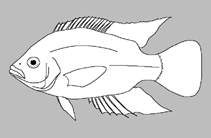 No image available for this species;
drawing shows typical species in Cichlidae.
Imagem do Google
drawing shows typical species in Cichlidae.
Classificação / Nomes Nomes comuns | Sinónimos | Catalog of Fishes(Género, Espécies) | ITIS | CoL | WoRMS | Cloffa
> Cichliformes (Cichlids, convict blennies) > Cichlidae (Cichlids) > Pseudocrenilabrinae
Etymology: konkourensis: The name konkourensis refers to the Konkouré River, the drainage to which the new species appears to be endemic; used as a noun in apposition (Ref. 90097).
Etymology: konkourensis: The name konkourensis refers to the Konkouré River, the drainage to which the new species appears to be endemic; used as a noun in apposition (Ref. 90097).
Ambiente: milieu / zona climática / intervalo de profundidade / gama de distribuição Ecologia
; Água doce demersal. Tropical
Distribuição Territórios | Áreas FAO | Ecossistemas | Ocorrências | Mapa dos pontos | Introduções | Faunafri
Africa: middle Konkouré River and its tributary Kakrima River in Guinea (Ref. 90097).
Tamanho / Peso / Idade
Descrição breve Chaves de identificação | Morfologia | Morfometria
Espinhos dorsais (total) : 16; Raios dorsais moles (total) : 11; Espinhos anais: 3; Raios anais moles: 8. Diagnosis: This species differs from all other tilapia except Coptodon fusiforme in a shallower body 30.0-31.5% of standard length vs. 32.9-52.5% and from Coptodon fusiforme in having 8 instead of 9-12 lower lateral line scales (Ref. 90097). It differs from all tilapia except Coptodon rheophila by additional morphological and meristic characters: stout teeth in oral jaw vs. spatulate teeth in Pelmatolapia mariae and P. cabrae; median pharyngeal teeth of lower pharyngeal jaw never broadened with crest-like cusps as in Heterotilapia cessiana and H. buttikoferi; posterior pharyngeal teeth of lower pharyngeal jaw never clearly bicuspid as in Tilapia busumana, T. pra, T. brevimanus, T. sparrmanii, T. baloni, T. ruweti and T. guinasana; vertical bars broader not than lighter interspaces; possessing slender to spatulate teeth in oral jaws as in Coelotilapia joka; no densely scaled caudal fin (Ref. 90097). Compared to Coptodon congica, C. tholloni and Congolapia bilineata, it further differs from all Coptodon, excluding C. rheophila, by a combination of the meristic characters: number of dorsal-fin spines, 16 vs. 13-17, and rays, 11 vs. 10-13; number of scales on the upper, 21 vs. 17-23, and lower lateral line, 8 vs. 7-14; and number of gill rakers, 7-9 vs. 7-12, on first ceratobranchial, excluding gill rakers on cartilaginous plague; it differs from C. rheophila by a smaller eye diameter, 7.5-7.6% of standard length vs. 8.0-10.7%, a shorter predorsal distance, 31.1-33.6% of standard length vs. 34.2-38.2%, a longer length of the base of dorsal fin, 61.4-62.3% of standard length vs. 56.9-60.9%, and a shorter pectoral fin length, 22.2-24.0% of standard length vs. 25.1-28.3% (Ref. 90097). It differs from the tilapia related species Chilochromis duponti in no densely scaled caudal fin or comb-like, spatulate teeth; from Gobiocichla in having two unconnected lateral lines vs. one continuous lateral line, and from Steatocranus in not developing a hump on forehead, and in fewer dorsal spines, 16 vs. 19-22 (Ref. 90097). The new species shares all typical Coptodon characters, which are: lower pharyngeal jaw as long as broad with anterior keel shorter than or just as long as toothed area of jaw; posterior pharyngeal teeth more or less clearly tricuspid, but sometimes quadricuspid or pentacuspid, median pharyngeal teeth never broadened with crest-like cusps; first outer gill arch bearing 10-17 rakers; two unconnected lateral lines; only cycloid scales present; 22-30 scales in the longitudinal scale row; upper and lower outer teeth rows bicuspid in both jaws, inner rows with smaller tricuspid teeth in both jaws; isognathous or retrognathous jaws; stout teeth; caudal fin not densely scaled; 13-17 dorsal spines; vertical bars, never oblique and mostly branched; pointed pelvic fin; no hump on forehead; no visor like hanging pad in pharynx; only one supraneural associated with first neural spine (Ref. 90097).
Body shape (shape guide): elongated; Cross section: compressed.
Body shape (shape guide): elongated; Cross section: compressed.
The very slender body in combination with a rounded head shape and slightly retrognathous jaws suggests that it is a benthic-rheophilic species, modified for life in rapids (Ref. 90097).
Ciclo de vida e comportamento de acasalamento Maturidade | Reprodução | Desova | Ovos | Fecundidade | Larvas
Referência principal
Carregar as suas referências | Referências | Coordenador : Kullander, Sven O. | Colaboradores
Dunz, A.R. and U.K. Schliewen, 2013. Molecular phylogeny and revised classification of the haplotilapiine cichlid fishes formerly referred to as "Tilapia". Mol. Phylogenet. Evol. 68(1):64-80. (Ref. 93285)
CITES
Not Evaluated
Ameaça para o homem
Harmless
Utilização humana
FAO - Publication: search | FishSource |
Mais informação
Ecologia Trófica
Produtos alimentares (presas)
Composição da dieta
Consumo alimentar
Rações alimentares
Predadores
Produtos alimentares (presas)
Composição da dieta
Consumo alimentar
Rações alimentares
Predadores
Dinâmica das populações
Parâmetros de crescimento
Idades / tamanhos máximos
Comprimento-peso rel.
Comprimento-comprimento rel.
Frequência de comprimento
Conversão de massa
Recrutamento
Abundância
Parâmetros de crescimento
Idades / tamanhos máximos
Comprimento-peso rel.
Comprimento-comprimento rel.
Frequência de comprimento
Conversão de massa
Recrutamento
Abundância
Ciclo de vida
Reprodução
Maturidade
Maturidade/Rel. das guelras
Fecundidade
Desova
Agregações de desova
Ovos
Desenvolvimento dos ovos
Larvas
Dinâmica larvar
Reprodução
Maturidade
Maturidade/Rel. das guelras
Fecundidade
Desova
Agregações de desova
Ovos
Desenvolvimento dos ovos
Larvas
Dinâmica larvar
Anatomia
Área branquial
Cérebro
Otólitos
Área branquial
Cérebro
Otólitos
Fisiologia
Composição corporal
Nutrientes
Consumo de oxigénio
Tipo de natação
Velocidade de natação
Pigmentos visuais
Som de peixe
Doenças e Parasitas
Toxicidade (LC50s)
Composição corporal
Nutrientes
Consumo de oxigénio
Tipo de natação
Velocidade de natação
Pigmentos visuais
Som de peixe
Doenças e Parasitas
Toxicidade (LC50s)
Genética
genoma
Genética
Heterozigotia
Hereditariedade
Diversidade genética
genoma
Genética
Heterozigotia
Hereditariedade
Diversidade genética
Relacionado com o ser humano
Sistemas de aquacultura
Perfis para aquacultura
Estirpes
Casos de Ciguatera
Selos, moedas, diversos.
Sistemas de aquacultura
Perfis para aquacultura
Estirpes
Casos de Ciguatera
Selos, moedas, diversos.
Ferramentas
E-book | Guia de campo | Ferramenta auxiliar de frequências de comprimento | Ferramenta sobre a história de vida | Mapa dos pontos |
Captura-MSY |
Relatórios especiais
Descarregue XML
Fontes da internet
AFORO (otoliths) | Aquatic Commons | BHL | Cloffa | Websites from users | Consultar FishWatcher | CISTI | Catalog of Fishes: Género, Espécies | DiscoverLife | ECOTOX | FAO - Publication: search | Faunafri | Fishipedia | Fishtrace | GloBI | Google Books | Google Scholar | Google | IGFA World Record | OneZoom | Open Tree of Life | Otolith Atlas of Taiwan Fishes | PubMed | Reef Life Survey | Socotra Atlas | TreeBase | Árvore da vida | Wikipedia: ir para, procurar | World Records Freshwater Fishing | Registo zoológico
Estimativas baseadas em modelos
Índice de diversidade filogenética (Ref. 82804): PD50 = 0.5000 [Uniqueness, from 0.5 = low to 2.0 = high].
Bayesian length-weight: a=0.00389 (0.00180 - 0.00842), b=3.12 (2.94 - 3.30), in cm total length, based on all LWR estimates for this body shape (Ref. 93245).
Nível Trófico (Ref. 69278): 2.7 ±0.1 se; based on size and trophs of closest relatives