>
Perciformes/Uranoscopoidei (Sand dwellers) >
Pinguipedidae (Sandperches)
Etymology: Parapercis: Greek, para = the side of + Greek, perke = perch (Ref. 45335); kentingensis: Named after the Kenting National Park in southern Taiwan, the type locality for the species (Ref. 89549).
Environment: milieu / climate zone / rango de profundidad / distribution range
Ecología
marino bentopelágico; rango de profundidad 50 - 150 m (Ref. 89549). Tropical
Pacific Ocean: China, Taiwan, Japan.
Tamaño / Peso / Age
Madurez: Lm ? range ? - ? cm
Max length : 13.1 cm SL macho / no sexado; (Ref. 89549)
Short description
Claves de identificación | Morfología | Morfometría
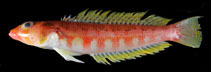
Espinas dorsales (total) : 5; Radios blandos dorsales (total) : 21; Espinas anales: 1; Radios blandos anales: 17; Vértebra: 30. This species is distinguished by the following characters: dorsal surface with 8 brown blotches; a large brownish patch above the opercle; cheek with an oblique reddish-yellow bar; below midline of lateral body, a series of 8 reddish bars; posterior portion of cheek with 1-3 small spots; dorsal fin with 3 rows of small brownish spots; pectoral fin base whitish with few small spots; above midline of lateral body is a series of small spots, each restricted to the size of one scale; caudal fin with 4-5 vertical rows of small spots; D V,21; A I,17; pectoral-fin rays 16-18 (mainly 17); pored lateral-line scales 52-54 (53-54); gill rakers on 1st gill arch 14-19 (16-18); pseudobranches 17-24; lower jaw with 3 pairs of canine teeth anteriorly; palatine teeth absent; vomerine teeth stout, in a single curved row; scales on body ctenoid, becoming cycloid on nuchal, prepectoral and prepelvic areas; margin of preopercle smoothly indented; fourth dorsal-fin spine longest; caudal fin rounded, with a slight prolongation on upper lobe; appressed pelvic fin not reaching origin of anal fin (Ref. 89549).
Body shape (shape guide): elongated.
Life cycle and mating behavior
Madurez | Reproducción | Puesta | Huevos | Fecundidad | Larva
Ho, H.-C., C.-H. Chang and K.-T. Shao, 2012. Two new sandperches (Perciformes: Pinguipedidae: Parapercis) from South China Sea, based on morphology and DNA barcoding. The Raffles Bulletin of Zoology 60(1):163-172. (Ref. 89549)
IUCN Red List Status (Ref. 130435: Version 2025-1)
Threat to humans
Harmless
Human uses
Herramientas
Special reports
Download XML
Fuentes de Internet
Estimates based on models
Preferred temperature (Referencia
123201): 15.7 - 23.4, mean 19.5 °C (based on 81 cells).
Phylogenetic diversity index (Referencia
82804): PD
50 = 0.5000 [Uniqueness, from 0.5 = low to 2.0 = high].
Bayesian length-weight: a=0.00692 (0.00314 - 0.01524), b=3.06 (2.88 - 3.24), in cm total length, based on LWR estimates for this Genus-body shape (Ref.
93245).
Nivel trófico (Referencia
69278): 3.5 ±0.4 se; based on size and trophs of closest relatives
Resiliencia (Referencia
120179): Alto, población duplicada en un tiempo mínimo inferior a 15 meses (Preliminary K or Fecundity.).
Fishing Vulnerability (Ref.
59153): Low vulnerability (10 of 100).
🛈