



Brochiraja heuresa Last & Séret, 2012
Sube tu fotos y Vídeos
Google image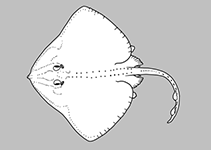 No image available for this species;
drawing shows typical species in Arhynchobatidae.
Google image
drawing shows typical species in Arhynchobatidae.
Clasificación / Nombres Nombres comunes | Sinónimos | Catalog of Fishes(Género, Especie) | ITIS | CoL | WoRMS | Cloffa
Elasmobranquios (tiburones y rayas) (sharks and rays) > Rajiformes (Skates and rays) > Arhynchobatidae (Softnose skates)
Etymology: heuresa: During the NORFANZ voyage, an attempt was made to collect additional specimens of the then "soon to be described" Enigma Skate (Brochiraja aenigma). The unique type specimen of B. aenigma Last & McEachran, 2006, which was collected some 22 years before from the Wanganella Bank, was in poor condition. Seven demersal trawl stations at depths of about 870–1350 m yielded several small skates that were initially thought to be additional specimens of the Enigma Skate. However, on closer inspection they turned out to be another undescribed species. The epithet is derived from the Greek heuresis (that which is found, discovered), based the Ancient Greek word Heureka (meaning "I have found it") or in modern English, simply "eureka"! Vernacular name: Eureka Skate (Ref. 89011).
More on authors: Last & Séret.
Etymology: heuresa: During the NORFANZ voyage, an attempt was made to collect additional specimens of the then "soon to be described" Enigma Skate (Brochiraja aenigma). The unique type specimen of B. aenigma Last & McEachran, 2006, which was collected some 22 years before from the Wanganella Bank, was in poor condition. Seven demersal trawl stations at depths of about 870–1350 m yielded several small skates that were initially thought to be additional specimens of the Enigma Skate. However, on closer inspection they turned out to be another undescribed species. The epithet is derived from the Greek heuresis (that which is found, discovered), based the Ancient Greek word Heureka (meaning "I have found it") or in modern English, simply "eureka"! Vernacular name: Eureka Skate (Ref. 89011).
More on authors: Last & Séret.
Entorno: milieu / zona climática / rango de profundidad / gama de distribución Ecología
marino batidemersal; rango de profundidad 870 - 1350 m (Ref. 89011). Deep-water; 32°S - 36°S, 166°E - 170°E
Distribución Territorios | Áreas FAO | Ecosistemas | Ocurrencias, apariciones | Mapa de puntos | Introducciones | Faunafri
Tasman Sea: known from deep banks and ridges of the northern Tasman Sea, including the western Norfolk Ridge and the Wanganella Bank (ca 32°35’–35°08’ S, 166°56’–169°29’ E), at 870–1350 m depth (Ref. 89011).
Tamaño / Peso / Edad
Madurez: Lm ? range ? - ? cm
Max length : 35.5 cm WD macho / no sexado; (Ref. 89011); 36.4 cm WD (female)
Max length : 35.5 cm WD macho / no sexado; (Ref. 89011); 36.4 cm WD (female)
Descripción breve Claves de identificación | Morfología | Morfometría
A small species of Brochiraja distinguished by the following combination of characters: long tail, 1.2–1.3 times disc length, 2.4–2.5 times ventral head length, 4.9–6.0 times snout length; orbit moderately large, 2.7–3.4 in preorbital snout length; tail slender but with relatively broad conical base, evenly tapering to mid-length of tail, its width at pelvic-fin insertions 2.1–3.0 times width at midlength; anterior lobe of pelvic fin fleshy, spatulate; dorsal disc deceptively granular in appearance, covered with minute spiny denticles; mid-dorsal surface of tail with small thorns, surrounded by fine denticles; dorsolateral surface of tail lacking thorns; snout length 2.4–3.0 times distance from snout tip to weak rostral thorn; calcified rostral shaft short; single reduced preorbital thorn, posterior thorn weak or absent; ventral disc naked; anteroventral lateral margin of tail covered in fine denticles; alar thorns of mature males united to form a broad patch over most of outer anterior part of pectoral fin; no obvious malar thorn patch; lateral skin fold weak, somewhat expanded at level of dorsal fins, but width less than tail width, originating well behind middle of tail; dorsal surface pale bluish pink, ventral surface darker than dorsal surface, reddish brown; well-defined series of pale-edged pores on ventral surface, forming a whitish line adjacent anterior margin (disc distinctly darker lateral to this line); nuchal pore band not obvious; total pectoral radials 58–63; predorsal vertebrae 88–100; 30–42 tooth rows in upper jaw (Ref. 89011).
Body shape (shape guide): other.
Body shape (shape guide): other.
Ciclo vital y comportamiento de apareamiento Madurez | Reproducción | Puesta | Huevos | Fecundidad | Larva
Referencia principal
Suba sus referencias | Referencias | Coordinador : McEachran, John | Colaboradores
Last, P.R. and B. Séret, 2012. Two new softnose skates of the genus Brochiraja (Rajoidei: Arhynchobatidae) from the deepwater slopes and banks of the Norfolk Ridge (South-West Pacific). Zootaxa 3155:47-64. (Ref. 89011)
Situación en la Lista Roja de la UICN (Ref. 130435: Version 2025-2 (Global))
Data deficient (DD) ; Date assessed: 22 June 2017
CITES
Not Evaluated
Amenaza para el ser humano
Harmless
Usos humanos
FAO - Publication: search | FishSource |
Más información
Ecología Trófica
Alimentos (presas)
Composición de la dieta
consumo de alimento
Raciones de comida
Despredadores
Alimentos (presas)
Composición de la dieta
consumo de alimento
Raciones de comida
Despredadores
Ecología
Ecología
Ecología
Dinámica de la población
Coeficiente del crecimiento para
Edades / tallas máximas
Longitud-peso rel.
Longitud-longitud rel.
Longitud-frecuencias
Conversión de masas
Reclutamiento
Abundancia
Coeficiente del crecimiento para
Edades / tallas máximas
Longitud-peso rel.
Longitud-longitud rel.
Longitud-frecuencias
Conversión de masas
Reclutamiento
Abundancia
Ciclo de vida
Reproducción
Madurez
Madurez/Gills rel.
Fecundidad
Puesta
Agregaciones de desove
Huevos
Desarrollo de los huevos
Larva
Dinámica larvaria
Reproducción
Madurez
Madurez/Gills rel.
Fecundidad
Puesta
Agregaciones de desove
Huevos
Desarrollo de los huevos
Larva
Dinámica larvaria
Distribución
Territorios
Áreas FAO
Ecosistemas
Ocurrencias, apariciones
Introducciones
BRUVS - Vídeos
Territorios
Áreas FAO
Ecosistemas
Ocurrencias, apariciones
Introducciones
BRUVS - Vídeos
Anatomía
Superficie branquial
Cerebro
Otolito
Superficie branquial
Cerebro
Otolito
Fisiología
Composición corporal
Nutrientes
Consumo del oxígeno
Tipo de natación
Velocidad de natación
Pigmentos visuales
Sonido de peces
Enfermedades y parásitos
Toxicidad (CL50)
Composición corporal
Nutrientes
Consumo del oxígeno
Tipo de natación
Velocidad de natación
Pigmentos visuales
Sonido de peces
Enfermedades y parásitos
Toxicidad (CL50)
Genética
Genoma
Genética
Heterocigosidad
heritabilidad
Diversidad genética
Genoma
Genética
Heterocigosidad
heritabilidad
Diversidad genética
Relacionados con el ser humano
Sistemas de acuicultura
Perfiles de acuicultura
Razas
Ciguatera cases
Sellos, monedas, varios
Sistemas de acuicultura
Perfiles de acuicultura
Razas
Ciguatera cases
Sellos, monedas, varios
Herramientas
Libro electrónico | Guía de campo | Asistente para frecuencias de tallas | Herramienta de ciclo de vida | Mapa de puntos |
Catch-MSY |
Informes especiales
Comprobar el mantenimiento del acuario | Buscar fichas sobre especies | Consulte las hojas informativas sobre acuicultura
Descargar XML
Fuentes de Internet
AFORO (otoliths) | Aquatic Commons | BHL | Cloffa | Websites from users | Check FishWatcher | CISTI | Catalog of Fishes: Género, Especie | DiscoverLife | ECOTOX | FAO - Publication: search | Faunafri | Fishipedia | Fishtrace | GloBI | Google Books | Google Scholar | Google | IGFA World Record | OneZoom | Open Tree of Life | Otolith Atlas of Taiwan Fishes | PubMed | Reef Life Survey | Socotra Atlas | TreeBase | Árbol de la vida | Wikipedia: Go, búsqueda | World Records Freshwater Fishing | Zoobank | Expediente Zoológico
Estimaciones basadas en modelos
Índice de diversidad filogenética (Referencia 82804): PD50 = 0.5039 [Uniqueness, from 0.5 = low to 2.0 = high].
Bayesian length-weight: a=0.00550 (0.00279 - 0.01081), b=3.11 (2.94 - 3.28), in cm total length, based on LWR estimates for this (Sub)family-body shape (Ref. 93245).
Nivel trófico (Referencia 69278): 3.8 ±0.7 se; based on size and trophs of closest relatives