



Trichomycterus tete Barbosa & Costa, 2011
Envoyez vos Photos et vidéos
Images Google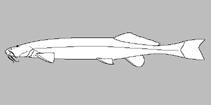 No image available for this species;
drawing shows typical species in Trichomycteridae.
Images Google
drawing shows typical species in Trichomycteridae.
Classification / Noms Noms communs | Synonymes | Catalog of Fishes(Genre, Espèce) | ITIS | CoL | WoRMS | Cloffa
> Siluriformes (Catfishes) > Trichomycteridae (Pencil or parasitic catfishes) > Trichomycterinae
Etymology: Trichomycterus: Greek, thrix = hair + Greek, mykter, -eros = nose (Ref. 45335); tete: The specific name tete makes reference to the popular name of the species.
More on authors: Barbosa & Costa.
Etymology: Trichomycterus: Greek, thrix = hair + Greek, mykter, -eros = nose (Ref. 45335); tete: The specific name tete makes reference to the popular name of the species.
More on authors: Barbosa & Costa.
Environnement : milieu / zone climatique / profondeur / gamme de distribution Écologie
; eau douce benthopélagique. Tropical
Distribution Territoires | Zones FAO | Écosystèmes | Occurrences | Carte par point | Introductions | Faunafri
South America: Cachoeira do Giló, and córrego Morceguinho, tributaries of rio Brumado, upper rio de Contas drainage, serra do Espinhaço, northeastern Brazil.
Taille / Poids / Âge
Description synthétique Clés d'identification | Morphologie | Morphométrie
Rayons mous dorsaux (Total) : 11; Rayons mous anaux: 9; Vertèbres: 36 - 37. Distinguished from all congeners by having a deeper outer edge of the hypobranchial 1 (vs. outer edge about the same deep as the inner edge). Similar to Trichomycterus albinotattus, T. alternatus, T. auroguttatus, T. bahianus, T. caudofasciatus, T. concolor, T. davisi, T. diabolus, T. fl orensis, T. goeldii, T. guaraquessaba, T. iheringi, T. itacambirussu, T. jacupiranga, T. jequitinhonhae, T. landinga, T. longibarbatus, T. maculosus, T. nigroauratus, T. paquequerense, T. travassosi, T. tupinamba, T. zonatus, and T. variegatus and can be diagnosed from all from all other species from southeastern and northeastern Brazil by having eight pectoral-fin rays (vs. six, seven or nine). Distinguished from Trichomycterus davisi, T. diabolus, T guaraquessaba, T. iheringi, T. tupinamba, and T. zonatus by having the first pectoral-fin ray prolonged as a filament (vs. not prolonged); from T. alternatus, T. bahianus, T. caudofasciatus, and T. longibarbatus by the smaller pectoral-fin filament, about 30% of the pectoral-fin length (vs. about 50%); from T. maculosus, T. diabolus, and T. nigroauratus by possessing a deeper metapterygoid, much deeper than wide (vs. wider than deep); from T. alternatus, T. bahianus, T. goeldii, T. itacambirussu, T. jequitinhonhae, T. landinga, T. longibarbatus, T. maracaya, T. nigroauratus by having a shorter maxillary barbel, reaching the middle of the opercular patch of odontodes (vs. pectoral-fin base); from T. albinotatus, T. auroguttatus, T. bahianus, T. guaraquessaba, T. jacupiranga, T. jequitinhonhae, T. landinga, T. longibarbatus, T. travassosi, and T. variegatus by having a narrower head (head width 68.7 - 77.5% HL, vs. 80.7 - 104.6%); from T. alternatus, T. albinotattus, T. diabolus, T. longibarbatus, T. tupinamba by having 11 dorsal-fin rays (vs. 12); from T. florensis, and T. paquequerense by having a caudal fin truncate (vs. emarginate); from T. auroguttatus, T. bahianus, T. concolor, T. iheringi, T. itacambirussu, T. landinga, T. longibarbatus and T. variegatus by having more slender body (body depth 12.5 - 13.2% SL, vs. 13.5 - 18.2%); from T. bahianus, T. concolor, T. guaraquessaba, T. jequitinhonhae, T. itacambirussu, T. landinga, T. longibarbatus and T. variegatus by having more slender caudal peduncle (caudal peduncle depth 9.7 - 10.8% SL, vs. 10.9 - 15.1%); from T. concolor, T. longibarbatus and T. variegatus by having a shorter dorsal-fin base (dorsal-fin base length 9.4 - 10.7% SL, vs. 10.9 - 15.5%) (Ref. 88926).
Body shape (shape guide): short and / or deep.
Body shape (shape guide): short and / or deep.
Occurs in a narrow artificial channel flowing at the side to a waterfall and in a large pool formed after a waterfall, both places with clearwater and rapid flow. Usually found in shallow places along the margins, on the gravel or litter substrate (Ref. 88926).
Cycle de vie et comportement reproducteur Maturité | Reproduction | Frai | Œufs | Fécondité | Larves
Référence principale
Téléchargez vos références | Références | Coordinateur : Pinna, Mário de | Collaborateurs
Barbosa, M.A. and W.J.E.M. Costa, 2011. Description of a new species of the catfish genus Trichomycterus (Teleostei: Siluriformes: Trichomycteridae) from the rio de Contas basin, northeastern Brazil. Vertebrate Zoology 61(3):307-312. (Ref. 88926)
Statut dans la liste rouge de l'IUCN (Ref. 130435: Version 2025-2 (Global))
Préoccupation mineure (LC) ; Date assessed: 07 November 2018
CITES
Not Evaluated
Menace pour l'homme
Harmless
Utilisations par l'homme
FAO - Publication: search | FishSource |
Plus d'informations
Écologie trophique
Aliments (proies)
Composition du régime alimentaire
Consommation alimentaire
Rations alimentaires
Prédateurs
Aliments (proies)
Composition du régime alimentaire
Consommation alimentaire
Rations alimentaires
Prédateurs
Écologie
Écologie
Écologie
Dynamique des populations
Paramètres de croissance
Âges / tailles maximales
Longueur-poids rel.
Rel. longueur-longueur.
Fréquences de longueurs
Conversion de masse
Recrutement
Abondance
Paramètres de croissance
Âges / tailles maximales
Longueur-poids rel.
Rel. longueur-longueur.
Fréquences de longueurs
Conversion de masse
Recrutement
Abondance
Cycle de vie
Reproduction
Maturité
Maturité/épines rel.
Fécondité
Frai
Agrégats de frai
Œufs
Développement de l'œuf
Larves
Dynamique des populations larvaires
Reproduction
Maturité
Maturité/épines rel.
Fécondité
Frai
Agrégats de frai
Œufs
Développement de l'œuf
Larves
Dynamique des populations larvaires
Anatomie
Surface branchiale
Cerveau
Otolithe
Surface branchiale
Cerveau
Otolithe
Physiologie
Composition corporelle
Nutriments
Consommation d'oxygène
Type de natation
Vitesse de nage
Pigments visuels
Son de poisson
Maladies et parasites
Toxicité (CL50)
Composition corporelle
Nutriments
Consommation d'oxygène
Type de natation
Vitesse de nage
Pigments visuels
Son de poisson
Maladies et parasites
Toxicité (CL50)
Génétique
génôme
Génétique
Hétérozygotie
Héritabilité
Diversité génétique
génôme
Génétique
Hétérozygotie
Héritabilité
Diversité génétique
Liées à l'homme
Systèmes d'aquaculture
Profils d'aquaculture
Souches
Cas de ciguatera
Timbres, pièces de monnaie, divers
Systèmes d'aquaculture
Profils d'aquaculture
Souches
Cas de ciguatera
Timbres, pièces de monnaie, divers
Outils
E-book | Guide de terrain | Générateur de fréquences de longueur | Outil de dynamique de population | Carte par point |
Capture-MSY |
Articles particuliers
Télécharger en XML
Sources Internet
AFORO (otoliths) | Aquatic Commons | BHL | Cloffa | Websites from users | FishWatcher | CISTI | Catalog of Fishes: Genre, Espèce | DiscoverLife | ECOTOX | FAO - Publication: search | Faunafri | Fishipedia | Fishtrace | GloBI | Google Books | Google Scholar | Google | IGFA World Record | OneZoom | Open Tree of Life | Otolith Atlas of Taiwan Fishes | PubMed | Reef Life Survey | Socotra Atlas | TreeBase | Arbre de Vie | Wikipedia: aller à, chercher | World Records Freshwater Fishing | Zoobank | Zoological Record
Estimations basées sur des modèles
Indice de diversité phylogénétique (Réf. 82804): PD50 = 0.5000 [Uniqueness, from 0.5 = low to 2.0 = high].
Bayesian length-weight: a=0.01995 (0.00906 - 0.04395), b=3.01 (2.83 - 3.19), in cm total length, based on all LWR estimates for this body shape (Ref. 93245).
Niveau trophique (Réf. 69278): 3.2 ±0.4 se; based on size and trophs of closest relatives