This website uses cookies to enhance your browsing experience and ensure the functionality of our site. For more detailed information about the types of cookies we use and how we protect your privacy, please visit our Privacy Information page.
×
Cookie Settings
This website uses different types of cookies to enhance your experience. Please select your preferences below:
> Gobiiformes (Gobies) > Gobiidae (Gobies) > Gobiinae
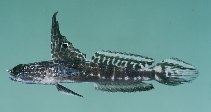
Etymology: Tomiyamichthys:occurring on sand-rubble bottoms in the vicinity of coral reefs; dorsostigma:Named for the distinctive black and white spot distally on the third membrane of the first dorsal fin. More on authors: Bogorodsky, Kovačić & Randall.
Lingkungan: lingkungan / zona iklim / kisaran kedalaman / jangkauan distribusi Ekologi
laut dasar (demersal); kisaran kedalaman ? - 8 m (Ref. 88846). Tropical
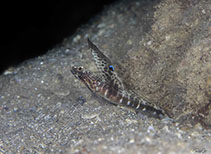
Duri punggung (Keseluruhan (total)) : 7; duri punggung lunak (Keseluruhan (total)) : 12; Duri dubur: 1; Sirip dubur lunak: 12. This species is distinguished by the following characters: D VI + I,12; A I,12; pectoral rays 17; cycloid scales, partially to complete embedded, nonimbricate, not in regular rows, about 120-125 in longitudinal series; naked head; elongated body, the depth at anal-fin origin 7.75-7.9 in SL, compressed; head length 3.55-3.6 in SL; eye extending little above dorsal profile of head; orbit diameter 4.35-4.45 in head length; gill opening reaching forward to below rear margin of preopercle; the first dorsal spine is longest, 3.0-3.15 in SL, twice length of longest dorsal soft ray; caudal fin slightly pointed, longer than head length; pelvic fins are fully united, nearly reaching anus, 3.45-3.5 in SL, with well developed frenum; colouration when fresh - pale grey with a series of 14 dark brown bars on body, much wider than pale interspaces and broken into one or two spots dorsally; head with irregular, close-set, dark brown spots of variable size, generally smaller anteriorly; first dorsal fin with close-set, dark brown spots, are larger posteriorly; third membrane of the first dorsal fin with a curved white mark on a large black spot near margin; second dorsal fin is whitish with a blackish margin, a middle dark brown stripe, and a row of large, dark brown, bilobed spots along its base; dorsal part of caudal fin with an oblique, blackish-edged, bluish white band (Ref. 88846). Body shape (shape guide): elongated; Cross section: compressed.
Lives symbiotically in sand near fringing reef with an unidentified alpheid shrimp, in shallow waters. Collected by multi-pronged spears (Ref. 88846),
Siklus hidup dan perilaku kawin Kematangan | Reproduksi, perkembang biakan | Pemijahan | telur-telur | Fekunditas | Larva
Bogorodsky, S. V., M. Kovačić and J. E. Randall, 2011. A new species and three new records of gobiid fishes from the Red Sea. Cybium 35(3):213-222. (Ref. 88846)
Status IUCN Red List (Ref. 130435: Version 2025-2 (Global))
Ekologi trofik Item makanan (mangsa) Komposisi makanan Konsumsi makanan Ransum makanan Pemangsa
Ekologi Ekologi
Dinamika populasi Parameter pertumbuhan Maks. usia / ukuran Panjang-berat rel. Panjang-panjang rel. ukuran frekuensi Konversi massa pemulihan Kelimpahan
Indeks keanekaragaman filogenetik (Acuan 82804): PD50 = 0.5000 [Uniqueness, from 0.5 = low to 2.0 = high].
Bayesian length-weight: a=0.00741 (0.00347 - 0.01582), b=3.09 (2.91 - 3.27), in cm total length, based on LWR estimates for this (Sub)family-body shape (Ref. 93245).
Tingkat Trofik (Acuan 69278): 3.3 ±0.3 se; based on size and trophs of closest relatives
Daya lenting (Acuan 120179): Tinggi, Waktu penggandaan populasi minimum kurang dari 15 bulan (Preliminary K or Fecundity.).
Kerentanan Penangkapan Ikan (Ref. 59153): Low vulnerability (10 of 100). 🛈