Classification / Names
Κοινά ονόματα | Συνώνυμα | Catalog of Fishes(Γένος, Είδη) | ITIS | CoL | WoRMS | Cloffa
>
Siluriformes (Catfishes) >
Mochokidae (Squeakers or upside-down catfishes) > Chiloglanidinae
Etymology: Chiloglanis: Greek, cheilos = lip + Greek, glanis = a fish that can eat the bait without touching the hook; a cat fish (Ref. 45335); orthodontus: A combination of the Greek word orthos, meaning straight or erect, and the Greek word odontos, meaning tooth; this name refers to the mandibular dentition in this species, which is relatively straight and evenly spread across the dentary as compared to most other members of the genus; used as a noun in apposition (Ref. 87986).
Environment: milieu / climate zone / εύρος βάθους / distribution range
Οικολογία
; Γλυκού νερού βενθοπελαγικό. Tropical
Africa: several greatly separated sites in the lower Malagarasi River in Tanzania (Ref. 87986).
Μέγεθος / Βάρος / Age
Γεννητική Ωρίμανση: Lm ? range ? - ? cm
Max length : 2.9 cm SL αρσενικό/απροσδιόριστο; (Ref. 87986)
Short description
Κλείδες προσδιορισμού | Μορφολογία | Μορφομετρία
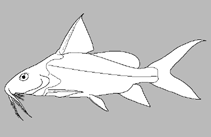
Ραχιαίες άκανθες (συνολικά) : 2; Μαλακές ραχιαίες ακτίνες (συνολικά) : 5; Εδρικές άκανθες: 0; Μαλακές εδρικές ακτίνες: 9 - 10; Σπόνδυλοι: 32 - 34. Diagnosis: Chiloglanis orthodontus is a relatively small species, less than 30 mm standard length, that can be distinguished from all other Malagarasi congeners by possessing dentary teeth spread out across the mouth opening as opposed to being concentrated at the midline, and a very short dorsal spine, 4.1–7.8% of standard length vs. always greater than 8.2% (Ref. 87986). This species is further distinguished from all Lake Tanganyika region species except C. productus, by a relatively long adipose fin, 25.0–31.3% of standard length vs. less than 23.4% in all other Chiloglanis species except C. productus, which has 22.5– 26.2% (Ref. 87986). Additional features useful for distinguishing this species from other species of Chiloglanis include a relatively small oral disc, width 16.5-21.7% of standard length and length 12.1-16.3% of standard length, with relatively elongate barbels, maxillary barbel 9.4-14.8% of standard length, lateral mandibular barbel 3.8-10.7% of standard length, medial mandibular barbel 3.8-5.9% of standard length (Ref. 87986). These features and the widely spaced teeth of the lower jaw are associated with another distinctive character in this species: the shape of the lower jaw; in most species of Chiloglanis the lower jaw is similar to that found in species of Synodontis, where elongate 'S'-shaped teeth insert in a cavity on the anterior side of the dentary; in C. orthodontus the dentary tooth cup is poorly developed; the dentary teeth project from the anterodorsal surface of the dentary and are only very gently 'S'-shaped; thus far among Chiloglanis species, only Chiloglanis voltae, known from the Volta and upper Bénoué River basins in western Africa, possesses a similar jaw morphology (Ref. 87986).
Body shape (shape guide): elongated.
It is most commonly encountered in small riffles, or in peripheral regions of rapids where the water velocity is much slower (Ref. 87986).
Life cycle and mating behavior
Γεννητική Ωρίμανση | Αναπαραγωγή | Γεννοβολία | Αβγά | Γονιμότητα | Προνύμφες
Friel, J.P. and T.R. Vigliotta, 2011. Three new species of African suckermouth catfishes, genus Chiloglanis (Siluriformes: Mochokidae), from the lower Malagarasi and Luiche rivers of western Tanzania. Zootaxa 3063:1-21. (Ref. 87986)
IUCN Red List Status (Ref. 130435: Version 2025-1)
Threat to humans
Harmless
Human uses
αλιεία: χωρίς ενδιαφέρον
Εργαλεία
Special reports
Download XML
Διαδικτυακές πηγές
Estimates based on models
Phylogenetic diversity index (Αναφ.
82804): PD
50 = 0.5000 [Uniqueness, from 0.5 = low to 2.0 = high].
Bayesian length-weight: a=0.00389 (0.00180 - 0.00842), b=3.12 (2.94 - 3.30), in cm total length, based on all LWR estimates for this body shape (Ref.
93245).
Τροφικό Επίπεδο (Αναφ.
69278): 3.1 ±0.4 se; based on size and trophs of closest relatives
Fishing Vulnerability (Ref.
59153): Low vulnerability (10 of 100).
🛈