



Etmopterus sculptus Ebert, Compagno & De Vries, 2011
Sculpted lanternshark
Добавить Ваши наблюдения в Fish Watcher
| Native range | All suitable habitat | Point map | Year 2050 |

|
| This map was computer-generated and has not yet been reviewed. |
| Etmopterus sculptus AquaMaps Data sources: GBIF OBIS |
Загрузить свой Фото и Видео
Изображение на Google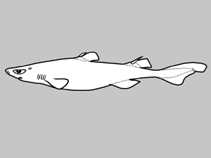 No image available for this species;
drawing shows typical species in Etmopteridae.
Изображение на Google
drawing shows typical species in Etmopteridae.
Классификация / Имена народные названия | синонимы | Catalog of Fishes(род, виды) | ITIS | CoL | WoRMS | Cloffa
Пластиножаберные (акулы и скаты) (sharks and rays) > Squaliformes (Sleeper and dogfish sharks) > Etmopteridae (Lantern sharks)
Etymology: Etmopterus: Greek, ethmos, -ou = sieve or ethmoides bone + Greek, pteron = wing, fin (Ref. 45335); sculptus: The species name derives from the Latin sculpo, in allusion to the carved or sculpted appearance of its linear denticles (Ref. 87957).
Etymology: Etmopterus: Greek, ethmos, -ou = sieve or ethmoides bone + Greek, pteron = wing, fin (Ref. 45335); sculptus: The species name derives from the Latin sculpo, in allusion to the carved or sculpted appearance of its linear denticles (Ref. 87957).
Окружающая среда: среда / климатическая зона / пределы глубины / диапазон распространения экология
морской батидемерсальный; пределы глубины 240 - 1023 m (Ref. 106604). Deep-water
распространение Территории | регионы FAO | Экосистемы | места находок | карта точек | интродукции | Faunafri
Southeast Atlantic and Southwest Indian Ocean: Namibia to southern Mozambique,
and Madagascar Ridge.
Длина при первой зрелости / Размер / Вес / Возраст
половая зрелость: Lm ?, range 42 - ? cm
Max length : 59.0 cm TL самец/пол неопределен; (Ref. 106604); 51.5 cm TL (female)
Max length : 59.0 cm TL самец/пол неопределен; (Ref. 106604); 51.5 cm TL (female)
Краткое описание определительные ключи | морфология | морфометрия
Etmopterus sculptus is a moderately large, stout, species of linear-denticled Etmopterus, which separates it from most other members of this genus, and can be distinguished from its three closest congeners within the E. Lucifer-group, E. brachyurus, E. lucifer, and E. molleri, by the length of its anterior flank markings being slightly longer than its posterior branch. The posterior branch of the flank markings on E. brachyurus and E. molleri are shorter relative to the anterior branch, and in E. lucifer, the anterior branch is nearly twice the length of the posterior branch. The new species can also be distinguished from its closest congeners by the arrangement of dermal denticles that extend over most of the upper and lower body surface. Etmopterus sculptus possesses non-overlapping denticles, giving it a rougher, more sculpted texture than these other aforementioned species. The arrangement of the dermal denticles onthe ventral head surface is also a good character for separating these species, with E. sculptus having uniformly distributed denticles while the ventral surface of E. Lucifer and E. molleri is sparsely covered with denticles. The ventral surface of the head of E. brachyurus typically lacks dermal denticles (Ref. 87957).
Body shape (shape guide): elongated.
Body shape (shape guide): elongated.
This species is fairly common along the upper continental slopes between Namibia and southern Mozambique (Ref. 87957); upper slope, on or near the bottom (Ref. 5578). Observed mostly at depths between 450 and 900 m (Ref. 27644), but with records as shallow as 240 m (in Bass et al., 1976: listed as E. lucifer) (Ref. 87957). Feeds mainly on mid-water bony fish, also squid, octopus, shrimp and brittle stars (Ref. 5578).
Жизненный цикл и брачное поведение половая зрелость | размножение | нерест | икра | Плодовитость | личинки
Основная ссылка
Загрузите свои рекомендации | ссылки | координатор | соавторы
Ebert, D.A., Compagno, L.J.V. and M.J. De Vries, 2011. A New Lanternshark (Squaliformes: Etmopteridae: Etmopterus) from Southern Africa. Copeia 2011(3):379-384. (Ref. 87957)
Статус Красного Списка МСОП (Ref. 130435: Version 2025-2 (Global))
Не вызывающий беспокойства (LC) ; Date assessed: 24 April 2018
CITES
Not Evaluated
Угроза для людей
Harmless
Использование человеком
рыболовство: интереса не представляет
FAO - Publication: search | FishSource |
дополнительная информация
Трофическая экология
Пищевые предметы (добыча)
состав пищи
потребление пищи
Продовольственные пайки
хищники
Пищевые предметы (добыча)
состав пищи
потребление пищи
Продовольственные пайки
хищники
экология
экология
экология
Динамика численности населения
Параметры роста
Макс. возраст / размер
Отношение длины к весу.
Отношение длины к длине.
Размерный состав
Преобразование массы
пополнение
численность
Параметры роста
Макс. возраст / размер
Отношение длины к весу.
Отношение длины к длине.
Размерный состав
Преобразование массы
пополнение
численность
Жизненный цикл
размножение
половая зрелость
Зрелость/Жиры относительно.
Плодовитость
нерест
Нерестовые скопления
икра
Развитие икры
личинки
динамика численности личинок
размножение
половая зрелость
Зрелость/Жиры относительно.
Плодовитость
нерест
Нерестовые скопления
икра
Развитие икры
личинки
динамика численности личинок
Анатомия
жаберная область
Мозг
Отолит
жаберная область
Мозг
Отолит
Физиология
Состав тела
Питательные вещества
Потребление кислорода
Тип плавания
Скорость плавания
Зрительные пигменты
Звук рыбы
Болезни и паразиты
Токсичность (LC50s)
Состав тела
Питательные вещества
Потребление кислорода
Тип плавания
Скорость плавания
Зрительные пигменты
Звук рыбы
Болезни и паразиты
Токсичность (LC50s)
генетика
Геном
генетика
Гетерозиготность
наследуемость
Генетическое разнообразие
Геном
генетика
Гетерозиготность
наследуемость
Генетическое разнообразие
Связанные с человеком
Системы аквакультуры
особенности рыбоводства
степень растяжения
Случаи заболевания сигуатерой
Марки, монеты и прочее.
Системы аквакультуры
особенности рыбоводства
степень растяжения
Случаи заболевания сигуатерой
Марки, монеты и прочее.
инструменты
Специальные отчеты
Проверить содержание в аквариумах | Проверить опубликованные видовые данные | Проверить опубликованные данные по аквакультуре
Скачать в формате XML
ресурсы в Интернет
AFORO (otoliths) | Aquatic Commons | BHL | Cloffa | Websites from users | Проверить FishWatcher | CISTI | Catalog of Fishes: род, виды | DiscoverLife | ECOTOX | FAO - Publication: search | Faunafri | Fishipedia | Fishtrace | GloBI | Google Books | Google Scholar | Google | IGFA World Record | OneZoom | Open Tree of Life | Otolith Atlas of Taiwan Fishes | PubMed | Reef Life Survey | Socotra Atlas | TreeBase | Tree of Life | Wikipedia: Вперёд, поиск | World Records Freshwater Fishing | Zoobank | Зоологическая летопись
Оценки, основанные на моделях
Предпочтительная температура (ссылка 123201): 1.9 - 8, mean 2.3 °C (based on 14 cells).
Индекс филогенетического разнообразия (ссылка 82804): PD50 = 0.5000 [Uniqueness, from 0.5 = low to 2.0 = high].
Bayesian length-weight: a=0.00389 (0.00200 - 0.00755), b=3.08 (2.91 - 3.25), in cm total length, based on LWR estimates for this Genus-body shape (Ref. 93245).
Трофический уровень (ссылка 69278): 4.3 ±0.6 se; based on size and trophs of closest relatives
устойчивость к внешним воздействиям (ссылка 120179): низкий, минимальное время удвоения популяции 4.5-14 лет (Deep-water species with low fecundity (RF)).