



Australoheros ykeregua Říčan, Piálek, Almirón & Casciotta, 2011
上傳你的 相片 和 影像
照片 | Google 影像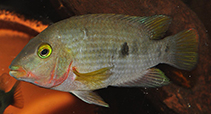 Australoheros ykeregua
Female 拍攝者 Albering, J.
照片 | Google 影像
Female 拍攝者 Albering, J.
分類 / 名稱 俗名 | 同種異名 | Catalog of Fishes(屬, 種) | ITIS | CoL | WoRMS | Cloffa
Teleostei > Cichliformes (Cichlids, convict blennies) 鱸形目 (Cichlids, convict blennies) > Cichlidae (Cichlids) 慈鯛科魚類 (Cichlids) > Cichlinae
Etymology: Australoheros: From the Latin word 'australis' meaning southern, and the name Heros, after the nominotypic genus of the Heroini tribe. Tribe; ykeregua: Name from the Guaraní word ykeregua, meaning neighbor (vecino in Spanish). It is based on the fact that A. ykeregua and A. forquilha have been preliminarily treated as conspecific, two sister group species living in the same river drainage (río Uruguay), though not sympatrically.
Etymology: Australoheros: From the Latin word 'australis' meaning southern, and the name Heros, after the nominotypic genus of the Heroini tribe. Tribe; ykeregua: Name from the Guaraní word ykeregua, meaning neighbor (vecino in Spanish). It is based on the fact that A. ykeregua and A. forquilha have been preliminarily treated as conspecific, two sister group species living in the same river drainage (río Uruguay), though not sympatrically.
環境: 環境 / 氣候帶 / 深度上下限 / 配送範圍 生態學
; 淡水 底中水層性.
分布 領土 | FAO區域 | 生態系 | 發現紀錄 | 分布圖 | 簡介 | Faunafri
South America: known only from Argentinean territory in the tributaries of the río Uruguay below the Salto Moconá, province of Misiones.
大小 / 重量 / 年齡
簡短描述 檢索表 | 型態特徵 | 形態測量圖
背棘 (總數) : 15 - 17; 背的軟條 (總數) : 9 - 11; 臀棘: 5 - 6; 臀鰭軟條: 7 - 9; 脊椎骨: 26 - 27. This species is distinguished from all Australoheros species except A. forquilha by the following characters: presence of a series of opalescent pale blue dots along the postero-lateral border of the suborbital series (dark markings in preserved specimens); with checkerboard-spotted dorsal, anal and caudal fins (red spots in live animals and dark grey in preserved specimens); a red to orange branchiostegal membrane, mouth and lower head area and base of pectoral fin; by having comparatively thick lips (shared also with A. tembe); with lower jaw shorter than the upper; E0 scales 25–26 (vs. less than 25); with the longest dorsal fin scale cover (shared also with A. tembe); by having the narrowest head, < 50% head width of HL (vs. more than 50%), shortest interorbital, 10.9% of SL and longest preorbital, 9.3% of SL distances. This species differs from A. forquilha by the absence of the opalescent pale blue dots on each body scale, by not having them widely distributed on the head, but limited to a single line below the suborbital series; in having a red coloration limited to the head region and the base of the pectoral fin (vs. red coloration on the whole belly to the end of the anal fin); by having lower counts of caudal vertebrae 13-14 (vs. 14-15), less caudal peduncle vertebrae, modally 2 (vs. 3), lower total dorsal fin counts 25-26 (vs. 26-27) and E0 scales 25 (vs. 26). It is distinguished from the only other similar species, Australoheros tembe, by the above listed unique characters and by coloration (shared only with A. forquilha) and additionally by a shorter caudal peduncle (including 2 vs. 3 vertebrae) and more dorsal fin rays 10-11 (vs. 9) (Ref. 87600).
Body shape (shape guide): short and / or deep.
Body shape (shape guide): short and / or deep.
生命週期和交配行為 成熟度 | 繁殖 | 產卵場 | 卵 | 孕卵數 | 仔魚
主要參考資料
上傳您的推薦信 | 參考文獻 | 合作者 : Kullander, Sven O. | 合作者
Říčan, O., L. Piálek, A. Almirón and J. Casciotta, 2011. Two new species of Australoheros (Teleostei: Cichlidae), with notes on diversity of the genus and biogeography of the Río de la Plata basin. Zootaxa 2982:1-26. (Ref. 87600)
IUCN 瀕危狀態 (Ref. 130435: Version 2025-2 (Global))
易受傷害 (VU) (B1ab(iii)+2ab(iii)); Date assessed: 20 November 2020
CITES
Not Evaluated
對人類具威脅
人類使用
FAO - Publication: search | FishSource |
更多資訊
營養生態學
食物項目(獵物)
食性組成
食物消耗量
食物配給
捕食者
食物項目(獵物)
食性組成
食物消耗量
食物配給
捕食者
生態學
生態學
生態學
人口動態
成長參數
最大年齡/尺寸
長度重量比
長度關係
長度-頻率
質量轉換
入添量
豐度
成長參數
最大年齡/尺寸
長度重量比
長度關係
長度-頻率
質量轉換
入添量
豐度
解剖學
鰓區
腦部
耳石
鰓區
腦部
耳石
生理學
身體成分
營養素
耗氧量
游泳類型
游泳速度
視覺色素
魚聲
疾病與寄生蟲
毒性 (LC50s)
身體成分
營養素
耗氧量
游泳類型
游泳速度
視覺色素
魚聲
疾病與寄生蟲
毒性 (LC50s)
遺傳學
基因組
遺傳學
異種性
遺傳率
遺傳多樣性
基因組
遺傳學
異種性
遺傳率
遺傳多樣性
工具
特別的報告
下載 XML
網路資源
AFORO (otoliths) | Aquatic Commons | BHL | Cloffa | Websites from users | 檢查 FishWatcher | CISTI | Catalog of Fishes: 屬, 種 | DiscoverLife | ECOTOX | FAO - Publication: search | Faunafri | Fishipedia | Fishtrace | GloBI | Google Books | Google Scholar | Google | IGFA World Record | OneZoom | Open Tree of Life | Otolith Atlas of Taiwan Fishes | PubMed | Reef Life Survey | Socotra Atlas | TreeBase | 樹狀分類階層 | Wikipedia: 去, 搜尋 | World Records Freshwater Fishing | Zoobank | 動物學的記錄
基於模型的估計
系統發育多樣性指數 (參考文獻 82804): PD50 = 0.5000 [Uniqueness, from 0.5 = low to 2.0 = high].
Bayesian length-weight: a=0.03020 (0.01328 - 0.06866), b=3.03 (2.84 - 3.22), in cm total length, based on LWR estimates for this (Sub)family-body shape (Ref. 93245).
營養階層 (參考文獻 69278): 3.2 ±0.5 se; based on size and trophs of closest relatives
回復力 (參考文獻 120179): 高度, 族群倍增時間少於 15個月 (Preliminary K or Fecundity.).