Klassifizierung / Names
Namen | Synonyme | Catalog of Fishes(Gattung, Arten) | ITIS | CoL | WoRMS | Cloffa
>
Osteoglossiformes (Bony tongues) >
Mormyridae (Elephantfishes)
Etymology: Petrocephalus: Latin, petra = stone + Greek, kephale = head (Ref. 45335); valentini: This species is named in honor of Mr. Valentin Mbossi, 'pinassier extraordinaire' at Odzala National Park; his first name is used to reflect appreciation for him and to avoid confusion with a similarly named species, Petrocephalus mbossou (Ref. 85331).
Eponymy: Valentin Mbossi is a Congolese field assistant. [...] (Ref. 128868), visit book page.
Environment: milieu / climate zone / Tiefenbereich / distribution range
Ökologie
; süßwasser benthopelagisch. Tropical
Africa: Likouala River (middle Congo River basin) in Republic of Congo (Ref. 85331). Also reported from "Lower Congo River in the vicinity of the Pool Malebo" (Ref. 85331).
Size / Gewicht / Alter
Geschlechtsreife: Lm ? range ? - ? cm
Max length : 7.7 cm SL Männchen/unbestimmt; (Ref. 85331)
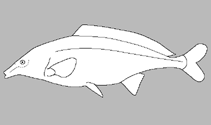
Diagnosis: Petrocephalus valentini is distinguished from all other Petrocephalus species in Central Africa by the following combination of characteristics: dorsal fin with 19-24 branched rays; anal fin with 24-26 branched rays; eye large, the ratio head length and eye-diameter between 2.9 and 3.2; mouth very small, the ratio head length and mouth width between 4.7 and 5.8; 12 teeth or fewer in the upper jaw; and 17 teeth or fewer in the lower jaw (Ref. 85331). Pigmentation pattern subtle, including two components: (1) a pale dorsal black mark on each side of the body below the anterior base of the dorsal fin, under the second to sixth dorsal rays; (2) an ovoid mark, sometimes scarcely visible, at the base of the caudal fin, extending weakly onto the upper and lower lobes of the fin (Ref. 85331).
Body shape (shape guide): fusiform / normal.
Life cycle and mating behavior
Geschlechtsreife | Fortpflanzung | Ablaichen | Eier | Fecundity | Larven
Lavoué, S., J.P. Sullivan and M.E. Arnegard, 2010. African weakly electric fishes of the genus Petrocephalus (Osteoglossomorpha: Mormyridae) of Odzala National Park, Republic of the Congo (Lékoli River, Congo River basin) with description of five new species. Zootaxa 2600:1-52. (Ref. 85331)
IUCN Rote Liste Status (Ref. 130435: Version 2025-1)
Bedrohung für Menschen
Harmless
Nutzung durch Menschen
Tools
Zusatzinformationen
Download XML
Internet Quellen
Estimates based on models
Phylogenetic diversity index (Ref.
82804): PD
50 = 0.5000 [Uniqueness, from 0.5 = low to 2.0 = high].
Bayesian length-weight: a=0.01549 (0.00684 - 0.03506), b=2.86 (2.68 - 3.04), in cm total length, based on LWR estimates for this Genus-body shape (Ref.
93245).
Trophic level (Ref.
69278): 3.2 ±0.4 se; based on size and trophs of closest relatives
Fishing Vulnerability (Ref.
59153): Low vulnerability (10 of 100).
🛈