



Baryancistrus chrysolomus Rapp Py-Daniel, Zuanon & Ribeiro de Oliveira, 2011
分類 / 名稱 俗名 | 同種異名 | Catalog of Fishes(屬, 種) | ITIS | CoL | WoRMS | Cloffa
Teleostei > Siluriformes (Catfishes) 鯰形目 (Catfishes) > Loricariidae (Armored catfishes) 甲鯰科 (Armored catfishes) > Hypostominae
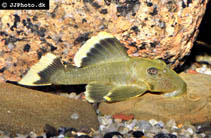
Etymology: Baryancistrus: Greek, barys = heavy + Greek, agkistron = hook (Ref. 45335); chrysolomus: Derived from the Greek 'chryso', meaning orange or yellow and 'loma', meaning border, in allusion to the colored band at the border of the dorsal and caudal fins. A noun in apposition.
Etymology: Baryancistrus: Greek, barys = heavy + Greek, agkistron = hook (Ref. 45335); chrysolomus: Derived from the Greek 'chryso', meaning orange or yellow and 'loma', meaning border, in allusion to the colored band at the border of the dorsal and caudal fins. A noun in apposition.
環境: 環境 / 氣候帶 / 深度上下限 / 配送範圍 生態學
; 淡水 居於水底的.
分布 領土 | FAO區域 | 生態系 | 發現紀錄 | 分布圖 | 簡介 | Faunafri
South America: Rio Xingu drainage in Brazil.
大小 / 重量 / 年齡
成熟度: Lm ? range ? - ? cm
Max length : 29.6 cm TL 雄魚/尚未辨別雌雄; (Ref. 111518); 最大體重: 410.00 g (Ref. 111518)
Max length : 29.6 cm TL 雄魚/尚未辨別雌雄; (Ref. 111518); 最大體重: 410.00 g (Ref. 111518)
簡短描述 檢索表 | 型態特徵 | 形態測量圖
背棘 (總數) : 2; 背的軟條 (總數) : 7; 臀鰭軟條: 5. Distinguished from its congeners by having a broad orange to yellow band along the entire distal border of dorsal and caudal fins. Can be diagnosed from other species of Baryancistrus by the combination of the following characters: absence of clear dots on the body; naked abdomen; mandibullary teeth around 70; and dark body with very faint, almost indistinguishable light marks. Both young of Baryancistrus xanthellus and Baryancistrus chrysolomus possess wide light bands on dorsal and caudal fins, but these bands are only retained in adults of Baryancistrus chrysolomus. Both species differ in body coloration, Baryancistrus xanthellus is spotted while Baryancistrus chrysolomus is almost plain (Ref. 87296).
Body shape (shape guide): elongated.
Body shape (shape guide): elongated.
Adults occur under large flat rocks settled directly on the river bottom, in places with considerable amounts of fine sediments. Young individuals inhabit marginal areas of the rapids, near the river banks, usually just one or two individuals. They occupy under rocks in places with slow to moderate flowing waters, usually with sediment accumulation over the rocks and river bottom. Based on two specimens, this species feeds mainly on diatoms and occasionally on invertebrate larvae associated with fine sediments and sand grains (Ref. 87296).
生命週期和交配行為 成熟度 | 繁殖 | 產卵場 | 卵 | 孕卵數 | 仔魚
主要參考資料
上傳您的推薦信 | 參考文獻 | 合作者 : Fisch-Muller, Sonia | 合作者
Rapp Py-Daniel, L.H., J. Zuanon and R. Ribeiro de Oliveira, 2011. Two new ornamental loricariid catfishes of Baryancistrus from rio Xingu drainage (Siluriformes: Hypostominae). Neotrop. Ichthyol. 9(2):241-252. (Ref. 87296)
CITES
Not Evaluated
對人類具威脅
人類使用
FAO - Publication: search | FishSource |
更多資訊
解剖學
鰓區
腦部
耳石
鰓區
腦部
耳石
生理學
身體成分
營養素
耗氧量
游泳類型
游泳速度
視覺色素
魚聲
疾病與寄生蟲
毒性 (LC50s)
身體成分
營養素
耗氧量
游泳類型
游泳速度
視覺色素
魚聲
疾病與寄生蟲
毒性 (LC50s)
遺傳學
基因組
遺傳學
異種性
遺傳率
遺傳多樣性
基因組
遺傳學
異種性
遺傳率
遺傳多樣性
工具
特別的報告
下載 XML
網路資源
AFORO (otoliths) | Aquatic Commons | BHL | Cloffa | Websites from users | 檢查 FishWatcher | CISTI | Catalog of Fishes: 屬, 種 | DiscoverLife | ECOTOX | FAO - Publication: search | Faunafri | Fishipedia | Fishtrace | GloBI | Google Books | Google Scholar | Google | IGFA World Record | OneZoom | Open Tree of Life | Otolith Atlas of Taiwan Fishes | PubMed | Reef Life Survey | Socotra Atlas | TreeBase | 樹狀分類階層 | Wikipedia: 去, 搜尋 | World Records Freshwater Fishing | Zoobank | 動物學的記錄
基於模型的估計
系統發育多樣性指數 (參考文獻 82804): PD50 = 0.5039 [Uniqueness, from 0.5 = low to 2.0 = high].
Bayesian length-weight: a=0.01549 (0.00854 - 0.02810), b=3.00 (2.85 - 3.15), in cm total length, based on LWR estimates for this species & (Sub)family-body (Ref. 93245).
回復力 (參考文獻 120179): 中等的, 族群倍增時間最少 1.4 - 4.4年 (Preliminary K or Fecundity.).