



Sube tu fotos y Vídeos
Imágenes | Google image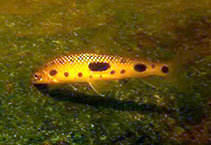 Leporinus apollo
Foto de Schönherr, K.
Imágenes | Google image
Foto de Schönherr, K.
Clasificación / Nombres Nombres comunes | Sinónimos | Catalog of Fishes(Género, Especie) | ITIS | CoL | WoRMS | Cloffa
> Characiformes (Characins) > Anostomidae (Headstanders)
Etymology: Leporinus: Latin, lepus, leporis = rabbit (Ref. 45335); apollo: Named after the god of the sun, music and healing in Greek and Roman mythology. The extremely slender form of the new species is reminiscent of the arrow that was Apollo’s favoured weapon and predominant symbol, and the yellow cast of the body and fins and the rounded shape of the lateral markings evoke the sun that was one of Apollo’s primary aspects.
Eponymy: Apollo was the god of sun, music and healing in Greek and Roman mythology, referring to the fish’s extremely slender form that is “reminiscent of the arrow that was Apollo’s favoured weapon and predominant symbol, and the yellow cast of body and [...] (Ref. 128868), visit book page.
More on authors: Sidlauskas, Mol & Vari.
Etymology: Leporinus: Latin, lepus, leporis = rabbit (Ref. 45335); apollo: Named after the god of the sun, music and healing in Greek and Roman mythology. The extremely slender form of the new species is reminiscent of the arrow that was Apollo’s favoured weapon and predominant symbol, and the yellow cast of the body and fins and the rounded shape of the lateral markings evoke the sun that was one of Apollo’s primary aspects.
Eponymy: Apollo was the god of sun, music and healing in Greek and Roman mythology, referring to the fish’s extremely slender form that is “reminiscent of the arrow that was Apollo’s favoured weapon and predominant symbol, and the yellow cast of body and [...] (Ref. 128868), visit book page.
More on authors: Sidlauskas, Mol & Vari.
Entorno: milieu / zona climática / rango de profundidad / gama de distribución Ecología
; agua dulce bentopelágico. Tropical
Distribución Territorios | Áreas FAO | Ecosistemas | Ocurrencias, apariciones | Mapa de puntos | Introducciones | Faunafri
South America: Coppename, Corantijn, and Suriname rivers in Suriname.
Tamaño / Peso / Edad
Descripción breve Claves de identificación | Morfología | Morfometría
Radios blandos dorsales (total) : 12; Radios blandos anales: 9 - 10; Vértebra: 38 - 39. Differs from all congeners except Leporinus cylindriformis, Leporinus niceforoi, Leporinus cf. niceforoi, Leporinus ortomaculatus, and a possibly undescribed species from the Amazon drainage (Leporinus sp.) by the combination of having an extremely dorsoventrally slender body (body depth immediately anterior to the dorsal-fin origin 18-23% in SL) and a pigmentation pattern including three or four large, black spots centred along the lateral-line-scale row. Can be separated from Leporinus niceforoi, Leporinus ortomaculatus, and Leporinus sp. by having six scales in a transverse series above the lateral line (in all but one examined specimen, which has five scales in that series) versus five scales in that series in all examined specimens of Leporinus niceforoi, Leporinus ortomaculatus, and Leporinus /i> sp.;
Leporinus cf. niceforoi by body depth 18.3-22.9% in SL versus 23.3-27.3% and by the typical transverse scale count at the dorsal and pelvic fin origins of 6/5 (5/5 and 6/4 each occur once) versus a typical count of 5/4 (occasionally 5/5, once 6/4, never 6/5); Leporinus cylindriformis and Leporinus niceforoi by the presence of a small, dark spot on the body immediately ventral to the seventh, eighth, or ninth scale of the lateral line, versus the absence of such a spot in those two species; and further Leporinus cylindriformis by the possession of a dark spot centered immediately posterior to the opercle and slightly ventral to the lateralline-scale row (versus the lack of such a spot), the presence of a series of nine to 14 dark bars across the dorsal surface of the body that terminate ventrally in darker areas that form an irregular stripe situated dorsal and parallel to the lateral line scale row (versus the lack of well-developed transverse bars and absence of such dark areas), and by body width 9.7-14.0% in SL (versus 15.2%) (Ref. 86822).
Body shape (shape guide): elongated.
Body shape (shape guide): elongated.
Distinct pairs breed on densely grown weedy places (Ref. 205).
Ciclo vital y comportamiento de apareamiento Madurez | Reproducción | Puesta | Huevos | Fecundidad | Larva
Distinct pairs breed on densely grown weedy places (Ref. 205).
Referencia principal
Suba sus referencias | Referencias | Coordinador : Garavello, Júlio | Colaboradores
Sidlauskas, B.L., J.H. Mol and R.P. Vari, 2011. Dealing with allometry in linear and geometric morphometrics: a taxonomic case study in the Leporinus cylindriformis group (Characiformes: Anostomidae) with description of a new species from Suriname. Zool. J. Linnean Soc. 162(1):103-130. (Ref. 86822)
Situación en la Lista Roja de la UICN (Ref. 130435: Version 2025-2 (Global))
Least Concern (LC) ; Date assessed: 13 December 2020
CITES
Not Evaluated
Amenaza para el ser humano
Harmless
Usos humanos
FAO - Publication: search | FishSource |
Más información
Ecología Trófica
Alimentos (presas)
Composición de la dieta
consumo de alimento
Raciones de comida
Despredadores
Alimentos (presas)
Composición de la dieta
consumo de alimento
Raciones de comida
Despredadores
Ecología
Ecología
Ecología
Dinámica de la población
Coeficiente del crecimiento para
Edades / tallas máximas
Longitud-peso rel.
Longitud-longitud rel.
Longitud-frecuencias
Conversión de masas
Reclutamiento
Abundancia
Coeficiente del crecimiento para
Edades / tallas máximas
Longitud-peso rel.
Longitud-longitud rel.
Longitud-frecuencias
Conversión de masas
Reclutamiento
Abundancia
Ciclo de vida
Reproducción
Madurez
Madurez/Gills rel.
Fecundidad
Puesta
Agregaciones de desove
Huevos
Desarrollo de los huevos
Larva
Dinámica larvaria
Reproducción
Madurez
Madurez/Gills rel.
Fecundidad
Puesta
Agregaciones de desove
Huevos
Desarrollo de los huevos
Larva
Dinámica larvaria
Distribución
Territorios
Áreas FAO
Ecosistemas
Ocurrencias, apariciones
Introducciones
BRUVS - Vídeos
Territorios
Áreas FAO
Ecosistemas
Ocurrencias, apariciones
Introducciones
BRUVS - Vídeos
Anatomía
Superficie branquial
Cerebro
Otolito
Superficie branquial
Cerebro
Otolito
Fisiología
Composición corporal
Nutrientes
Consumo del oxígeno
Tipo de natación
Velocidad de natación
Pigmentos visuales
Sonido de peces
Enfermedades y parásitos
Toxicidad (CL50)
Composición corporal
Nutrientes
Consumo del oxígeno
Tipo de natación
Velocidad de natación
Pigmentos visuales
Sonido de peces
Enfermedades y parásitos
Toxicidad (CL50)
Genética
Genoma
Genética
Heterocigosidad
heritabilidad
Diversidad genética
Genoma
Genética
Heterocigosidad
heritabilidad
Diversidad genética
Relacionados con el ser humano
Sistemas de acuicultura
Perfiles de acuicultura
Razas
Ciguatera cases
Sellos, monedas, varios
Sistemas de acuicultura
Perfiles de acuicultura
Razas
Ciguatera cases
Sellos, monedas, varios
Herramientas
Libro electrónico | Guía de campo | Asistente para frecuencias de tallas | Herramienta de ciclo de vida | Mapa de puntos |
Catch-MSY |
Informes especiales
Comprobar el mantenimiento del acuario | Buscar fichas sobre especies | Consulte las hojas informativas sobre acuicultura
Descargar XML
Fuentes de Internet
AFORO (otoliths) | Aquatic Commons | BHL | Cloffa | Websites from users | Check FishWatcher | CISTI | Catalog of Fishes: Género, Especie | DiscoverLife | ECOTOX | FAO - Publication: search | Faunafri | Fishipedia | Fishtrace | GloBI | Google Books | Google Scholar | Google | IGFA World Record | OneZoom | Open Tree of Life | Otolith Atlas of Taiwan Fishes | PubMed | Reef Life Survey | Socotra Atlas | TreeBase | Árbol de la vida | Wikipedia: Go, búsqueda | World Records Freshwater Fishing | Zoobank | Expediente Zoológico
Estimaciones basadas en modelos
Índice de diversidad filogenética (Referencia 82804): PD50 = 0.5000 [Uniqueness, from 0.5 = low to 2.0 = high].
Bayesian length-weight: a=0.01023 (0.00469 - 0.02234), b=3.04 (2.86 - 3.22), in cm total length, based on LWR estimates for this Genus-body shape (Ref. 93245).
Nivel trófico (Referencia 69278): 2.5 ±0.1 se; based on size and trophs of closest relatives
Resiliencia (Referencia 120179): Alto, población duplicada en un tiempo mínimo inferior a 15 meses (Preliminary K or Fecundity.).