



Hoplolatilus randalli Allen, Erdmann & Hamilton, 2010
Randall's tilefish
Beobachtung melden im Fish Watcher
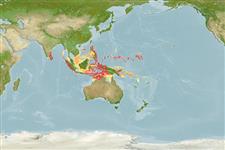
| Native range | All suitable habitat | Point map | Year 2050 |
|
| This map was computer-generated and has not yet been reviewed. |
| Hoplolatilus randalli AquaMaps Data sources: GBIF OBIS |
Hochladen Photos und videos
Bilder | Google Bild Hoplolatilus randalli
Photo von Allen, G.R.
Bilder | Google Bild
Photo von Allen, G.R.
Klassifizierung / Names Namen | Synonyme | Catalog of Fishes(Gattung, Arten) | ITIS | CoL | WoRMS | Cloffa
> Eupercaria/misc (Various families in series Eupercaria) > Malacanthidae (Tilefishes)
Etymology: Hoplolatilus: Greek, hoplon = weapon + Latin, latus = wide (Ref. 45335); randalli: Named for John E. Randall, in recognition of his numerous valuable contributions to our knowledge of Indo-Pacific fishes and particularly his previous work on the genus Hoplolatilus.
Eponymy: Dr John ‘Jack’ Ernest Randall Jr. [...] (Ref. 128868), visit book page.
Etymology: Hoplolatilus: Greek, hoplon = weapon + Latin, latus = wide (Ref. 45335); randalli: Named for John E. Randall, in recognition of his numerous valuable contributions to our knowledge of Indo-Pacific fishes and particularly his previous work on the genus Hoplolatilus.
Eponymy: Dr John ‘Jack’ Ernest Randall Jr. [...] (Ref. 128868), visit book page.
Umwelt: Milieu / Klimazone / Tiefenbereich / Verbreitungsgebiet Ökologie
seewasser riff-verbunden; tiefenbereich 30 - 85 m (Ref. 85568). Tropical
Verbreitung Territorien | FAO Gebiete | Ökosysteme | Vorkommen | Punkt Karte | Einführungen | Faunafri
Indo West Pacific: Indonesia, Philipines, Palau, Yap Is. and the Solomon Islands.
Größe / Gewicht / Alter
Kurzbeschreibung Bestimmungsschlüssel | Morphologie | Morphometrie
Rückenflossenstacheln (insgesamt) : 10; Rückenflossenweichstrahlen (insgesamt) : 13; Afterflossenstacheln: 2; Afterflossenweichstrahlen: 12; Wirbelzahl: 24. This species is distinguished by the following characters: D X,13; A II,12; pectoral rays 17; total gill rakers on first branchial arch 27-29; pored lateral line scales 84-92 with 98-120 scales in lateral series above lateral line; preopercular serrae 16-23; greatest body depth 3.4-3.9 in SL; length of last dorsal spine 2.5-3.0 in HL; longest soft dorsal ray 1.1-1.4 in HL; colour in life mainly greenish (darker dorsally), shading to light blue on lower head, thorax, and abdomen; caudal peduncle with an elongate sky aqua-blue saddle-like spot dorsally; narrow sky-blue band from front of snout to lower edge of eye; lips mainly blue; narrow yellow-orange band just below blue band, passing just under eye to posterior margin of preoperculum; dorsal and anal fins pale yellow with pink margin; caudal fin reddish with indistinct central pale streak, the upper and lower margins narrowly light blue to pinkish; pectoral fins mainly translucent except upper 4-5 rays blue; pelvic fins bluish white; iris yellow with bright blue streak dorsally and ventrally (Ref. 85568).
Body shape (shape guide): fusiform / normal; Cross section: compressed.
Body shape (shape guide): fusiform / normal; Cross section: compressed.
Inhabits gentle rubble slopes; constructs impressive rubble mounds over its burrows, which range from about 50-70 cm in height and 1.5-2 m in diameter and typically, the fish are seen hovering a short distance from their home mound, with up to six individuals using a single mound. The fish when approached closely or frightened by spear shots, quickly retreat
into the burrow, which is located near the apex of the mound (Ref. 85568).
Lebenszyklus und Paarungsverhalten Geschlechtsreife | Fortpflanzung | Ablaichen | Eier | Fruchtbarkeit | Larven
Hauptreferenz
Laden Sie Ihre Referenzen hoch | Referenzen | Koordinator : Dooley, James | Partner
Allen, G.R., M.V. Erdmann and A.M. Hamilton, 2010. Hoplolatilus randalli, a new species of sand tilefish (Pisces: Malacanthidae) from the tropical western Pacific with comments on the validity of H. luteus. aqua, Int. J. Ichthyol. 16(4):171-186. (Ref. 85568)
CITES
Not Evaluated
Bedrohung für Menschen
Harmless
Nutzung durch Menschen
Fischereien: kommerzielles potential
FAO - Publication: search | FishSource |
Mehr Information
Trophische Ökologie
Lebensmittel (Beutetiere)
Nahrungszusammensetzung
Nahrungsaufnahme
Lebensmittelrationen
Räuber
Lebensmittel (Beutetiere)
Nahrungszusammensetzung
Nahrungsaufnahme
Lebensmittelrationen
Räuber
Ökologie
Ökologie
Ökologie
Populationsdynamik
Wachstumsparameter
Max. Alter/Größen
Länge-Gewicht-Rel.
Länge-Länge-Verhältnis.
Längenhäufigkeiten
Massenkonvertierung
Rekrutierung
Dichte
Wachstumsparameter
Max. Alter/Größen
Länge-Gewicht-Rel.
Länge-Länge-Verhältnis.
Längenhäufigkeiten
Massenkonvertierung
Rekrutierung
Dichte
Lebenszyklus
Fortpflanzung
Geschlechtsreife
Reifung/Kiemen rel.
Fruchtbarkeit
Ablaichen
Laichaggregationen
Eier
Eientwicklung
Larven
Larven Pop.Dyn.
Fortpflanzung
Geschlechtsreife
Reifung/Kiemen rel.
Fruchtbarkeit
Ablaichen
Laichaggregationen
Eier
Eientwicklung
Larven
Larven Pop.Dyn.
Anatomie
Kiemenoberfläche
Gehirn
Otolith
Kiemenoberfläche
Gehirn
Otolith
Physiologie
Körperliche Zusammensetzung
Nährstoffe
Sauerstoffverbrauch
Schwimmart
Schwimmgeschwindigkeit
Visuelle Pigmente
Fischgeräusche
Krankheiten und Parasiten
Toxizität (LC50s)
Körperliche Zusammensetzung
Nährstoffe
Sauerstoffverbrauch
Schwimmart
Schwimmgeschwindigkeit
Visuelle Pigmente
Fischgeräusche
Krankheiten und Parasiten
Toxizität (LC50s)
Genetik
Genom
Genetik
Heterozygotie
Vererbbarkeit
Genetische Vielfalt
Genom
Genetik
Heterozygotie
Vererbbarkeit
Genetische Vielfalt
Menschenbezogen
Aquakultur-Systeme
Aquakultur Profile
Zuchtlinien
Ciguatera-Fälle
Briefmarken, Münzen, Verschiedenes.
Aquakultur-Systeme
Aquakultur Profile
Zuchtlinien
Ciguatera-Fälle
Briefmarken, Münzen, Verschiedenes.
Tools
Zusatzinformationen
Download XML
Zusammenfassung | Punktdaten | Namen | Photos
Internet Quellen
AFORO (otoliths) | Aquatic Commons | BHL | Cloffa | Websites from users | FishWatcher Einträge suchen | CISTI | Catalog of Fishes: Gattung, Arten | DiscoverLife | ECOTOX | FAO - Publication: search | Faunafri | Fishipedia | Fishtrace | GloBI | Google Books | Google Scholar | Google | IGFA World Record | OneZoom | Open Tree of Life | Otolith Atlas of Taiwan Fishes | PubMed | Reef Life Survey | Socotra Atlas | TreeBase | Tree of Life | Wikipedia: Gehe zu, Suchen | World Records Freshwater Fishing | Zoobank | Zoologischer Rekord
Schätzungen auf der Grundlage von Modellen
Bevorzugte Temperatur (Ref. 123201): 26.7 - 28.6, mean 27.6 °C (based on 41 cells).
Phylogenetischer Diversitätsindex (Ref. 82804): PD50 = 0.5001 [Uniqueness, from 0.5 = low to 2.0 = high].
Bayesian length-weight: a=0.01122 (0.00514 - 0.02450), b=3.04 (2.87 - 3.21), in cm total length, based on all LWR estimates for this body shape (Ref. 93245).
Trophische Ebene (Ref. 69278): 3.5 ±0.5 se; based on size and trophs of closest relatives