



Sarotherodon lamprechti Neumann, Stiassny & Schliewen, 2011
Adicionar o seu Fotografias e vídeos
Imagem do Google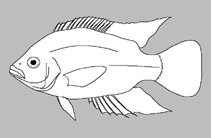 No image available for this species;
drawing shows typical species in Cichlidae.
Imagem do Google
drawing shows typical species in Cichlidae.
Classificação / Nomes Nomes comuns | Sinónimos | Catalog of Fishes(Género, Espécies) | ITIS | CoL | WoRMS | Cloffa
> Cichliformes (Cichlids, convict blennies) > Cichlidae (Cichlids) > Pseudocrenilabrinae
Etymology: Sarotherodon: Greek, saros, -ou = sawdust + Greek, ther = animal * Greek, odous = teeth (Ref. 45335); lamprechti: Named for Jürg Lamprecht (1941–2000), who worked for his PhD on haplotilapiine cichlids, and who supported UKS as a mentor, teacher and friend at the Max-Planck-Institut (Seewiesen), and DN as a teacher (Ref. 86429).
Eponymy: Jürg Lamprecht (1941–2000) was a Swiss fish behaviourist, researcher and teacher. [...] (Ref. 128868), visit book page.
Etymology: Sarotherodon: Greek, saros, -ou = sawdust + Greek, ther = animal * Greek, odous = teeth (Ref. 45335); lamprechti: Named for Jürg Lamprecht (1941–2000), who worked for his PhD on haplotilapiine cichlids, and who supported UKS as a mentor, teacher and friend at the Max-Planck-Institut (Seewiesen), and DN as a teacher (Ref. 86429).
Eponymy: Jürg Lamprecht (1941–2000) was a Swiss fish behaviourist, researcher and teacher. [...] (Ref. 128868), visit book page.
Ambiente: milieu / zona climática / intervalo de profundidade / gama de distribuição Ecologia
; Água doce pelágico(a,os,as). Tropical; 6°N - 5°N, 8°E - 9°E
Distribuição Territórios | Áreas FAO | Ecossistemas | Ocorrências | Mapa dos pontos | Introduções | Faunafri
Africa: Lake Ejagham in Cameroon (Ref. 86429).
Tamanho / Peso / Idade
Descrição breve Chaves de identificação | Morfologia | Morfometria
Espinhos dorsais (total) : 15 - 16; Raios dorsais moles (total) : 12 - 14; Espinhos anais: 3; Raios anais moles: 10 - 12. Diagnosis: Sarotherodon lamprechti is distinguished from all congeners by a lack of scales over the pectoral-fin base (Ref. 86429). Further distinguished from its sympatric sibling species, S. knauerae, and other S. galilaeus populations, by a combination of a prognathous lower jaw and an elongate ventral keel on the lower pharyngeal jaw; it also differs from the sympatric S. knauerae in a lower gill raker number, 20–25 vs. 24–30; longer pelvic fins reaching to or beyond first anal fin-spine, vs. not reaching beyond anus; from S. knauerae and other S. galilaeus populations and subspecies by long pectorals reaching the last anal fin-spine, vs. ending either in front of or at first anal fin-spine; upper lip large and prominent, upper lip length 22.5–28.4% of head length vs. 19.1– 25.4% in S. knauerae, 19.3–23.6% in neighbouring riverine S. galilaeus, 18.9–24.2% in S. g. borkuanus and 6.9–12.3% in S. g. multifasciatus; it differs from S. g. sanagaensis in lower preorbital depth, 16.3–25.2% of standard length vs. 25.0–27.8%; and from S. g. boulengeri in lower body depth, 36.3–40.4% of standard length vs. 44.5–50.0% (Ref. 86429). Finally it differs from phenotypically similar S. caroli and S. linnellii in lower gill raker number, 20–25 vs. 18–20 and 15–18; and from other Barombi Mbo Sarotherodon in higher number of dorsal fin-rays, 13–15 vs. 10–12 (Ref. 86429).
Body shape (shape guide): short and / or deep.
Body shape (shape guide): short and / or deep.
A pelagic phytoplanctivore found in Lake Ejagham; common in large swarms in open water, or on the lake bottom in deeper zones during the main breeding season (Ref. 86429). Nuptial males excavate shallow pits with narrow rims over sand, which serve as courtship territories and spawning sites; bower diameter ranges from 16-47 cm; larger bowers appear to be more common in deeper sandy areas, 3-9 m deep, where the majority of bowers are concentrated often in close proximity; neighbouring males often engage in agonistic interactions between bowers; only rarely, and only in shallow water less than 3 m deep, males in full nuptial colouration can be observed without bowers, but over natural depressions above fallen trees or flat stones (Ref. 86429). This species is a female mouth-brooder (Ref. 86429).
pelagic phytoplanctivore found in open water or on lake bottom in deeper zones; nuptial males excavate shallow pits with narrow rims over sand which serve as courtship territories and spawning sites; neighbouring males often engage in agonistic interactions between bowers; female mouth-brooder; reproduction takes place in the rainy season (August/September) (Ref. 86429).
Ciclo de vida e comportamento de acasalamento Maturidade | Reprodução | Desova | Ovos | Fecundidade | Larvas
Nuptial males excavate shallow pits with narrow rims over sand, which serve as courtship territories and spawning sites; bower diameter ranges from 16-47 cm; larger bowers appear to be more common in deeper sandy areas, 3-9 m deep, where the majority of bowers are concentrated often in close proximity; neighbouring males often engage in agonistic interactions between bowers; only rarely, and only in shallow water less than 3 m deep, males in full nuptial colouration can be observed without bowers, but over natural depressions above fallen trees or flat stones (Ref. 86429). This species is a female mouth-brooder (Ref. 86429).
Referência principal
Carregar as suas referências | Referências | Coordenador : Kullander, Sven O. | Colaboradores
Neumann, D., M.L.J. Stiassny and U.K. Schliewen, 2011. Two new sympatric Sarotherodon species (Pisces: Cichlidae) endemic to Lake Ejagham, Cameroon, west-central Africa, with comments on the Sarotherodon galilaeus species complex. Zootaxa 2765:1-20 (Ref. 86429)
Categoria na Lista Vermelha da IUCN (Ref. 130435: Version 2025-2 (Global))
Criticamente ameaçada (CR) (B1ab(iii)+2ab(iii)); Date assessed: 15 October 2014
CITES
Not Evaluated
Ameaça para o homem
Harmless
Utilização humana
FAO - Publication: search | FishSource |
Mais informação
Ecologia Trófica
Produtos alimentares (presas)
Composição da dieta
Consumo alimentar
Rações alimentares
Predadores
Produtos alimentares (presas)
Composição da dieta
Consumo alimentar
Rações alimentares
Predadores
Dinâmica das populações
Parâmetros de crescimento
Idades / tamanhos máximos
Comprimento-peso rel.
Comprimento-comprimento rel.
Frequência de comprimento
Conversão de massa
Recrutamento
Abundância
Parâmetros de crescimento
Idades / tamanhos máximos
Comprimento-peso rel.
Comprimento-comprimento rel.
Frequência de comprimento
Conversão de massa
Recrutamento
Abundância
Ciclo de vida
Reprodução
Maturidade
Maturidade/Rel. das guelras
Fecundidade
Desova
Agregações de desova
Ovos
Desenvolvimento dos ovos
Larvas
Dinâmica larvar
Reprodução
Maturidade
Maturidade/Rel. das guelras
Fecundidade
Desova
Agregações de desova
Ovos
Desenvolvimento dos ovos
Larvas
Dinâmica larvar
Anatomia
Área branquial
Cérebro
Otólitos
Área branquial
Cérebro
Otólitos
Fisiologia
Composição corporal
Nutrientes
Consumo de oxigénio
Tipo de natação
Velocidade de natação
Pigmentos visuais
Som de peixe
Doenças e Parasitas
Toxicidade (LC50s)
Composição corporal
Nutrientes
Consumo de oxigénio
Tipo de natação
Velocidade de natação
Pigmentos visuais
Som de peixe
Doenças e Parasitas
Toxicidade (LC50s)
Genética
genoma
Genética
Heterozigotia
Hereditariedade
Diversidade genética
genoma
Genética
Heterozigotia
Hereditariedade
Diversidade genética
Relacionado com o ser humano
Sistemas de aquacultura
Perfis para aquacultura
Estirpes
Casos de Ciguatera
Selos, moedas, diversos.
Sistemas de aquacultura
Perfis para aquacultura
Estirpes
Casos de Ciguatera
Selos, moedas, diversos.
Ferramentas
E-book | Guia de campo | Ferramenta auxiliar de frequências de comprimento | Ferramenta sobre a história de vida | Mapa dos pontos |
Captura-MSY |
Relatórios especiais
Descarregue XML
Fontes da internet
AFORO (otoliths) | Aquatic Commons | BHL | Cloffa | Websites from users | Consultar FishWatcher | CISTI | Catalog of Fishes: Género, Espécies | DiscoverLife | ECOTOX | FAO - Publication: search | Faunafri | Fishipedia | Fishtrace | GloBI | Google Books | Google Scholar | Google | IGFA World Record | OneZoom | Open Tree of Life | Otolith Atlas of Taiwan Fishes | PubMed | Reef Life Survey | Socotra Atlas | TreeBase | Árvore da vida | Wikipedia: ir para, procurar | World Records Freshwater Fishing | Zoobank | Registo zoológico
Estimativas baseadas em modelos
Índice de diversidade filogenética (Ref. 82804): PD50 = 0.5001 [Uniqueness, from 0.5 = low to 2.0 = high].
Bayesian length-weight: a=0.01905 (0.00846 - 0.04293), b=3.01 (2.82 - 3.20), in cm total length, based on LWR estimates for this (Sub)family-body shape (Ref. 93245).
Nível Trófico (Ref. 69278): 2.4 ±0.2 se; based on size and trophs of closest relatives