



Trichogenes claviger de Pinna, Helmer, Britski & Nunes, 2010
Uploaden van uw Foto's en video's
Afbeeldingen | Google afbeelding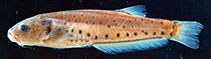 Trichogenes claviger
Afbeelding van Sarmento-Soares, L.M.
Afbeeldingen | Google afbeelding
Afbeelding van Sarmento-Soares, L.M.
Classificatie / Namen Lokale namen | Synoniemen | Catalog of Fishes(Genus, Soort(en)) | ITIS | CoL | WoRMS | Cloffa
> Siluriformes (Catfishes) > Trichomycteridae (Pencil or parasitic catfishes) > Trichogeninae
Etymology: Trichogenes: Greek, thrix = hair + Greek, genes, genesis = birth, race (Ref. 45335); claviger: The specific name refers to club-bearing in Latin, an allusion to the peculiar shape of the hypertrophied posterior process of the opercle in males of this species. An adjective.
Etymology: Trichogenes: Greek, thrix = hair + Greek, genes, genesis = birth, race (Ref. 45335); claviger: The specific name refers to club-bearing in Latin, an allusion to the peculiar shape of the hypertrophied posterior process of the opercle in males of this species. An adjective.
Milieu: milieu / Klimaatzone / Diepte / verspreidingsgebied Ecologie
; zoet water demersaal. Tropical
Verspreiding Gebieden | FAO regio's | Ecosystemen | Voorkomen | Verspreidingskaart | Introducties | Faunafri
South America: known only from the type locality, an upland tributary of the headwaters of the rio Itapemirim drainage in southeastern Brazil.
Grootte / Gewicht / Leeftijd
Korte beschrijving Determinatiesleutels | Morfologie | Morfometrie
Three autapomorphies distinguish T. claviger from all other members of the family: the sexually dimorphic posterior process of the opercle, much elongated in males (vs. short in both males and females); the terminal mouth (vs.subterminal or inferior); and the presence of an anterodorsal claw-like process on the dorsal surface of the neural arch of each of the anterior four free vertebrae. This species is distinguished from T. longipinnis, by several additional characteristics (some of which may also be autapomorphic, pending more detailed analysis): shape of the interopercle, with odontodes extending onto the posterodorsal margin of the interopercle on a bony expansion (vs. odontodes mostly restricted to ventral and posterior margins of the bone); posterior naris broader than long (vs. round); presence of an entirely differentiated fleshy lobe laterally on the lower lip (vs. fleshy lobe mostly continuous with the lower lip); no branched anal-fin rays in specimens of any size (vs. most rays branched in specimens over 41 mm SL); less deep caudal peduncle, 9.3-11.5 (vs. 10.3-12.6% SL); deeper head, head depth 72.9-86.6 (vs. 50.3-62.8% HL); no antorbital (vs. plate-like antorbital present dorsally to antorbital process of lateral ethmoid); deep coronoid process of the lower jaw (vs. coronoid process approximately one-third less deep); flattened bifurcated tooth cusps, with roundish margins (vs. bifurcated tooth cusps conical, pointed); vertebrae 35 (vs. 38 or 39); branchiostegal rays 6 (vs. 7); no pelvic splint (vs. present); pleural ribs 8 (vs. 10 or 11); few sparse dark spots on body (spots more numerous and more densely arranged); well-defined thin dark line along base of anal fin, formed by a regular row of slanted elongate spots on the distal portion of each pterygiophore (vs. no such line); no dark spots on the sides of head (vs. lateral surfaces of head with roundish spots); dark spots on body not extending onto base of caudal fin (vs. spots covering bases of principal caudal-fin rays). The deepest part of the body of T. claviger is at the middle of the abdomen, continuously less deep posteriorly to the base of the caudal fin, and the dorsal and ventral profiles of the head forming broad symmetrical arcs with the body profile, and these result in a rather different general aspect when compared to T. longipinnis, where the deepest part of the body is at the origin of the anal fin, and the body depth is approximately even along its entire length, only slightly decreasing towards the caudal fin. Also, the dorsal and ventral profiles of the head and body are not symmetrical, in T. claviger, it is gently convex and in T. longipinnis it is approximately straight (Ref. 85858).
Body shape (shape guide): elongated.
Body shape (shape guide): elongated.
The specimens were collected in a shallow sector (ca. 30 cm) of the córrego Picada Comprida, on a plateau at ca. 1150 m altitude, water is darkly tea-stained and transparent, with slow current and negligible altitudinal gradient. The stream runs through an area of moderately impacted high-altitude rainforest mingled with sectors of exotic pine culture. The substrate is mostly exposed sand, with masses of accumulated leaf litter and other vegetable debris in many spots. Fish were concentrated on quiet shaded areas with litter, swimming in midwater, and were collected with hand seines. No associated fish species were found with this species. Gut contents revealed numerous disarticulated arthropod remains, indicating that the feeding habits of the species are broadly similar to those of T. longipinnis. The species were also observed swimming in two other nearby spots in tributaries to the córrego Picada Comprida, but were not seen in four additional collection points in the same stream system and their distribution seems to be patchy (Ref. 85858).
Levenscyclus en paargedrag Maturiteit | Voortplanting | Paaien | Eieren | Fecunditeit | Larven
Hoofdreferentie
Upload uw referenties | Referenties | Coördinator : Pinna, Mário de | Medewerkers
de Pinna, M.C.C., J.L. Helmer, H.A. Britski and L.R. Nunes, 2010. A new species of Trichogenes from the rio Itapemirim drainage, southeastern Brazil, with comments on the monophyly of the genus (Siluriformes: Trichomycteridae). Neotrop. Ichthyol. 8(4):707-717. (Ref. 85858)
Status op de Rode Lijst van het IUCN (Ref. 130435: Version 2025-2 (Global))
Ernstig bedreigd (CR) (B2ab(iii)); Date assessed: 07 November 2018
CITES
Not Evaluated
Gevaar voor de mens
Harmless
Gebruik door de mens
FAO - Publication: search | FishSource |
Meer informatie
Trofische ecologie
Voedsel (prooien)
Dieetsamenstelling
Voedselconsumptie
Voedselrantsoenen
Predatoren
Voedsel (prooien)
Dieetsamenstelling
Voedselconsumptie
Voedselrantsoenen
Predatoren
Ecologie
Ecologie
Ecologie
Populatiedynamica
Groeiparameters
Max. leeftijden / maten
Lengte-gewicht rel.
Lengte-lengte rel.
Lengtefrequenties
Massaconversie
Rekrutering
Abundantie
Groeiparameters
Max. leeftijden / maten
Lengte-gewicht rel.
Lengte-lengte rel.
Lengtefrequenties
Massaconversie
Rekrutering
Abundantie
Levenscyclus
Voortplanting
Maturiteit
Rijpheid/kieuwen rel.
Fecunditeit
Paaien
Paaibestanden
Eieren
Ontwikkeling van de eieren
Larven
Larvale populatiedynamiek
Voortplanting
Maturiteit
Rijpheid/kieuwen rel.
Fecunditeit
Paaien
Paaibestanden
Eieren
Ontwikkeling van de eieren
Larven
Larvale populatiedynamiek
Anatomie
Kieuwoppervlak
Hersenen
Otoliet
Kieuwoppervlak
Hersenen
Otoliet
Fysiologie
Lichaamssamenstelling
Voedingsstoffen
Zuurstofverbruik
Type zwemmen
Zwemsnelheid
Visuele pigmenten
Vis geluid
Ziekten en parasieten
Toxiciteit (LC50)
Lichaamssamenstelling
Voedingsstoffen
Zuurstofverbruik
Type zwemmen
Zwemsnelheid
Visuele pigmenten
Vis geluid
Ziekten en parasieten
Toxiciteit (LC50)
Genetica
genoom
Genetica
Heterozygositeit
Erfelijkheid
Genetische diversiteit
genoom
Genetica
Heterozygositeit
Erfelijkheid
Genetische diversiteit
Menselijk gerelateerd
Aquacultuursystemen
Aquacultuurprofielen
Kweeklijnen
Ciguatera gevallen
Postzegels, munten, diversen.
Aquacultuursystemen
Aquacultuurprofielen
Kweeklijnen
Ciguatera gevallen
Postzegels, munten, diversen.
Tools
Speciale rapporten
Bekijk gegevens voor het houden in een aquarium | Bekijk Fact Sheets voor de soort | Bekijk Aquacultuur Fact Sheets
Download XML
Internetbronnen
AFORO (otoliths) | Aquatic Commons | BHL | Cloffa | Websites from users | Bekijk FishWatcher | CISTI | Catalog of Fishes: Genus, Soort(en) | DiscoverLife | ECOTOX | FAO - Publication: search | Faunafri | Fishipedia | Fishtrace | GloBI | Google Books | Google Scholar | Google | IGFA World Record | OneZoom | Open Tree of Life | Otolith Atlas of Taiwan Fishes | PubMed | Reef Life Survey | Socotra Atlas | TreeBase | Tree of Life | Wikipedia: ga naar, zoek | World Records Freshwater Fishing | Zoobank | Zoological Record
Schattingen op basis van modellen
Fylogenetische diversiteitsindex (Ref. 82804): PD50 = 0.7500 [Uniqueness, from 0.5 = low to 2.0 = high].
Bayesian length-weight: a=0.00389 (0.00180 - 0.00842), b=3.12 (2.94 - 3.30), in cm total length, based on all LWR estimates for this body shape (Ref. 93245).
Trofisch niveau (Ref. 69278): 3.2 ±0.4 se; based on size and trophs of closest relatives