This website uses cookies to enhance your browsing experience and ensure the functionality of our site. For more detailed information about the types of cookies we use and how we protect your privacy, please visit our Privacy Information page.
×
Cookie Settings
This website uses different types of cookies to enhance your experience. Please select your preferences below:
Clasificación / Nombres Nombres comunes | Sinónimos | Catalog of Fishes(Género, Especie) | ITIS | CoL | WoRMS | Cloffa
> Siluriformes (Catfishes) > Loricariidae (Armored catfishes) > Hypoptopomatinae
Etymology: Microlepidogaster:Greek, mikros = small + Greek, lepis = scale + Greek, gaster = stomach (Ref. 45335); longicolla:The specific name longicolla is from the Latin longus (long) and collum (neck), meaning long-necked in allusion to the long predorsal region resulting from the posterior shift of the dorsal fin. An adjective. More on authors: Calegari & Reis.
Entorno: milieu / zona climática / rango de profundidad / gama de distribución Ecología
South America: upper reaches of the rio São Bartolomeu, a tributary to the rio Corumbá, itself a tributary to the rio Paranaíba of the upper rio Paraná basin near Brasília in central Brazil.
Tamaño / Peso / Edad
Madurez: Lm? range ? - ? cm Max length : 4.6 cm SL macho / no sexado; (Ref. 99822)
Descripción breve Claves de identificación | Morfología | Morfometría
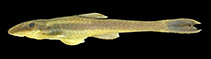
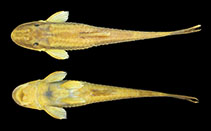
Espinas dorsales (total) : 2; Radios blandos dorsales (total) : 7; Radios blandos anales: 6; Vértebra: 31 - 33. Distinguished from Microlepidogaster perforatus, the only other species in this genus, by the possession of a continuous lateral line, median lateral plate series reaching, rather than falling short of, the end of the caudal peduncle, a shorter pectoral-fin spine (13.4-16.2 vs. 18.2-21.0% standard length), a smaller interorbital distance (38.9-43.1 vs. 47.7-53.3% head length), more numerous dentary teeth (16-29 vs. 12-15), the anterior margin of the snout naked (vs. the snout completely covered by plates), the preopercle not contacting the fourth postrostral plate (vs. the preopercle contacting and extending to midlength of that plate), the absence of the anterior processes of the supraneural (vs. supraneural bearing a bilateral pair of processes along its anterior margin), and the dorsal fin located more posteriorly relative to the parietosupraoccipital, where the neural spine of the tenth or eleventh vertebral centrum supports the compound supraneural plus first pterygiophore of the dorsal fin (vs. compound supraneural plus first pterygiophore supported by the neural spine of the eighth or ninth vertebra. Exhibits a remarkable suite of secondary sexually dimorphic characters, involving the presence of a conical urogenital papilla in males, the presence of a fleshy flap along the dorsal margin of first thickened pelvic-fin ray of males, longer pelvic fin in males, and a more strongly arched first pelvic-fin ray in females (Ref. 85171). Body shape (shape guide): elongated.
Facultative air-breathing in the genus (Ref. 126274)
Ciclo vital y comportamiento de apareamiento Madurez | Reproducción | Puesta | Huevos | Fecundidad | Larva
Calegari, B.B. and R.E. Reis, 2010. A new species of Microlepidogaster (Siluriformes: Loricariidae: Hypoptopomatinae) from the upper rio Paraná basin, Brazil. Neotrop. Ichthyol. 8(3):625-630. (Ref. 85171)
Situación en la Lista Roja de la UICN (Ref. 130435: Version 2025-2 (Global))
Ecología Trófica Alimentos (presas) Composición de la dieta consumo de alimento Raciones de comida Despredadores
Ecología Ecología
Dinámica de la población Coeficiente del crecimiento para Edades / tallas máximas Longitud-peso rel. Longitud-longitud rel. Longitud-frecuencias Conversión de masas Reclutamiento Abundancia
Ciclo de vida Reproducción Madurez Madurez/Gills rel. Fecundidad Puesta Agregaciones de desove Huevos Desarrollo de los huevos Larva Dinámica larvaria
Fisiología Composición corporal Nutrientes Consumo del oxígeno Tipo de natación Velocidad de natación Pigmentos visuales Sonido de peces Enfermedades y parásitos Toxicidad (CL50)
Índice de diversidad filogenética (Referencia 82804): PD50 = 0.5039 [Uniqueness, from 0.5 = low to 2.0 = high].
Bayesian length-weight: a=0.00977 (0.00434 - 0.02202), b=3.06 (2.87 - 3.25), in cm total length, based on LWR estimates for this (Sub)family-body shape (Ref. 93245).
Vulnerabilidad pesquera (Ref. 59153): Low vulnerability (10 of 100). 🛈