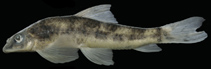
Classification / Names
Noms communs | Synonymes | Catalog of Fishes(Genre, Espèce) | ITIS | CoL | WoRMS | Cloffa
>
Cypriniformes (Carps) >
Psilorhynchidae (Mountain carps)
Etymology: Psilorhynchus: Greek, psilos = hairless + Greek, rhyngchos = snout (Ref. 45335); pavimentatus: From the Latin adjective pavimentatus, meaning furnished with a pavement, paved, in reference to the color pattern of this species.
More on authors: Conway & Kottelat.
Environment: milieu / climate zone / profondeur / distribution range
Écologie
; eau douce benthopélagique. Tropical
Asia: headwaters of Ann Chaung drainage in Myanmar.
Taille / Poids / Âge
Maturité: Lm ? range ? - ? cm
Max length : 5.0 cm SL mâle / non sexé; (Ref. 85100)
Description synthétique
Clés d'identification | Morphologie | Morphométrie
Rayons mous dorsaux (Total) : 12; Rayons mous anaux: 8; Vertèbres: 34. Shares with its most similar congeners Psilorhynchus amplicephalus, Psilorhynchus balitora and Psilorhynchus nepalensis a low number of rays in the upper caudal fin
lobe and in terms of general appearance. Diagnosed from these species and all other congeners by presence of sexually dimorphic pectoral fins, which are much longer in males than in females (vs. pectoral fins of both sexes equal in size or only slightly longer in males). Differs further from Psilorhynchus amplicephalus, Psilorhynchus balitora and Psilorhynchus nepalensis by its higher number of principal rays in the lower caudal-fin lobe (9 vs. 8 in Psilorhynchus amplicephalus and Psilorhynchus nepalensis, 7-8 in Psilorhynchus balitora), and from Psilorhynchus balitora by the absence (vs. presence) of scales from the midventral region between pectoral fins. Can be easily separated from three other congeners (Psilorhynchus breviminor, Psilorhynchus robustus, and the sympatric Psilorhynchus melissa) in Myanmar by having lower number of principal rays in the upper caudal-fin lobe (9 vs. 10) (Ref. 85100).
Body shape (shape guide): elongated.
Collected together with Akysis vespertinus, Psilorhynchus melissa and other new fish species from the headwaters of Ann Chaung drainage in Myanmar (Ref. 85100).
Life cycle and mating behavior
Maturité | Reproduction | Frai | Œufs | Fécondité | Larves
Conway, K.W. and M. Kottelat, 2010. Two new species of torrent minnow (Ostariophysi: Psilorhynchidae) from western Myanmar. Raffles Bull. Zool. 58(2):259-267. (Ref. 85100)
Statut dans la liste rouge de l'IUCN (Ref. 130435: Version 2025-1)
Menace pour l'homme
Harmless
Utilisations par l'homme
Outils
Articles particuliers
Télécharger en XML
Sources Internet
Estimates based on models
Phylogenetic diversity index (Réf.
82804): PD
50 = 0.5000 [Uniqueness, from 0.5 = low to 2.0 = high].
Bayesian length-weight: a=0.00417 (0.00183 - 0.00952), b=3.16 (2.95 - 3.37), in cm total length, based on LWR estimates for this (Sub)family-body shape (Ref.
93245).
Niveau trophique (Réf.
69278): 3.0 ±0.2 se; based on size and trophs of closest relatives
Fishing Vulnerability (Ref.
59153): Low vulnerability (10 of 100).
🛈