



Navigobius dewa Hoese & Motomura, 2009
Envoyez vos Photos et vidéos
Images | Images Google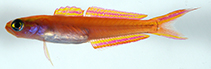 Navigobius dewa
Photo de Motomura, H.
Images | Images Google
Photo de Motomura, H.
Classification / Noms Noms communs | Synonymes | Catalog of Fishes(Genre, Espèce) | ITIS | CoL | WoRMS | Cloffa
> Gobiiformes (Gobies) > Microdesmidae (Wormfishes) > Ptereleotrinae
Etymology: Navigobius: Name from Latin ' navi' meaning to float or swim, an allusion to the swimming habits of the species; dewa: Named for Mr. Shin’ichi Dewa; noun in apposition.
Eponymy: Shin-ichi Dewa is an amateur ichthyologist from Kagoshima, Japan, the type locality. He has co-authored at least seven papers including: Global warming and comparison of fish fauna in southern Japan (2014). He collected the type. (See also DewaPyle) (Ref. 128868), visit book page.
More on authors: Hoese & Motomura.
Etymology: Navigobius: Name from Latin ' navi' meaning to float or swim, an allusion to the swimming habits of the species; dewa: Named for Mr. Shin’ichi Dewa; noun in apposition.
Eponymy: Shin-ichi Dewa is an amateur ichthyologist from Kagoshima, Japan, the type locality. He has co-authored at least seven papers including: Global warming and comparison of fish fauna in southern Japan (2014). He collected the type. (See also DewaPyle) (Ref. 128868), visit book page.
More on authors: Hoese & Motomura.
Environnement : milieu / zone climatique / profondeur / gamme de distribution Écologie
marin démersal; profondeur 45 - 85 m (Ref. 83368). Subtropical
Distribution Territoires | Zones FAO | Écosystèmes | Occurrences | Carte par point | Introductions | Faunafri
Northwest Pacific: currently known only from southern Japan.
Taille / Poids / Âge
Maturité: Lm ? range ? - ? cm
Max length : 4.1 cm SL (female)
Max length : 4.1 cm SL (female)
Description synthétique Clés d'identification | Morphologie | Morphométrie
Épines dorsales (Total) : 7; Rayons mous dorsaux (Total) : 19; Épines anales: 1; Rayons mous anaux: 19 - 20; Vertèbres: 26. This species is distinguished by the following characters: lower lip with free ventral margin over whole length, the fold narrowing at anterior tip of lower jaw; compressed head and body; elongated body; naked cheek, preoperculum and operculum while most of the body scaled; most scales are cycloid, but with ctenoid patch below pectoral fin and on posterior region of caudal peduncle, imbricate, in 92-97 vertical rows; terminal mouth only slightly protrusible, forming an angle of 27-37° to longitudinal axis of body; maxilla reaching posteriorly to below the middle of eye; head pores are paired laterally, with 4 pores around dorsal margin of each eye; relatively short and rounded snout with length less than eye diameter; anterior nostril at the end of a short tube while posterior nostril a simple pore; head papillae in a transverse pattern; median nuchal crest, formed by very low fold of skin, from first dorsal spine onto head to just above the middle to posterior end of operculum; gill opening is moderate, extending from upper pectoral-fin base ventrally to just below posterior preopercular margin; interorbital about three-quarters diameter of eye; gill rakers on first arch 5+1+10, spatulate and elongate; all rakers are ossified, those on second, third and fourth arches tuberculate, with dorsal spiny projections; D1 VI, D2 I,19; A I,19-20; pectoral-fin rays 20; segmented caudal-fin rays usually 9+8; branched caudal-fin rays 6+5; pelvic fins are separate, each with rays I,4; vertebrae 10+16; branchiostegals 5 (Ref. 83368).
Body shape (shape guide): elongated; Cross section: compressed.
Body shape (shape guide): elongated; Cross section: compressed.
An epibenthic species found in sandy and muddy bottoms on the steep slope. Adults form epibenthic schools, comprising 10-300 individuals (in Kagoshima Bay) (Ref. 83368).
Cycle de vie et comportement reproducteur Maturité | Reproduction | Frai | Œufs | Fécondité | Larves
Référence principale
Téléchargez vos références | Références | Coordinateur : Randall, John E. | Collaborateurs
Hoese, D.F. and H. Motomura, 2009. Descriptions of two new genera and species of ptereleotrine fishes from Australia and Japan (Teleostei: Gobioidei) with discussion of possible relationships. Zootaxa 2312:49-59. (Ref. 83368)
Statut dans la liste rouge de l'IUCN (Ref. 130435: Version 2025-2 (Global))
Préoccupation mineure (LC) ; Date assessed: 21 March 2024
CITES
Not Evaluated
Menace pour l'homme
Harmless
Utilisations par l'homme
FAO - Publication: search | FishSource |
Plus d'informations
Écologie trophique
Aliments (proies)
Composition du régime alimentaire
Consommation alimentaire
Rations alimentaires
Prédateurs
Aliments (proies)
Composition du régime alimentaire
Consommation alimentaire
Rations alimentaires
Prédateurs
Écologie
Écologie
Écologie
Dynamique des populations
Paramètres de croissance
Âges / tailles maximales
Longueur-poids rel.
Rel. longueur-longueur.
Fréquences de longueurs
Conversion de masse
Recrutement
Abondance
Paramètres de croissance
Âges / tailles maximales
Longueur-poids rel.
Rel. longueur-longueur.
Fréquences de longueurs
Conversion de masse
Recrutement
Abondance
Cycle de vie
Reproduction
Maturité
Maturité/épines rel.
Fécondité
Frai
Agrégats de frai
Œufs
Développement de l'œuf
Larves
Dynamique des populations larvaires
Reproduction
Maturité
Maturité/épines rel.
Fécondité
Frai
Agrégats de frai
Œufs
Développement de l'œuf
Larves
Dynamique des populations larvaires
Anatomie
Surface branchiale
Cerveau
Otolithe
Surface branchiale
Cerveau
Otolithe
Physiologie
Composition corporelle
Nutriments
Consommation d'oxygène
Type de natation
Vitesse de nage
Pigments visuels
Son de poisson
Maladies et parasites
Toxicité (CL50)
Composition corporelle
Nutriments
Consommation d'oxygène
Type de natation
Vitesse de nage
Pigments visuels
Son de poisson
Maladies et parasites
Toxicité (CL50)
Génétique
génôme
Génétique
Hétérozygotie
Héritabilité
Diversité génétique
génôme
Génétique
Hétérozygotie
Héritabilité
Diversité génétique
Liées à l'homme
Systèmes d'aquaculture
Profils d'aquaculture
Souches
Cas de ciguatera
Timbres, pièces de monnaie, divers
Systèmes d'aquaculture
Profils d'aquaculture
Souches
Cas de ciguatera
Timbres, pièces de monnaie, divers
Outils
E-book | Guide de terrain | Générateur de fréquences de longueur | Outil de dynamique de population | Carte par point |
Capture-MSY |
Articles particuliers
Télécharger en XML
Sources Internet
AFORO (otoliths) | Aquatic Commons | BHL | Cloffa | Websites from users | FishWatcher | CISTI | Catalog of Fishes: Genre, Espèce | DiscoverLife | ECOTOX | FAO - Publication: search | Faunafri | Fishipedia | Fishtrace | GloBI | Google Books | Google Scholar | Google | IGFA World Record | OneZoom | Open Tree of Life | Otolith Atlas of Taiwan Fishes | PubMed | Reef Life Survey | Socotra Atlas | TreeBase | Arbre de Vie | Wikipedia: aller à, chercher | World Records Freshwater Fishing | Zoobank | Zoological Record
Estimations basées sur des modèles
Indice de diversité phylogénétique (Réf. 82804): PD50 = 0.5625 [Uniqueness, from 0.5 = low to 2.0 = high].
Bayesian length-weight: a=0.00389 (0.00180 - 0.00842), b=3.12 (2.94 - 3.30), in cm total length, based on all LWR estimates for this body shape (Ref. 93245).
Niveau trophique (Réf. 69278): 3.2 ±0.4 se; based on size and trophs of closest relatives