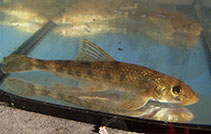
Klassifizierung / Names
Namen | Synonyme | Catalog of Fishes(Gattung, Arten) | ITIS | CoL | WoRMS | Cloffa
Environment: milieu / climate zone / Tiefenbereich / distribution range
Ökologie
; süßwasser benthopelagisch. Temperate
Europe and Asia: Aegean basin, from Maritza to Aliakmon drainages (Turkey, Bulgaria, Greece, Macedonia). Populations from Maritza and Vardar drainages probably represent two species, Gobio bulgaricus and Gobio balcanicus.
Size / Gewicht / Alter
Geschlechtsreife: Lm ? range ? - ? cm
Max length : 9.0 cm SL Männchen/unbestimmt; (Ref. 59043)
Kurzbeschreibung
Bestimmungsschlüssel | Morphologie | Morphometrie
Diagnosed from other congeners in Adriatic and Aegean Sea basin by having the following characters: scales between anus and anal origin 4-6; head length 25-29% SL; breast scaled between pectorals, scales reaching forward beyond base of pectoral (at least in some individuals of any population); scales on lateral line usually 35-38 + 3 ; scale rows around caudal peduncle 14-16; eye diameter 1.1-1.5 times in interorbital distance (Ref. 59043).
Body shape (shape guide): elongated.
Found in stretches of streams and rivers with moderate flow, usually on sand bottom (Ref. 59043). Size reaches up to about 9 cm SL (Ref. 59043).
Life cycle and mating behavior
Geschlechtsreife | Fortpflanzung | Ablaichen | Eier | Fecundity | Larven
Kottelat, M. and J. Freyhof, 2007. Handbook of European freshwater fishes. Publications Kottelat, Cornol and Freyhof, Berlin. 646 pp. (Ref. 59043)
IUCN Rote Liste Status (Ref. 130435: Version 2025-1)
Bedrohung für Menschen
Harmless
Nutzung durch Menschen
Tools
Zusatzinformationen
Download XML
Internet Quellen
Estimates based on models
Phylogenetic diversity index (Ref.
82804): PD
50 = 0.5000 [Uniqueness, from 0.5 = low to 2.0 = high].
Bayesian length-weight: a=0.00708 (0.00304 - 0.01646), b=3.13 (2.96 - 3.30), in cm total length, based on LWR estimates for this Genus-body shape (Ref.
93245).
Trophic level (Ref.
69278): 3.2 ±0.4 se; based on size and trophs of closest relatives
Widerstandsfähigkeit (Ref.
120179): hoch, Verdopplung der Population dauert weniger als 15 Monate. (Preliminary K or Fecundity.).
Fishing Vulnerability (Ref.
59153): Low vulnerability (10 of 100).
🛈