



Beobachtung melden im Fish Watcher
| Native range | All suitable habitat | Point map | Year 2050 |

|
| This map was computer-generated and has not yet been reviewed. |
| Mobula alfredi AquaMaps Data sources: GBIF OBIS |
Hochladen Photos und videos
Bilder | videos | Briefmarken, Münzen, Verschiedenes. | Google Bild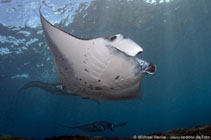 Mobula alfredi
Photo von Henke, M.
Bilder | videos | Briefmarken, Münzen, Verschiedenes. | Google Bild
Photo von Henke, M.
Klassifizierung / Names Namen | Synonyme | Catalog of Fishes(Gattung, Arten) | ITIS | CoL | WoRMS | Cloffa
Elasmobranchii (Haie und Rochen) (sharks and rays) > Myliobatiformes (Stingrays) > Mobulidae (Devilrays)
Eponymy: Prince Alfred, Duke of Edinburgh (1844–1900) was a son of Queen Victoria who ruled as Duke of Saxe-Coburg and Gotha (1893) in the Prussian Empire. [...] (Ref. 128868), visit book page.
Eponymy: Prince Alfred, Duke of Edinburgh (1844–1900) was a son of Queen Victoria who ruled as Duke of Saxe-Coburg and Gotha (1893) in the Prussian Empire. [...] (Ref. 128868), visit book page.
Umwelt: Milieu / Klimazone / Tiefenbereich / Verbreitungsgebiet Ökologie
seewasser; süßwasser benthopelagisch; tiefenbereich 0 - 120 m (Ref. 86942). Tropical; 32°N - 34°S, 30°E - 134°W
Verbreitung Territorien | FAO Gebiete | Ökosysteme | Vorkommen | Punkt Karte | Einführungen | Faunafri
Indo-Pacific: Red Sea, South Africa, Thailand to Western Australia.; north to Japan (Yaeyama Is.), to Solitary Is., Australia as far east as French Polynesia and the Hawaiian Is. Reported in the Atlantic (Canary and Cape Verde islands) but this species may be restricted more or less to the Indian and Western Pacific only (McEachran, pers.comm. 03/10).
Länge bei der ersten Reifung / Größe / Gewicht / Alter
Geschlechtsreife: Lm 371.1, range 324 - 390 cm
Max length : 450 cm WD Männchen/unbestimmt; (Ref. ); max. veröff. Alter: 31 Jahre (Ref. 97313)
Max length : 450 cm WD Männchen/unbestimmt; (Ref. ); max. veröff. Alter: 31 Jahre (Ref. 97313)
Kurzbeschreibung Bestimmungsschlüssel | Morphologie | Morphometrie
This species is characterized by the following: disc approximately 2.2-2.4 times as broad as it is long, the maximum disc width size approximately 550 cm; slender whip-like tail approximately 123% of disc length if intact; no distinct caudal spine or cartilaginous mass at base of tail; some specimens have small hump at the base of the tail on the dorsal surface, while others have a slight depression and groove on the dorsum of the tail immediately posterior to the posterior margin of the dorsal fin; small, knob-like dermal denticles evenly distributed on both the dorsal and ventral surfaces, with ventral surface having slightly larger denticles; dental ligament with small cusped teeth on the lower jaw measuring roughly 22% of total disc length, approximately 6-8 rows, 142-182 files across entire width of the tooth band; total tooth counts of 900-1500 for entire tooth band; top jaw lacks rows of enlarged denticles (Ref. 82755).
Body shape (shape guide): other.
Body shape (shape guide): other.
Adults are commonly sighted inshore, within a few kilometers of land; found around coral and rocky reefs as well as along productive coastlines with consistent upwelling, tropical island groups, atolls and bays (Ref. 82755). Maximum movement recorded is >500,000 m (Ref. 97317). Known aggregations include sites in Hawai'i, Mozambique, Maldives, Ryukyu Island, Yap Island, Indonesia, eastern and western Australia (Ref. 82755). Gestation period is 12-13 months. Major food consists of planktonic organisms and probably small bony fishes (Ref. 114953). Maximum correted to 450 cm WD by Giuseppe Notarbartolo di Sciara (pers. Comm. 01/2025).
Lebenszyklus und Paarungsverhalten Geschlechtsreife | Fortpflanzung | Ablaichen | Eier | Fruchtbarkeit | Larven
Young may tend to follow large objects such as their mother (Ref. 205).
Hauptreferenz
Laden Sie Ihre Referenzen hoch | Referenzen | Koordinator | Partner
Last, P.R., W.T. White, M.R. de Carvalho, B. Séret, M.F.W. Stehmann and G.J.P. Naylor, 2016. Rays of the world. CSIRO Publishing, Comstock Publishing Associates. i-ix + 1-790. (Ref. 114953)
IUCN Rote Liste Status (Ref. 130435: Version 2025-2 (Global))
Verwundbar (VU) (A2bcd+3d); Date assessed: 09 November 2018
Bedrohung für Menschen
Harmless
Nutzung durch Menschen
FAO - Publication: search | FishSource |
Mehr Information
Trophische Ökologie
Lebensmittel (Beutetiere)
Nahrungszusammensetzung
Nahrungsaufnahme
Lebensmittelrationen
Räuber
Lebensmittel (Beutetiere)
Nahrungszusammensetzung
Nahrungsaufnahme
Lebensmittelrationen
Räuber
Populationsdynamik
Wachstumsparameter
Max. Alter/Größen
Länge-Gewicht-Rel.
Länge-Länge-Verhältnis.
Längenhäufigkeiten
Massenkonvertierung
Rekrutierung
Dichte
Wachstumsparameter
Max. Alter/Größen
Länge-Gewicht-Rel.
Länge-Länge-Verhältnis.
Längenhäufigkeiten
Massenkonvertierung
Rekrutierung
Dichte
Lebenszyklus
Fortpflanzung
Geschlechtsreife
Reifung/Kiemen rel.
Fruchtbarkeit
Ablaichen
Laichaggregationen
Eier
Eientwicklung
Larven
Larven Pop.Dyn.
Fortpflanzung
Geschlechtsreife
Reifung/Kiemen rel.
Fruchtbarkeit
Ablaichen
Laichaggregationen
Eier
Eientwicklung
Larven
Larven Pop.Dyn.
Anatomie
Kiemenoberfläche
Gehirn
Otolith
Kiemenoberfläche
Gehirn
Otolith
Physiologie
Körperliche Zusammensetzung
Nährstoffe
Sauerstoffverbrauch
Schwimmart
Schwimmgeschwindigkeit
Visuelle Pigmente
Fischgeräusche
Krankheiten und Parasiten
Toxizität (LC50s)
Körperliche Zusammensetzung
Nährstoffe
Sauerstoffverbrauch
Schwimmart
Schwimmgeschwindigkeit
Visuelle Pigmente
Fischgeräusche
Krankheiten und Parasiten
Toxizität (LC50s)
Menschenbezogen
Aquakultur-Systeme
Aquakultur Profile
Zuchtlinien
Ciguatera-Fälle
Briefmarken, Münzen, Verschiedenes.
Aquakultur-Systeme
Aquakultur Profile
Zuchtlinien
Ciguatera-Fälle
Briefmarken, Münzen, Verschiedenes.
Tools
Zusatzinformationen
Download XML
Zusammenfassung | Punktdaten | Namen | Photos
Internet Quellen
AFORO (otoliths) | Aquatic Commons | BHL | Cloffa | Websites from users | FishWatcher Einträge suchen | CISTI | Catalog of Fishes: Gattung, Arten | DiscoverLife | DORIS | ECOTOX | FAO - Publication: search | Faunafri | Fishipedia | Fishtrace | GloBI | Google Books | Google Scholar | Google | IGFA World Record | Nationale Datenbanken | OneZoom | Open Tree of Life | Otolith Atlas of Taiwan Fishes | PubMed | Reef Life Survey | Socotra Atlas | TreeBase | Tree of Life | Wikipedia: Gehe zu, Suchen | World Records Freshwater Fishing | Zoologischer Rekord
Schätzungen auf der Grundlage von Modellen
Bevorzugte Temperatur (Ref. 123201): 24.3 - 29, mean 27.8 °C (based on 1274 cells).
Phylogenetischer Diversitätsindex (Ref. 82804): PD50 = 0.5020 [Uniqueness, from 0.5 = low to 2.0 = high].
Bayesian length-weight: a=0.01000 (0.00244 - 0.04107), b=3.04 (2.81 - 3.27), in cm total length, based on all LWR estimates for this body shape (Ref. 93245).
Trophische Ebene (Ref. 69278): 3.5 ±0.5 se; based on size and trophs of closest relatives
Widerstandsfähigkeit (Ref. 120179): sehr niedrig, Verdopplung der Population dauert mehr als 14 Jahre. (tmax>31; tm = 3-8; Fec =1).
Nährstoffe (Ref. 124155): Calcium = 5.54 [0.80, 100.50] mg/100g; Iron = 0.474 [0.044, 5.786] mg/100g; Protein = 19.2 [13.9, 24.5] %; Omega3 = 0.0832 [, ] g/100g; Selenium = 90.7 [16.3, 541.7] μg/100g; VitaminA = 6.64 [0.42, 83.54] μg/100g; Zinc = 0.545 [0.030, 6.451] mg/100g (wet weight);