



Sabanejewia baltica Witkowski, 1994
Uploaden van uw Foto's en video's
Afbeeldingen | Google afbeelding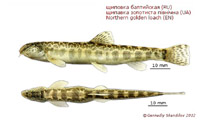 Sabanejewia baltica
Male Afbeelding van Shandikov, G.A.
Afbeeldingen | Google afbeelding
Male Afbeelding van Shandikov, G.A.
Classificatie / Namen Lokale namen | Synoniemen | Catalog of Fishes(Genus, Soort(en)) | ITIS | CoL | WoRMS | Cloffa
> Cypriniformes (Carps) > Cobitidae (Spined loaches)
Etymology: Sabanejewia: Because of P. Sabanejev, expert in plankton.
Eponymy: Leonid Pavlovich Sabanejew, aka Sabaneev (1844–1898), was a Russian zoologist and an expert on freshwater fish biology. [...] (Ref. 128868), visit book page.
Etymology: Sabanejewia: Because of P. Sabanejev, expert in plankton.
Eponymy: Leonid Pavlovich Sabanejew, aka Sabaneev (1844–1898), was a Russian zoologist and an expert on freshwater fish biology. [...] (Ref. 128868), visit book page.
Milieu: milieu / Klimaatzone / Diepte / verspreidingsgebied Ecologie
; zoet water demersaal. Temperate
Verspreiding Gebieden | FAO regio's | Ecosystemen | Voorkomen | Verspreidingskaart | Introducties | Faunafri
Europe: Black Sea basin in Dniestr, Dniepr, and Don drainages; Baltic basin in Vistula and Odra drainages.
Lengte bij maturiteit / Grootte / Gewicht / Leeftijd
Maturiteit: Lm 7.5, range 6 - 9 cm
Max length : 9.0 cm SL mannelijk / geslacht onbekend; (Ref. 59043)
Max length : 9.0 cm SL mannelijk / geslacht onbekend; (Ref. 59043)
Korte beschrijving Determinatiesleutels | Morfologie | Morfometrie
Presence of a midlateral row of dark blotches along flank. Ventral adipose crest on caudal peduncle absent or less developed than dorsal one. No row of small spots directly below midlateral blotches (if present, then most prominent between pelvic and anal bases). Dorsal origin above or in front of pelvic origin. Distance between the two black spots at caudal base much less than their diameter. Interspaces between midlateral blotches usually with dark pigmentation (if there is little or no dark pigmentation, then no dark spots in narrow whitish saddle behind head. Body above midlateral blotches uniform brown or with small whitish to yellowish spots or speckles.
Body shape (shape guide): elongated.
Body shape (shape guide): elongated.
Adults occur in a wide array of habitats from small lowland streams to fast-flowing piedmont rivers with clear water and sand to gravel bottom. Usually do not occur in large lowland rivers. They are found burrowed in sand, avoiding mud or silt, sometimes in gravel (Ref. 59043). Mature individuals spawn in batches (Ref. 59043). Eggs, 1.1-1.2 mm in diameter, lay scattered over sand, gravel or other structures (Ref. 59043). Absence of external gill filaments in free larvae but transparent bump on forehead prominent (Ref. 59043). Larvae start to feed after 6 days at 3.1-4.2 mm TL (Ref. 59043).
Levenscyclus en paargedrag Maturiteit | Voortplanting | Paaien | Eieren | Fecunditeit | Larven
Hoofdreferentie
Upload uw referenties | Referenties | Coördinator | Medewerkers
Kottelat, M. and J. Freyhof, 2007. Handbook of European freshwater fishes. Publications Kottelat, Cornol and Freyhof, Berlin. 646 pp. (Ref. 59043)
Status op de Rode Lijst van het IUCN (Ref. 130435: Version 2025-2 (Global))
Niet bedreigd (LC) ; Date assessed: 04 July 2023
CITES
Not Evaluated
Gevaar voor de mens
Harmless
Gebruik door de mens
FAO - Publication: search | FishSource |
Meer informatie
Trofische ecologie
Voedsel (prooien)
Dieetsamenstelling
Voedselconsumptie
Voedselrantsoenen
Predatoren
Voedsel (prooien)
Dieetsamenstelling
Voedselconsumptie
Voedselrantsoenen
Predatoren
Populatiedynamica
Groeiparameters
Max. leeftijden / maten
Lengte-gewicht rel.
Lengte-lengte rel.
Lengtefrequenties
Massaconversie
Rekrutering
Abundantie
Groeiparameters
Max. leeftijden / maten
Lengte-gewicht rel.
Lengte-lengte rel.
Lengtefrequenties
Massaconversie
Rekrutering
Abundantie
Levenscyclus
Voortplanting
Maturiteit
Rijpheid/kieuwen rel.
Fecunditeit
Paaien
Paaibestanden
Eieren
Ontwikkeling van de eieren
Larven
Larvale populatiedynamiek
Voortplanting
Maturiteit
Rijpheid/kieuwen rel.
Fecunditeit
Paaien
Paaibestanden
Eieren
Ontwikkeling van de eieren
Larven
Larvale populatiedynamiek
Anatomie
Kieuwoppervlak
Hersenen
Otoliet
Kieuwoppervlak
Hersenen
Otoliet
Fysiologie
Lichaamssamenstelling
Voedingsstoffen
Zuurstofverbruik
Type zwemmen
Zwemsnelheid
Visuele pigmenten
Vis geluid
Ziekten en parasieten
Toxiciteit (LC50)
Lichaamssamenstelling
Voedingsstoffen
Zuurstofverbruik
Type zwemmen
Zwemsnelheid
Visuele pigmenten
Vis geluid
Ziekten en parasieten
Toxiciteit (LC50)
Genetica
genoom
Genetica
Heterozygositeit
Erfelijkheid
Genetische diversiteit
genoom
Genetica
Heterozygositeit
Erfelijkheid
Genetische diversiteit
Menselijk gerelateerd
Aquacultuursystemen
Aquacultuurprofielen
Kweeklijnen
Ciguatera gevallen
Postzegels, munten, diversen.
Aquacultuursystemen
Aquacultuurprofielen
Kweeklijnen
Ciguatera gevallen
Postzegels, munten, diversen.
Tools
Speciale rapporten
Bekijk gegevens voor het houden in een aquarium | Bekijk Fact Sheets voor de soort | Bekijk Aquacultuur Fact Sheets
Download XML
Internetbronnen
AFORO (otoliths) | Aquatic Commons | BHL | Cloffa | Websites from users | Bekijk FishWatcher | CISTI | Catalog of Fishes: Genus, Soort(en) | DiscoverLife | ECOTOX | FAO - Publication: search | Faunafri | Fishipedia | Fishtrace | GloBI | Google Books | Google Scholar | Google | IGFA World Record | OneZoom | Open Tree of Life | Otolith Atlas of Taiwan Fishes | PubMed | Reef Life Survey | Socotra Atlas | TreeBase | Tree of Life | Wikipedia: ga naar, zoek | World Records Freshwater Fishing | Zoological Record
Schattingen op basis van modellen
Fylogenetische diversiteitsindex (Ref. 82804): PD50 = 0.5005 [Uniqueness, from 0.5 = low to 2.0 = high].
Bayesian length-weight: a=0.00501 (0.00233 - 0.01079), b=3.08 (2.90 - 3.26), in cm total length, based on LWR estimates for this (Sub)family-body shape (Ref. 93245).
Trofisch niveau (Ref. 69278): 3.2 ±0.4 se; based on size and trophs of closest relatives
Weerstandsvermogen (Ref. 120179): Gemiddeld, minimale populatieverdubbelingstijd 1,4-4,4 jaar (Assumed Fec < 10,000).