>
Ophidiiformes (Cusk eels) >
Carapidae (Pearlfishes) > Carapinae
Etymology: Echiodon: Greek, echieys, eos = a little viper + Greek, odous = teeth (Ref. 45335).
Eponymy: Dr James Lawson Drummond (1783–1853) was an Irish physician, botanist and naturalist. [...] (Ref. 128868), visit book page.
Environment: milieu / climate zone / intervalo de profundidade / distribution range
Ecologia
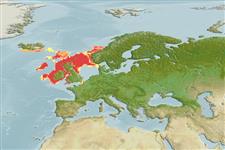
marinhas batidemersal; intervalo de profundidade 52 - 403 m (Ref. 10704). Deep-water; 65°N - 50°N, 23°W - 10°E
Northeast Atlantic: coasts of southern Norway, western Denmark, and around British Isles. Reported from Iceland (Ref. 12462). Misidentified as a Carapus in literature.
Tamanho / Peso / Idade
Maturidade: Lm ? range ? - ? cm
Max length : 30.0 cm TL macho/indeterminado; (Ref. 4741)
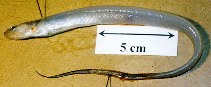
Espinhos dorsais (total) : 0; Raios dorsais moles (total) : 42 - 45; Raios anais moles: 47 - 49. Eel-like, shallow body depth; 1 to several symphyseal fangs on dentary and premaxilla; lacking cardiform teeth, pelvic fins, and swim bladder rocker bone; a patch of ridges posteriorly on the ventral surface of the swim bladder (Ref. 34024). Pigmented eye diameter greater than 16% head length (Ref. 34024). Pre-dorsal bone present; maxilla extends well behind orbit; precaudal vertebrae 25-29 (Ref. 232). Reddish with silvery abdomen, operculum and iris; dark markings on head and median edges (Ref. 232).
Body shape (shape guide): eel-like.
Common species. Free-living, fairly deep. Assumed to feed on small invertebrates and fish (Ref. 34024). Feed on small bottom animals (Ref. 35388).
Life cycle and mating behavior
Maturidade | Reprodução | Desova | Ovos | Fecundidade | Larvas
Nielsen, J.G., D.M. Cohen, D.F. Markle and C.R. Robins, 1999. Ophidiiform fishes of the world (Order Ophidiiformes). An annotated and illustrated catalogue of pearlfishes, cusk-eels, brotulas and other ophidiiform fishes known to date. FAO Fish. Synop. 125(18):178p. Rome: FAO. (Ref. 34024)
Categoria na Lista Vermelha da IUCN (Ref. 130435: Version 2025-1)
Ameaça para o homem
Harmless
Utilização humana
Pescarias: sem interesse
Ferramentas
Relatórios especiais
Descarregue XML
Fontes da internet
Estimates based on models
Preferred temperature (Ref.
123201): 7.1 - 10.2, mean 8.4 °C (based on 170 cells).
Phylogenetic diversity index (Ref.
82804): PD
50 = 0.5001 [Uniqueness, from 0.5 = low to 2.0 = high].
Bayesian length-weight: a=0.00102 (0.00046 - 0.00225), b=3.06 (2.88 - 3.24), in cm total length, based on all LWR estimates for this body shape (Ref.
93245).
Nível Trófico (Ref.
69278): 4.0 ±0.65 se; based on food items.
Fishing Vulnerability (Ref.
59153): Low vulnerability (20 of 100).
🛈
Nutrients (Ref.
124155): Calcium = 24.6 [5.8, 82.4] mg/100g; Iron = 0.475 [0.170, 1.188] mg/100g; Protein = 16.2 [13.8, 18.5] %; Omega3 = 0.313 [0.121, 0.824] g/100g; Selenium = 10.7 [3.5, 36.0] μg/100g; VitaminA = 14.1 [3.1, 61.9] μg/100g; Zinc = 0.445 [0.229, 0.859] mg/100g (wet weight);