>
Blenniiformes (Blennies) >
Labrisomidae (Labrisomids)
Etymology: Labrisomus: Greek, labrax, -akos = a fish, Dicentrarchus labrax+ Greek, soma = body (Ref. 45335); conditus: From the Latin conditus = hidden, an allusion to this scaly blenny being misidentified as L.nuchipinnis by most authors who dealt with specimens from Fernando de Noronha Archipelago (Ref. 80465).
Environment: milieu / Klimaatzone / Diepte / distribution range
Ecologie
marien benthopelagisch. Tropical; 3°S - 4°S, 32°W - 33°W
Atlantic Ocean: known from Fernando de Noronha Archipelago, a volcanic formation off NE Brazil (Ref. 80465) and reported in Florida, USA (Benjamin Victor, pers.comm. 12/09)..
Grootte / Gewicht / Leeftijd
Maturiteit: Lm ? range ? - ? cm
Max length : 13.4 cm SL mannelijk / geslacht onbekend; (Ref. 80465)
Korte beschrijving
Determinatiesleutels | Morfologie | Morfometrie
Dorsale stekels (totaal) : 18; Dorsale zachte stralen (totaal) : 12; Anale stekels: 2; Anale zachte stralen: 17 - 18. Labrisomus conditus sp. n. differs from its Western Atlantic congeners (Springer 1959a,
Sazima et al. 2002) by the following combination of characters: nuchal cirri when depressed not reaching dorsal-fin origin, 68 to 73 lateral line scales, first and second dorsal-fin spines slightly shorter than third spine and not flexible, numerous pale dots overall (light blue in life), opercular dark spot with incomplete and
diffuse broad pale margin (orange in life) (Ref. 80465).
Body entirely scaly except for interpelvic space, pectoral axilla, head and opercle; scales present oncaudal and pectoral-fin bases, basal portion of whole dorsal-fin and anal-fin membranes. Numerous branched canals and pores on head, one branch from pre-opercular series extending onto upper opercle. A single well-developed row of conical slightly recurved teeth on each jaw, and an inner closeset patch of much smaller, villiform teeth. Distal teeth on upper jaw larger than proximal ones. Vomerine teeth in a “V” pattern, the apical and centralmost one at least 5 times larger than remainder, the latter arranged in 2–3 rows (Ref. 80465).
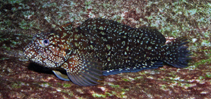
Color pattern: adult males variable; body grayish or reddish brown to dark brown crossed by four darker irregular bars, sometimes with fainter and shorter ones between them, with scattered irregular pale spots (less conspicuous on dark individuals, and faint or absent in preservation) (Ref. 80465).
Levenscyclus en paargedrag
Maturiteit | Voortplanting | Paaien | Eieren | Fecunditeit | Larven
Sazima, I., A. Carvalho-Filho, J.L. Gasparini and C. Sazima, 2009. A new species of scaly blenny of the genus Labrisomus (Actinopterygii: Labrisomidae) from the tropical West Atlantic. Zootaxa 2015:62-68. (Ref. 80465)
Status op de Rode Lijst van het IUCN (Ref. 130435: Version 2025-1)
Gevaar voor de mens
Harmless
Gebruik door de mens
Tools
Speciale rapporten
Download XML
Internetbronnen
Estimates based on models
Fylogenetische diversiteitsindex (Ref.
82804): PD
50 = 0.5005 [Uniqueness, from 0.5 = low to 2.0 = high].
Bayesian length-weight: a=0.00933 (0.00410 - 0.02122), b=3.10 (2.91 - 3.29), in cm total length, based on LWR estimates for this (Sub)family-body shape (Ref.
93245).
Trofisch niveau (Ref.
69278): 3.5 ±0.3 se; based on size and trophs of closest relatives
Fishing Vulnerability (Ref.
59153): Low vulnerability (10 of 100).
🛈