



Taeniurops meyeni (Müller & Henle, 1841)
Round ribbontail ray
Lägg till din observation i Fish Watcher
| Native range | All suitable habitat | Point map | Year 2050 |

|
| This map was computer-generated and has not yet been reviewed. |
| Taeniurops meyeni AquaMaps Data sources: GBIF OBIS |
Ladda upp din foton och Videor
Bilder | Videor | Google image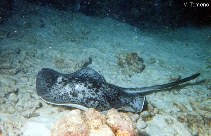 Taeniurops meyeni
Bild av Tomeno, V.
Bilder | Videor | Google image
Bild av Tomeno, V.
Klassificering / Namn Populärnamn | synonymer | Catalog of Fishes(Släkte, Arter) | ITIS | CoL | WoRMS | Cloffa
Elasmobranchii (hajar och rockor) (sharks and rays) > Myliobatiformes (Stingrays) > Dasyatidae (Stingrays) > Dasyatinae
Etymology: Taeniurops: From feminine Latin noun, 'taenia' = ribbon or band, ancient Greek 'oura' = tail, referring to fin fold underneath tail and Greek 'ops' = appearance; originally proposed as a subgenus of Taeniura (Richard Bajol, pers. Comm. 06/16); meyeni: Named for Franz Julius Ferdinand Meyen (1804-1840), physician and botanist (R. Bajol, pers.comm. 06/16).
Eponymy: Dr Franz Julius Ferdinand Meyen (1804–1840) was a German surgeon, a botanist and collector who was a Professor in Berlin. [...] (Ref. 128868), visit book page.
More on authors: Müller & Henle.
Etymology: Taeniurops: From feminine Latin noun, 'taenia' = ribbon or band, ancient Greek 'oura' = tail, referring to fin fold underneath tail and Greek 'ops' = appearance; originally proposed as a subgenus of Taeniura (Richard Bajol, pers. Comm. 06/16); meyeni: Named for Franz Julius Ferdinand Meyen (1804-1840), physician and botanist (R. Bajol, pers.comm. 06/16).
Eponymy: Dr Franz Julius Ferdinand Meyen (1804–1840) was a German surgeon, a botanist and collector who was a Professor in Berlin. [...] (Ref. 128868), visit book page.
More on authors: Müller & Henle.
Taxonomic Remarks
More widely known as Taeniura melanospila Bleeker 1853, a junior synonym based on the description of a juvenile specimen.
Miljö: miljö / Klimatzon / djupintervall / distributionsområde Ekologi
marina revassocierade; djupintervall 1 - 500 m (Ref. 37816), usually 20 - 60 m (Ref. 30573). Tropical; 41°N - 36°S, 25°E - 77°W
Utbredning Territorier | FAO områden | Ekosystem | Förekomster | Prickkarta | Utplanteringar | Faunafri
Indo-West Pacific: Persian Gulf (Ref. 68964), Red Sea and East Africa to southern Japan, Micronesia, tropical Australia and Lord Howe Island. Eastern Pacific: known only from oceanic islands (Cocos and the Galapagos) but because of sheer number, individuals may colonize the Central America mainland (Ref. 28023).
Längd vid första mognad / Storlek / Vikt / Ålder
Könsmognad: Lm 105.0, range 100 - 110 cm
Max length : 330 cm TL hane/ej könsbestämd; (Ref. 30573); publicerad maxvikt: 150.0 kg (Ref. 11228)
Max length : 330 cm TL hane/ej könsbestämd; (Ref. 30573); publicerad maxvikt: 150.0 kg (Ref. 11228)
Kort beskrivning Bestämningsnycklar | Morfologi | Morfometri
A large stingray with a circular disc, no thorns, a black and white mottled upper surface, and a deep and prominent ventral skin fold that extends to the tail tip (Ref. 6871).
Body shape (shape guide): other.
Body shape (shape guide): other.
Occurs in a wide range of habitats, from shallow lagoons to outer reef slopes (Ref. 1602). Feeds on bottom fish, bivalves, crabs and shrimp (Ref. 5578). Ovoviviparous (Ref. 50449). Smallest free-swimming specimen recorded was 33 cm WD. Caught commonly by demersal tangle net fisheries, and occasionally by longline and bottom trawl fisheries. Utilized for its meat and cartilage (Ref.58048). Found singly or in aggregates and usually with jacks and cobia swimming near them (Ref. 12951). Not normally aggressive, but it has been responsible for at least one human fatality. Sought by surf and ski boat anglers in southern Africa, but usually released unharmed (Ref. 5578). Longevity record for a specimen in an aquarium is 81 days (Ref. 12951). May reach disc width in excess of 3 m (Ref. 28023).
Livscykel och parningsbeteende Könsmognad | Reproduktion | Lek | Ägg | Fekunditet | Larver
Exhibit ovoviparity (aplacental viviparity), with embryos feeding initially on yolk, then receiving additional nourishment from the mother by indirect absorption of uterine fluid enriched with mucus, fat or protein through specialised structures (Ref. 50449). Distinct pairing with embrace (Ref. 205). With up to 7 in a litter (Ref. 6871, 12951).
Huvudreferens
Ladda upp dina referenser | referenser | Koordinator : McEachran, John | Medarbetare
Last, P.R. and J.D. Stevens, 1994. Sharks and rays of Australia. CSIRO, Australia. 513 p. (Ref. 6871)
Status på IUCN:s rödlista (Ref. 130435: Version 2025-2 (Global))
Sårbar (VU) (A2cd); Date assessed: 24 July 2023
CITES
Not Evaluated
Hot mot människor
Venomous (Ref. 6871)
Mänskliga användningsområden
Fiskeri: kommersiell; sportfisk: ja
FAO - Publication: search | FishSource | Havet omkring oss
Ytterligare information
Populationsdynamik
Tillväxtparametrar
Max. åldrar / storlekar
Längd-vikt rel.
Längd-längd rel.
Längd-frekvenser
Massakonvertering
Rekrytering
Abundans
Tillväxtparametrar
Max. åldrar / storlekar
Längd-vikt rel.
Längd-längd rel.
Längd-frekvenser
Massakonvertering
Rekrytering
Abundans
Livscykel
Reproduktion
Könsmognad
Mognad/Gills rel.
Fekunditet
Lek
Lekande aggregat
Ägg
Utveckling av ägg
Larver
Larvdynamik
Reproduktion
Könsmognad
Mognad/Gills rel.
Fekunditet
Lek
Lekande aggregat
Ägg
Utveckling av ägg
Larver
Larvdynamik
Anatomi
Gälyta
Hjärna
Otolit
Gälyta
Hjärna
Otolit
Fysiologi
Kroppssammansättning
Näringsämnen
Syreförbrukning
Typ av simning
Simhastighet
Visuella pigment
Ljud från fisk
Sjukdomar & Parasiter
Toxicitet (LC50)
Kroppssammansättning
Näringsämnen
Syreförbrukning
Typ av simning
Simhastighet
Visuella pigment
Ljud från fisk
Sjukdomar & Parasiter
Toxicitet (LC50)
Människorelaterad
Vattenbrukssystem
Vattenbruksprofiler
Avelslinjer
Ciguatera-fall
Frimärken, mynt, diverse.
Vattenbrukssystem
Vattenbruksprofiler
Avelslinjer
Ciguatera-fall
Frimärken, mynt, diverse.
Verktyg
Organisk frågesport | E-bok | Fälthandbok | Bestämningsnycklar | Längdfördelnings-verktyg | Livshistorie-verktyg | Prickkarta |
Fångst-MSY |
Särskilda rapporter
Kontrollera för underhåll av akvarium | Kontrollera om det finns faktablad om arter | Kontrollera om det finns faktablad om vattenbruk
Ladda ner XML
Internet-källor
AFORO (otoliths) | Aquatic Commons | BHL | Cloffa | Websites from users | Check FishWatcher | CISTI | Catalog of Fishes: Släkte, Arter | DiscoverLife | ECOTOX | FAO - Publication: search | Faunafri | Fishipedia | Fishtrace | GloBI | Google Books | Google Scholar | Google | IGFA World Record | Nationella databaser | OneZoom | Open Tree of Life | Otolith Atlas of Taiwan Fishes | PubMed | Reef Life Survey | Socotra Atlas | TreeBase | Tree of Life | Wikipedia: Go, sök | World Records Freshwater Fishing | Zoologiskt register
Uppskattningar baserade på modeller
Önskad temperatur (Ref. 123201): 23.3 - 29.1, mean 28 °C (based on 1102 cells).
Index för fylogenetisk mångfald (Ref. 82804): PD50 = 0.7500 [Uniqueness, from 0.5 = low to 2.0 = high].
Bayesian length-weight: a=0.00447 (0.00189 - 0.01058), b=3.12 (2.92 - 3.32), in cm total length, based on LWR estimates for this (Sub)family-body shape (Ref. 93245).
Trofisk nivå (Ref. 69278): 4.2 ±0.69 se; based on food items.
Resiliens (Ref. 120179): Mycket låg, lägsta populationsfördubblingstid mer än 14 år (Fec=7).
Näringsämnen (Ref. 124155): Calcium = 5.36 [1.38, 23.00] mg/100g; Iron = 0.325 [0.076, 0.884] mg/100g; Protein = 22.9 [20.0, 26.0] %; Omega3 = 0.111 [0.033, 0.353] g/100g; Selenium = 57.9 [17.0, 165.9] μg/100g; VitaminA = 23.7 [8.9, 66.7] μg/100g; Zinc = 0.511 [0.249, 1.019] mg/100g (wet weight);