Environment: milieu / climate zone / djupintervall / distribution range
Ekologi
marina djupbottenlevande; djupintervall 1947 - ? m (Ref. 79064). Polar; 68°S - 69°S, 78°W -
Antarctic Pacific: Bellingshausen Sea.
Size / Vikt / Age
Könsmognad: Lm ? range ? - ? cm
Max length : 23.4 cm TL hane/ej könsbestämd; (Ref. 79064)
Short description
Bestämningsnycklar | Morfologi | Morfometri
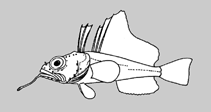
Taggstrålar i analfenan: 17; Ryggkotor: 38. A dorsally-spotted species of Pogonophryne distinguished from others in the “mentella” group by a combination of: a short light-colored mental barbel; terminal expansion short, barely wider than stalk, and composed of short, irregular fingerlike processes which continue onto anterior part of stalk; a median, unspotted patch on dorsal surface of head, posterior to posttemporal ridges and anterior to first dorsal fin; a wide interorbital region.
Body robust anteriorly, tapering to low, narrow caudal peduncle. Snout rounded in dorsal view. Interorbital region wide. Teeth of upper jaw short, conical, 3 rows anteriorly, 2 rows posteriorly. Teeth of lower jaw long, thin conical; 2 rows anteriorly, 1 row posteriorly. Skin on anterior floor of mouth and proximal lower oral valve darkly pigmented. Mental barbel short with an inconspicuous terminal expansion composed of short, irregular, fingerlike processes which continue, in reduced size, onto the anterior part of the stalk.
First dorsal fin with two spines of about equal length; Second dorsal fin with 27 rays. Anal
rays 17. Pectoral rays 20 and 20. Upper lateral line with about 22 (left) and 24 (right) pores (tubular scales). Middle lateral line with about 13 (left) and 12 (right) pores and tubular scales arranged as 2 pores + 10 tubular scales + 1 pore (left) and 2 pores + 9 tubular scales + 1 pore (right). Cephalic lateral line pores: preoperculo-mandibular canal 9; infraorbital canal 7; supraorbital canals with 2 nasal pores, 2 interorbital pores, and 1 unpaired coronal pore; temporal canal 6; supratemporal canal incomplete across occiput with 1 pore on each side. Vertebrae 15 + 23 = 38.
Body shape (shape guide): elongated.
Life cycle and mating behavior
Könsmognad | Reproduktion | Lek | Ägg | Fecundity | Larver
Eakin, R.R., J.T. Eastman and J. Matallanas, 2008. New species of Pogonophryne (Pisces, Artedidraconidae) from the Bellingshausen Sea, Antarctica. Polar Biol. 31:1175-1179. (Ref. 79064)
IUCN Red List Status (Ref. 130435: Version 2025-1)
Threat to humans
Harmless
Human uses
Fiskeri: saknar intresse
Verktyg
Special reports
Download XML
Internet-källor
Estimates based on models
Phylogenetic diversity index (Ref.
82804): PD
50 = 0.5000 [Uniqueness, from 0.5 = low to 2.0 = high].
Bayesian length-weight: a=0.00501 (0.00240 - 0.01046), b=3.13 (2.94 - 3.32), in cm total length, based on LWR estimates for this (Sub)family-body shape (Ref.
93245).
Trofisk nivå (Ref.
69278): 3.3 ±0.5 se; based on size and trophs of closest relatives
Fishing Vulnerability (Ref.
59153): Low vulnerability (13 of 100).
🛈